







Business
India blocks Telegram ahead of NEET re-exam, CEO calls it a mistake






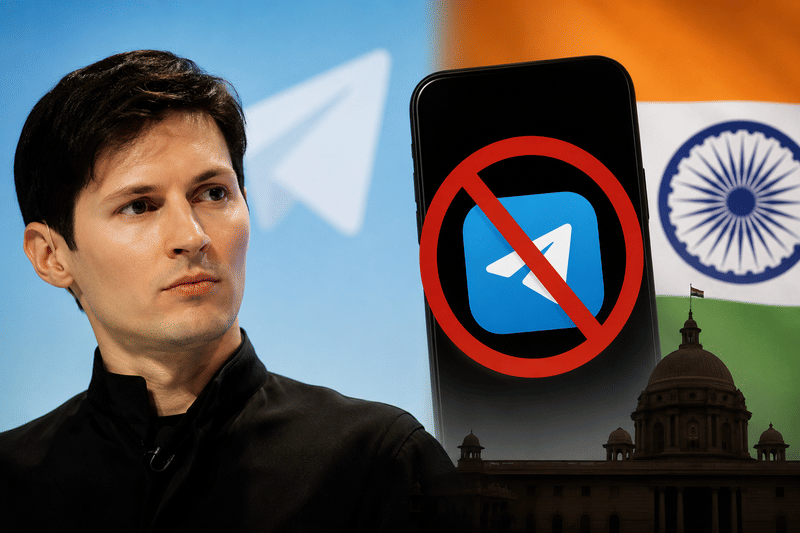
As India temporarily blocks Telegram ahead of the NEET-UG 2026 re-examination, Telegram founder Pavel Durov, education authorities, digital rights advocates and cybersecurity experts are locked in a debate over exam integrity, misinformation and platform accountability.
India's temporary restriction on Telegram ahead of the NEET-UG 2026 re-examination has triggered a wider debate about how governments should tackle online misinformation and exam-related fraud.
The Centre's decision to block access to the messaging platform until June 22 has drawn criticism from Telegram founder and CEO Pavel Durov, who said the move penalises millions of legitimate users while doing little to stop those responsible for leaking or falsely claiming access to examination papers.
The restriction comes days before the re-examination scheduled for June 21 and follows recommendations from the National Testing Agency (NTA), which said the action was necessary to curb organised cheating networks and the spread of misleading content targeting students.
Durov challenges the government's approach
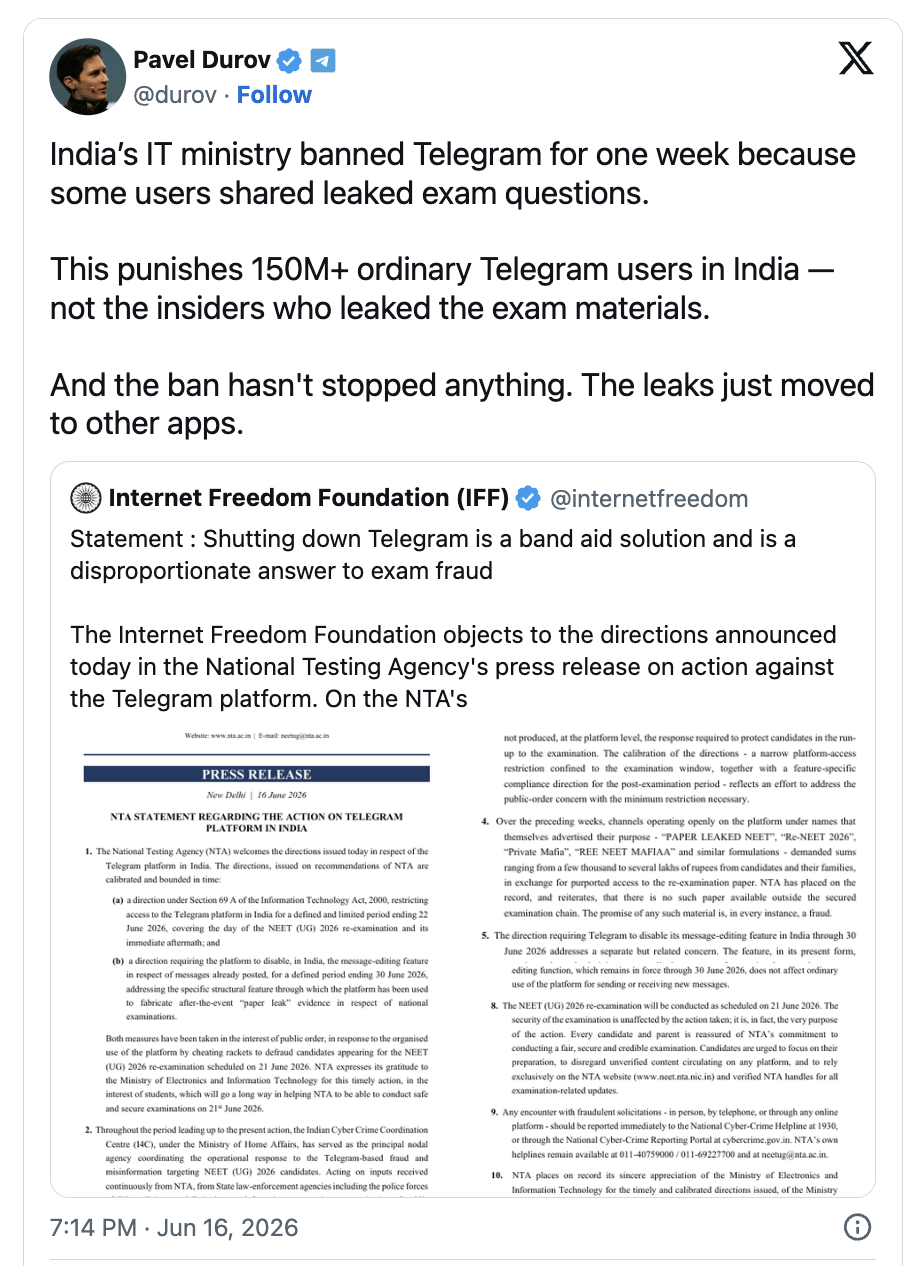
Durov publicly criticised the decision in posts on X, claiming the ban unfairly impacts ordinary users.
According to Durov, India's IT ministry blocked Telegram for one week because some users shared leaked exam questions. He said the action affects more than 150 million Telegram users in India rather than those responsible for distributing examination materials.
Durov also claimed the restrictions had failed to address the underlying issue.
"The leaks just moved to other apps," he wrote.
In a subsequent post, Durov said Telegram had already removed hundreds of channels linked to leaked exam materials and scams in India over recent weeks. He added that the platform was making its "edited" label more visible to help prevent backdating-related fraud.
He described Telegram as "a force for good" and said banning the platform, even temporarily, was a mistake.
Why authorities intervened
The government's decision follows recommendations from the NTA, which has been under pressure to ensure the integrity of the NEET-UG re-examination after the original test held on May 3 was cancelled amid allegations of irregularities.
According to the NTA, the restrictions are intended to combat both organised cheating rackets and the circulation of fake leak claims that have generated anxiety among candidates.
NTA Director General Abhishek Singh told PTI that there was no new confirmed paper leak that prompted the action.
Instead, authorities were responding to misleading messages and fabricated claims being circulated online.
"We will not let anything go wrong. We will take all possible actions to ensure that the examination is conducted without any malpractice," Singh said.
The order was issued by the Ministry of Electronics and Information Technology (MeitY) under Section 69A of the Information Technology Act, 2000.
A feature at the centre of the controversy
Alongside the temporary access restriction, Telegram has been directed to disable the editing of previously posted messages in India until June 30.
The NTA said the feature had been misused by some channel administrators.
According to the agency, operators could edit old posts and replace attached files while preserving the original timestamp. This allowed screenshots to be circulated as purported evidence that examination papers had been available before the test.
Authorities said this created confusion among students and parents, even when no genuine leak had occurred.
The agency stressed that legitimate examination papers remain within a secured process and that offers to sell advance access are fraudulent.
Channels under scrutiny
The NTA said several Telegram channels had been promoting alleged access to examination papers in exchange for money.
Examples cited by the agency included channels using names such as:
- PAPER LEAKED NEET
- Re-NEET 2026
- Private Mafia
- REE NEET MAFIAA
According to the agency, some operators sought payments ranging from thousands to several lakh rupees from students and families.
Before recommending platform-level action, authorities said the Indian Cyber Crime Coordination Centre (I4C), working alongside state police forces in Bihar, Gujarat and Rajasthan, had already helped remove multiple channels, groups and bots linked to such activity.
Critics question whether the ban is proportionate
The move has also attracted criticism from digital rights groups and members of the technology community.
The Internet Freedom Foundation (IFF) described the restrictions as a "band-aid solution" and called the nationwide measure disproportionate.
The organisation said shutting down access to an entire platform raised broader constitutional and policy concerns.
On social media, cybersecurity researcher Nisarga Adhikary, who has worked on education-related security issues and is associated with IIT Kanpur's C3iHub, questioned the effectiveness of the ban.
He said users could still access Telegram through proxy services and other workarounds, making a complete shutdown difficult to enforce.
Meanwhile, Manindra Agrawal, Director of IIT Kanpur, defended the focus on Telegram's editing capability. He said the concern extended beyond sharing actual examination papers and included the creation of convincing fake leak narratives.
According to Agrawal, Telegram's ability to modify posts without prominently indicating edits created risks that do not exist on many other major social media platforms.
Student activist Sarthak Siddhant also criticised the move, questioning whether shutting down an entire communication platform was an appropriate response to misinformation.
A broader test of platform accountability
The controversy highlights a growing challenge facing governments, technology companies and educational institutions.
Authorities are increasingly expected to prevent digital fraud and misinformation, particularly around high-stakes examinations affecting millions of students. At the same time, platform-wide restrictions often raise concerns about proportionality, user rights and effectiveness.
For Telegram, the episode places renewed scrutiny on how messaging platforms moderate content and respond to misuse. For regulators, it raises questions about where targeted enforcement ends and broader platform intervention begins.
With the NEET-UG re-examination set for June 21, the immediate focus remains on conducting the test without disruption. What happens after that may shape future conversations about online platforms, exam security and the limits of digital regulation in India.
Topics
Author
Loading...