







Business
TCS and Infosys still offer Rs 3–3.1 lakh to freshers as entry-level IT salaries remain stuck





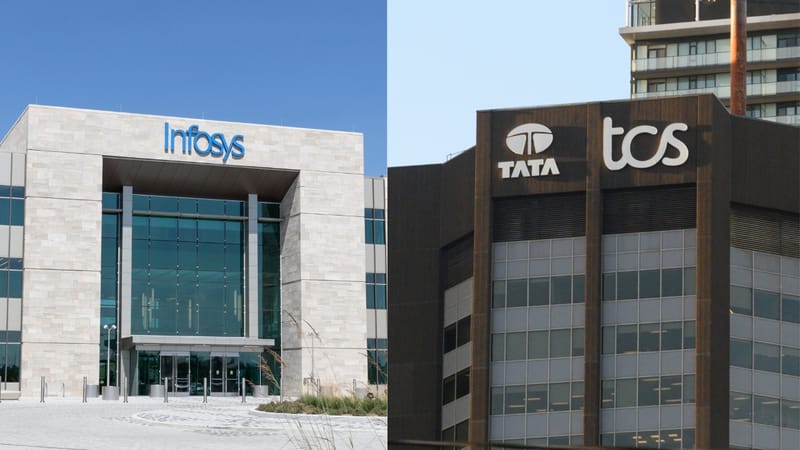
Entry-level salaries at India’s top IT services firms have barely moved in two decades, despite soaring industry growth and rising urban living costs.
Entry-level salaries at India’s biggest IT services companies remain anchored around Rs 3–3.1 lakh a year, even as the sector has grown into a global outsourcing powerhouse.
Tata Consultancy Services and Infosys continue to offer fresh graduates pay packages that have barely changed in nearly two decades, underscoring a persistent wage stagnation at the bottom of the industry’s workforce pyramid.
India Today reported that fresher compensation across large IT services firms has stayed within a narrow band since the mid-2000s, despite sharp increases in company revenues, global expansion and higher expectations from new hires.
Former employees interviewed by the publication described how the benchmark has remained strikingly stable. One ex-IT worker said starting pay during probation was around Rs 3 lakh in 2004, a figure widely considered standard at the time.
By 2008, salary bands had effectively become fixed. A former fresher told India Today that TCS offered around Rs 3.1 lakh CTC, while Infosys started recruits at roughly Rs 2.8 lakh per annum — levels that have continued to define entry pay across the sector.
The stagnation is sharper because costs have risen dramatically. Housing rents, transport expenses, healthcare and food prices have surged in technology hubs such as Bengaluru, Hyderabad and Pune, eroding the real value of these salaries for today’s graduates.
Abhishek Mehta, Director HR at BSI, told India Today that while the industry’s scale has expanded significantly, the gains have not translated into fresher compensation. He pointed to inflation, higher education costs and expensive urban living as factors reducing purchasing power for young professionals.
Mehta also cited structural pressures. He said an oversupply of engineering graduates continues to keep entry-level wages under strain, while the traditional outsourcing model prioritises cost efficiency and volume hiring, leaving little room for base-level salary correction.
Neeti Sharma, CEO of TeamLease Digital, told the publication that India produces more than 1.5 million engineering graduates annually, but only a small share are immediately deployable for client-facing work. That imbalance, she said, keeps entry pay flat even as job demands increase.
Freshers are now expected to be digitally proficient, adaptable to global clients and prepared for continuous upskilling from day one — expectations that sit uneasily alongside static compensation.
At the same time, the market is beginning to split between commodity roles and specialised skills. Sharma noted that entry-level positions in AI, cloud and cybersecurity can command 30 to 60 per cent higher pay, with AI and machine learning roles ranging between Rs 6 and 12 lakh. Niche generative AI jobs can exceed Rs 22 lakh, widening disparities within the same graduate talent pool.
Industry leaders argue that the outsourcing pyramid model, built on low-cost entry hiring and large-scale training, leaves limited scope to raise fresher pay without pressuring margins. Critics counter that the model is increasingly misaligned with present-day urban realities and shifting employee expectations.
With attrition among new recruits often rising within the first 12 to 18 months, the entry-level pay question is likely to sharpen further. The challenge for India’s IT giants is whether the first rung of the career ladder can remain frozen while the rest of the industry moves rapidly ahead.
Topics
Author
Loading...