







Business
Why Microsoft CEO Satya Nadella is being called to testify in Elon Musk’s OpenAI lawsuit






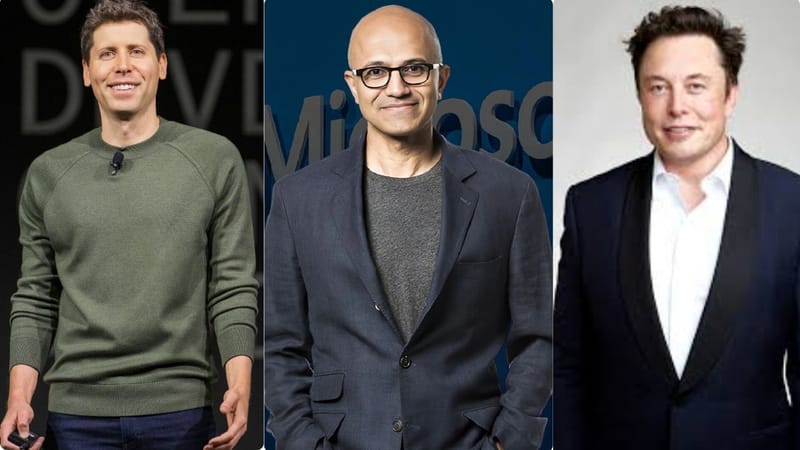
Elon Musk’s legal battle against OpenAI is entering a crucial phase as Microsoft CEO Satya Nadella prepares to testify over the company’s shift from a nonprofit research lab to one of the world’s most valuable AI businesses.
Satya Nadella is expected to testify in court on Monday as part of Elon Musk’s high-profile lawsuit against OpenAI, a case that could influence the future structure of one of the world’s most powerful artificial intelligence companies.
At the centre of the dispute is a simple but highly consequential question: did OpenAI abandon its original nonprofit mission after receiving billions of dollars from Microsoft?
The lawsuit, being heard in federal court in Oakland, California, has become one of the most closely watched legal battles in the global AI industry. It has also exposed internal tensions, strategic disagreements and early doubts among some of Silicon Valley’s most influential executives before ChatGPT transformed OpenAI into a global technology force.
Nadella’s testimony is expected to play a major role because Microsoft became OpenAI’s biggest financial and infrastructure partner during the company’s transition towards a commercial AI business.
Musk says OpenAI moved away from its original purpose
Musk, one of OpenAI’s original co-founders, alleges that the company drifted away from the charitable and public-interest mission on which it was founded.
According to reports from BusinessWorld, Musk claims OpenAI redirected around $38 million of his donations into building what has now become a commercial AI powerhouse valued at more than $850 billion.
He is asking the court to force OpenAI to return to a nonprofit structure.
If successful, the case could significantly reshape competition across the AI industry, particularly among companies including Anthropic, Google and China-based DeepSeek.
OpenAI has rejected Musk’s allegations.
The company argues that Musk voluntarily left the organisation after failing to gain majority control and later became a direct competitor through his own AI venture, xAI.
Why Nadella’s testimony matters
Nadella’s appearance is significant because Musk’s legal team is trying to establish that Microsoft knowingly supported OpenAI’s shift away from its nonprofit roots.
Lawyers representing Musk are expected to argue that Microsoft understood OpenAI’s commercial potential from the beginning and actively backed its transformation into a profit-driven enterprise.
The case is likely to focus heavily on internal Microsoft emails from 2018 that were disclosed during the trial.
According to reports, the emails show senior Microsoft executives debating whether OpenAI’s research would ultimately create commercial value for Microsoft.
In one email presented in court, Nadella reportedly questioned the value of offering OpenAI discounted access to Microsoft’s Azure cloud platform.
He wrote that it was unclear what research OpenAI was pursuing or how the partnership would benefit Microsoft competitively.
The emails also revealed uncertainty within Microsoft’s leadership team at the time.
According to court disclosures, Microsoft Chief Technology Officer Kevin Scott warned that OpenAI could potentially “storm off to Amazon in a huff”.
Those internal discussions are now central to Musk’s argument that OpenAI’s nonprofit structure may have already been under strain before Microsoft formally invested.
Microsoft’s OpenAI investment became one of tech’s biggest AI bets
Despite the early hesitation reflected in the emails, Microsoft eventually became OpenAI’s most important corporate partner.
Facing rising research costs and limited donations, OpenAI later established a for-profit subsidiary structure to attract external capital.
Microsoft invested $1 billion into OpenAI in 2019 after initially declining to fund the company roughly 18 months earlier.
Since then, Microsoft’s total commitment to OpenAI has reportedly reached around $13 billion.
According to reports cited during the trial, that investment stake is now estimated to be worth approximately $228 billion.
The partnership transformed Microsoft into one of the biggest beneficiaries of the generative AI boom.
It also gave OpenAI access to massive computing infrastructure through Microsoft Azure, allowing the company to scale its AI models rapidly before the launch of ChatGPT in 2022.
That launch fundamentally altered the competitive landscape across the global technology sector.
Trial offers rare look into early AI power struggles
The courtroom battle has also provided an unusually detailed glimpse into the early strategic tensions inside the AI industry before generative AI became commercially dominant.
The testimony and internal emails reveal how uncertain even major technology leaders were about OpenAI’s future direction during its early years.
At the time, OpenAI was still primarily viewed as a research-focused organisation pursuing artificial general intelligence rather than a mainstream commercial company.
The trial is now exposing how quickly that changed.
Musk’s lawyers are attempting to show that the company’s nonprofit identity became secondary once commercial opportunity and large-scale investment entered the picture.
OpenAI, meanwhile, maintains that its structural changes were necessary to secure the funding required for advanced AI research.
The company argues that developing frontier AI systems demanded levels of capital and computing power that a traditional nonprofit model could not sustain.
Sam Altman expected to testify later this week
Nadella’s testimony is expected to be followed later this week by an appearance from Sam Altman, who has become one of the most recognisable figures in the AI industry since ChatGPT’s release.
An advisory jury is expected to provide its view on whether wrongdoing occurred by the week of May 18.
US District Judge Yvonne Gonzalez Rogers will later issue the final ruling on liability and possible remedies.
The judge has reportedly indicated she is likely to give significant weight to the jury’s recommendation.
The outcome of the case could have implications far beyond OpenAI itself.
If the court sides with Musk and forces structural changes at OpenAI, it could alter investment models, governance structures and competitive dynamics across the wider artificial intelligence industry.
For now, the case has already done something unusual in Silicon Valley: it has pulled back the curtain on the private negotiations, rivalries and strategic calculations that shaped the early AI boom before it became a global commercial race.
Topics
Author

Loading...