







Economy Policy
Davos 2026: EU trade deal, trillion-rupee MoUs and CEO diplomacy lift India to centre stage





Von der Leyen signals an India–EU trade finish line as states tout mega MoUs and CEOs step into geopolitical rooms at Davos.
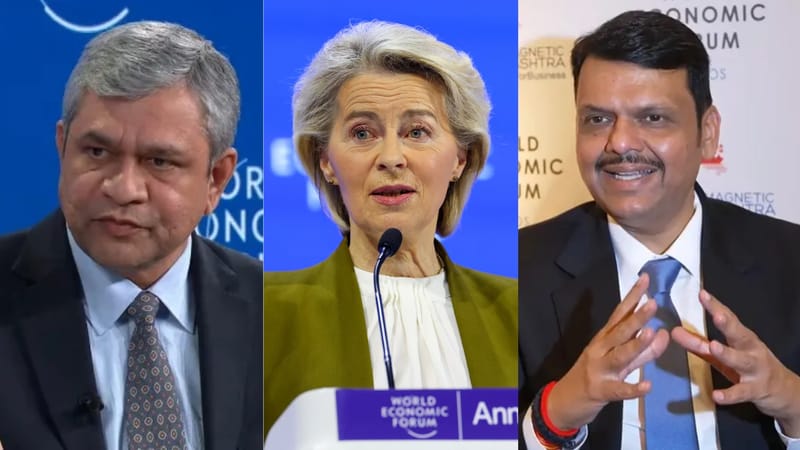
India’s Davos narrative snapped into focus on Tuesday after European Commission President Ursula von der Leyen said the EU is “on the cusp” of a historic trade agreement with India, describing it as what some call “the mother of all deals”.
Speaking in a special address at the World Economic Forum Annual Meeting, von der Leyen said she would travel to India straight after Davos and suggested negotiations are near a political close, even as she cautioned that “there is still work to do”, PTI reported. The deal, if finalised, would create a market spanning around two billion people and roughly a quarter of global GDP, she said.
The visit is being framed as more than symbolism. European Council President Antonio Costa and von der Leyen are set to be in India from January 25 to 27, PTI reported, timed with Republic Day celebrations and summit talks with Prime Minister Narendra Modi. The two sides are set to announce the conclusion of negotiations at the India–EU summit on January 27.
Trade weight, strategic width
The EU is already India’s biggest trading partner, with bilateral trade in goods at $135 billion in FY2023–24. In Davos, Europe’s message was that the agreement is about first-mover advantage in a fast-growing region — and a hedge against a more fractured global trade environment.
The negotiations have been long-running and politically sensitive. India and the EU launched FTA talks in 2007, paused them in 2013 and relaunched negotiations in June 2022. The current push comes as both sides try to insulate growth plans from rising tariff risks and supply-chain realignments.
PTI also reported that the summit agenda is expected to extend beyond tariffs: the two sides could unveil a defence framework pact and a strategic agenda, alongside a joint comprehensive strategic vision for 2026–2030. A proposed Security and Defence Partnership is intended to deepen interoperability and open avenues for Indian firms in EU defence readiness initiatives, while a Security of Information Agreement is also expected to enter negotiations.
India’s federal pitch: states go big — and get questioned
Alongside the EU trade drumbeat, India’s states used Davos to sell their own capital pipelines — with Maharashtra putting the largest number on the table early.
The Maharashtra government said it signed 19 MoUs worth ₹14.5 lakh crore and projected more than 15 lakh jobs from the commitments, adding that the deals span sectors from consumer goods and logistics to green steel and digital infrastructure. Chief Minister Devendra Fadnavis held business-to-government meetings with companies including Coca-Cola, Antora Energy and Brookfield.
A crowded India Pavilion — and a unified projection
India’s pavilion this year hosted one of the broadest political contingents seen at Davos, with Union ministers and leaders from around 10 states appearing together.
Andhra Pradesh Chief Minister N Chandrababu Naidu used the platform to argue that India can rise from the world’s fourth-largest economy to the top spot by 2047 if it “wakes up”. He messaging served a tactical purpose: to position India as a stable growth story while much of Davos is preoccupied with geopolitical volatility.
Confidence plays in finance, tech and the CEO rooms
A second India theme ran parallel to the trade and investment headlines: capability — the pitch that India is not only a market, but an operating base.
CNBC-TV18 reported that GIFT City is sharpening its next phase around global capability centres (GCCs), global innovation centres and centres of excellence, signalling a shift beyond pure financial services.
GIFT City already hosts 37 banks and has 194 asset management entities registered or operating. Managing Director and Group CEO Sanjay Kaul said about 27,000 people work in the ecosystem today, with a target of 100,000 by 2030, as he argued that operational cost advantages are pulling corporate interest.
In technology services, CNBC-TV18 reported that TCS is leaning into an AI-first strategy focused on capability-building rather than chasing immediate revenue, with CEO K Krithivasan saying AI-led transformation is being positioned as productivity and reskilling, not job-cutting.
NDTV, meanwhile, reported that seven Indian corporate leaders were invited to a reception hosted by US President Donald Trump at Davos, including leaders from Tata Sons, Infosys, Wipro and Bharti Enterprises — a reminder that corporate India is increasingly being drawn into geopolitical rooms where trade frameworks and strategic alignments are often discussed as much as investment.
What to watch next
The clearest near-term marker is political, not rhetorical: January 27, when India and the EU are expected to make a summit announcement on the trade negotiations, PTI reported. If that landing is clean, India leaves Davos with more than a narrative — it leaves with a headline that markets can price: deeper access, clearer rules, and a long-delayed agreement moving into execution mode.
Topics
Author
Loading...