







Economy Policy
New labour code says employers should pay salaries by the 7th of the following month







The Code on Wages, 2019 introduces uniform timelines for salary payments, expands wage protection to all employees and streamlines payroll compliance, although its implementation still awaits formal notification.
The Code on Wages, 2019 lays down clear timelines for salary payments, requiring employers to pay monthly wages before the expiry of the seventh day of the succeeding month. The legislation also prescribes deadlines for final wage settlements, broadens employee protection against delayed payments and unauthorised deductions, and creates a common legal framework for wage-related matters.
However, while the Code and the Code on Wages (Central) Rules contain these provisions, they will come into force only after the Central Government and individual states issue the necessary notifications.
A single framework for wage laws
The Code on Wages, 2019 replaces four existing labour legislations with a unified framework governing wages, minimum wages, bonus and equal remuneration. It consolidates:
- Payment of Wages Act, 1936
- Minimum Wages Act, 1948
- Payment of Bonus Act, 1965
- Equal Remuneration Act, 1976
The objective is to simplify wage-related compliance while ensuring consistent protections for employees across sectors.
Salary payment timelines prescribed under the Code
The Code prescribes payment deadlines based on the wage period.
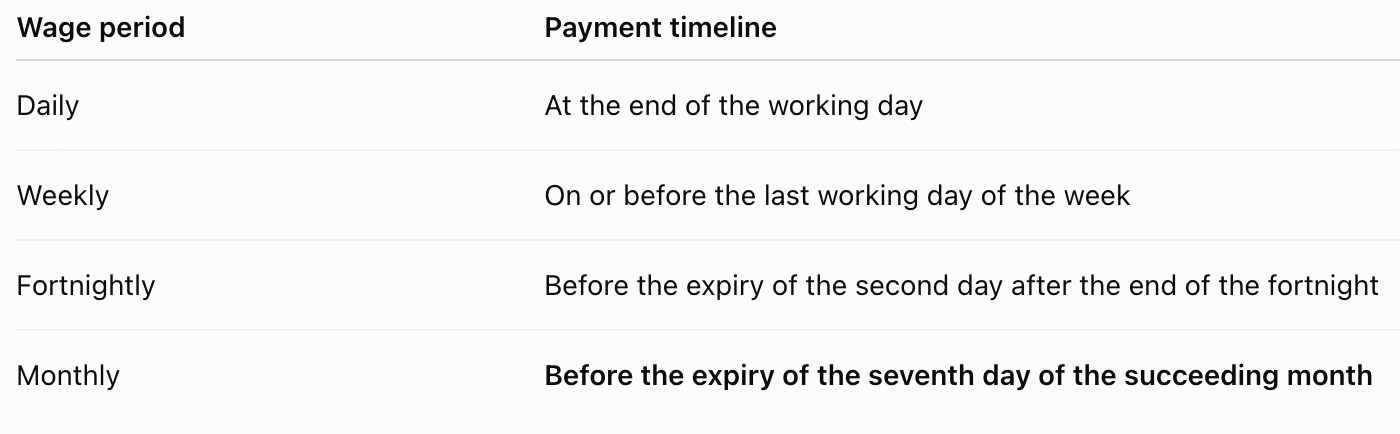
These timelines are intended to create greater certainty for both employers and employees while reducing disputes over delayed wage payments.
Final dues to be settled within two working days
The Code also prescribes timelines for employees leaving an organisation.
In cases involving resignation, dismissal, removal, retrenchment or closure of an establishment, wages due are generally required to be paid within two working days, as provided under the Code.
The provision seeks to minimise delays in final settlements, an issue that has frequently resulted in employment disputes.
Protection extends beyond wage ceilings
A significant change under the Code is its broader coverage.
Under the earlier Payment of Wages Act, 1936, protections relating to timely payment of wages applied only to employees earning up to prescribed wage limits.
The Code on Wages, 2019 extends provisions relating to timely payment of wages and authorised deductions to all employees, irrespective of salary levels.
This brings senior professionals and higher-income employees within the scope of the legislation.
Employees can seek relief for delayed wages
The Code establishes a mechanism for employees to pursue claims relating to delayed wages and unauthorised deductions.
Employees may file claims before the authority appointed under the Code, subject to the prescribed limitation period.
The legislation also provides for the appointment of Inspector-cum-Facilitators, who are responsible for promoting compliance with wage-related provisions and assisting in enforcement.
Employers must issue wage slips
The Code on Wages (Central) Rules require employers to provide employees with a wage slip on or before the payment of wages.
The wage slip may be issued in either:
- Physical form
- Electronic form
The provision is intended to improve transparency and help employees verify wage payments and deductions.
The Code regulates salary deductions
The legislation also specifies the categories of deductions employers are permitted to make from wages.
It prescribes limits on the total deductions that can be made during a wage period, with the objective of preventing excessive or unauthorised deductions from employee salaries.
Implementation depends on government notification
Although the Code on Wages, 2019 has been enacted, its provisions are not yet operational nationwide. Their implementation depends on notifications issued by the Central Government as well as corresponding notifications and rules adopted by individual states.
Once notified, the Code is expected to establish a common framework for wage payments, payroll compliance and employee protections across India's labour market.
Topics
Author
Loading...