







Economy Policy
WEF day 1 in Davos: India leads with states, manufacturing and investment readiness





As WEF week opens in Davos, India foregrounds state-led growth, industrial proof points and investment readiness in a cautious global economy.
Davos opened to heavy security, muted optimism and a sharp focus on execution. On day one of the World Economic Forum week, India made its presence felt not through rhetoric, but through states, factories and a clear investment pitch.
As global leaders and CEOs began arriving for the WEF Annual Meeting 2026, the Alpine town reflected the fragility of the moment. Reuters reported that more than 400 political leaders, including over 60 heads of state or government, are expected this week, alongside over 1,000 chief executives and hundreds of civil society representatives. Swiss authorities have deployed thousands of security personnel, airspace restrictions and enhanced surveillance, underscoring heightened global risk.
Yet inside the meeting rooms and informal receptions, the focus quickly shifted from protection to productivity.
Global backdrop: risk-heavy, execution-light
Early conversations at Davos pointed to a world grappling with slower growth, geopolitical spillovers and uneven recovery. The Wall Street Journal reported that executives arriving in Davos are increasingly wary of large bets, prioritising resilience, supply chain security and regulatory clarity over expansionary ambition.
The World Economic Forum’s Global Cooperation Barometer 2026, released ahead of the meeting, captured the mood: cooperation has not collapsed, but it is becoming narrower and more transactional as multilateral frameworks weaken. In that context, countries able to offer scale, stability and delivery stood to command attention.
India used day one to position itself squarely in that category.
India’s opening play: states take the lead
India arrived in Davos with one of its largest and most decentralised delegations in recent years. Union ministers, chief ministers and senior bureaucrats fanned out across bilateral meetings, state showcases and corporate engagements, signalling a shift in how India uses the WEF platform.
According to the Economic Times, ten Indian states are presenting investment-ready projects at the India Pavilion this year, targeting capital across manufacturing, infrastructure, clean energy, electric mobility and digital services. The emphasis is less on aspiration and more on readiness — land, approvals, incentives and execution timelines.
Maharashtra sets the tone
Maharashtra Chief Minister Devendra Fadnavis arrived in Davos ahead of the formal programme, setting an early tone for India’s state-led approach. Welcomed by members of the Indian diaspora with Lezim performances and a presentation of the Wari pilgrimage tradition, Fadnavis blended cultural diplomacy with economic intent.
“For a moment, it felt as if I was in Maharashtra, not Zurich,” he said, thanking the performers for their precision and grace. Speaking about the Wari tradition, he described it as a source of resilience that had sustained Maharashtra through centuries of upheaval.
Fadnavis also accepted a WEF badge bearing the ‘Magnetic Maharashtra’ identity, reinforcing the state’s investor positioning. Maharashtra has articulated an ambition to become a $1 trillion economy by 2030, driven by infrastructure expansion, industrial diversification and foreign direct investment across logistics, manufacturing, agriculture and services.
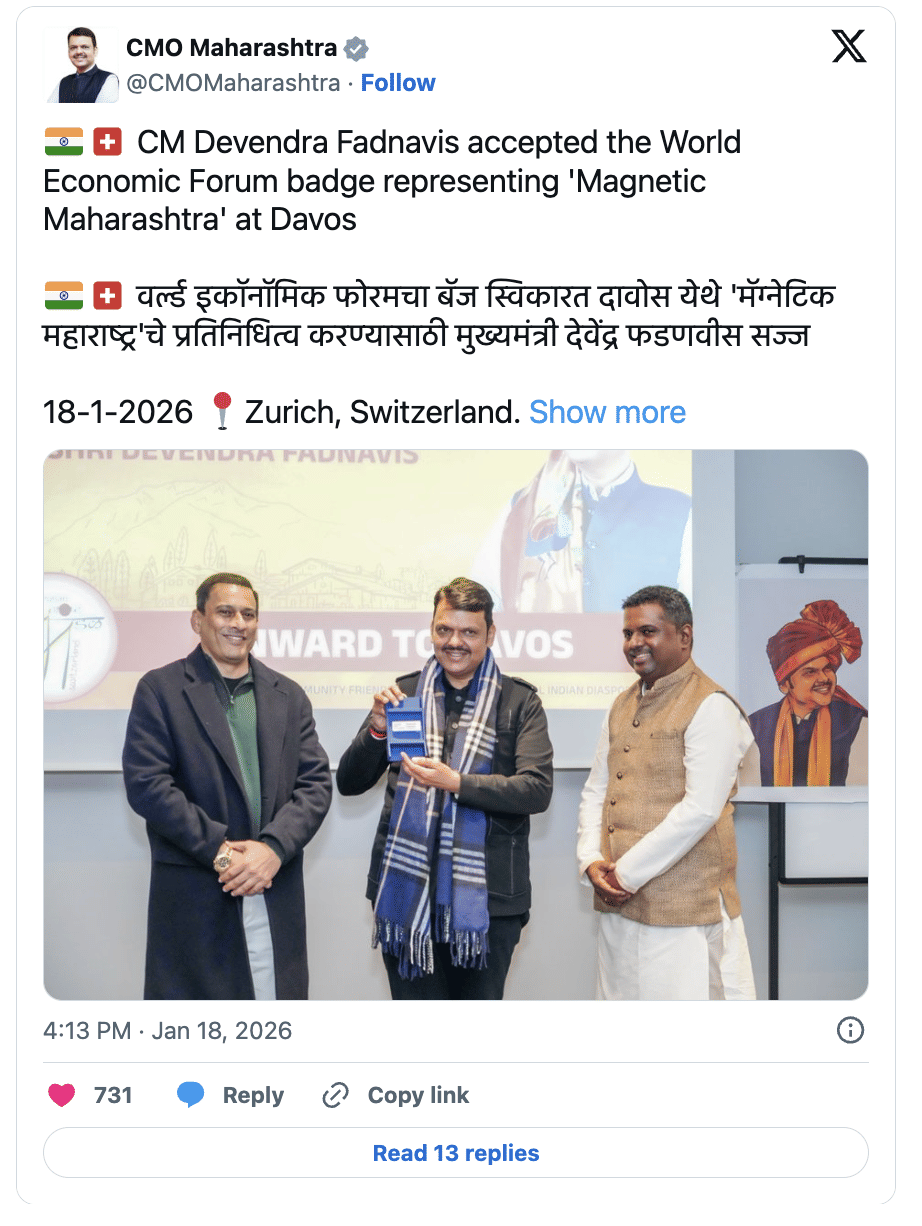
He outlined the proposed ‘MahaNRI Connect’ platform, aimed at bringing the global Marathi diaspora into a structured ecosystem for collaboration, investment and knowledge-sharing. “Our diaspora is doing meaningful and transformative work across the world,” he said. “These efforts should connect back to Maharashtra.”
More states, broader pitch
Maharashtra was not alone. Assam Chief Minister Himanta Biswa Sarma, attending the WEF Annual Meeting for the first time, is expected to hold more than 17 high-level meetings during the week. State officials said Assam will present its governance reforms, industrial growth strategy and technology-led development roadmap to global investors, building on momentum from its recent investment summits.
Telangana is showcasing its strengths in data centres, green energy and emerging technologies, while Kerala’s delegation is highlighting opportunities in tourism, healthcare, human capital and services. The collective message is clear: India’s growth story is no longer concentrated in a handful of metros, but distributed across competing state ecosystems.
Manufacturing proof from corporate India
If states brought ambition, Indian industry brought evidence.
On day one, the World Economic Forum announced that Hindustan Unilever Limited’s factories in Gandhidham (Gujarat) and Pondicherry had been designated Advanced Fourth Industrial Revolution (4IR) Lighthouse sites under the WEF’s Global Lighthouse Network.
With this recognition, HUL now has five factories globally acknowledged for digital transformation, productivity and sustainability — one of the strongest industrial endorsements for an Indian company at this year’s forum.
WEF officials said the Gandhidham facility cut water use by 17%, reduced Scope 1 and 2 emissions by 90% through renewable energy, and used AI, digital twins and industrial internet tools to improve traceability and efficiency. The Pondicherry unit achieved 25% volume growth and a 23% reduction in defects through machine learning-driven process optimisation.
For India, the significance went beyond corporate achievement. In a Davos dominated by caution, manufacturing credibility carried more weight than manufacturing promise.
Day one at Davos rarely produces announcements. It establishes hierarchy and credibility.
In a forum shaped by geopolitical uncertainty and risk aversion, India chose to lead with delivery — decentralised state power, factory-level proof and investment-ready projects. The approach resonated with a global business audience increasingly focused on where capital can move with confidence.
As the week progresses into closed-door negotiations and policy debates, the real test will be conversion: memoranda, partnerships and capital commitments. But on day one, India succeeded in one critical task — positioning itself as a country ready to absorb investment, not just attract attention.
Topics
Author
Loading...