







Leadership
Founder reconsiders management style after losing top talent over flexible work






Dubai-based co-founder says denying a Friday work-from-home request led to a valued employee’s resignation and a rethink on flexibility.
A Dubai-based Indian-origin co-founder has publicly admitted that refusing a simple work-from-home request led to the resignation of one of his top employees, prompting him to rethink his management approach to flexibility.
In a LinkedIn post that has since sparked debate among professionals, Malik A, co-founder of Virtualpartner, said he declined a team member’s request to work remotely on Fridays — a decision he now describes as short-sighted.
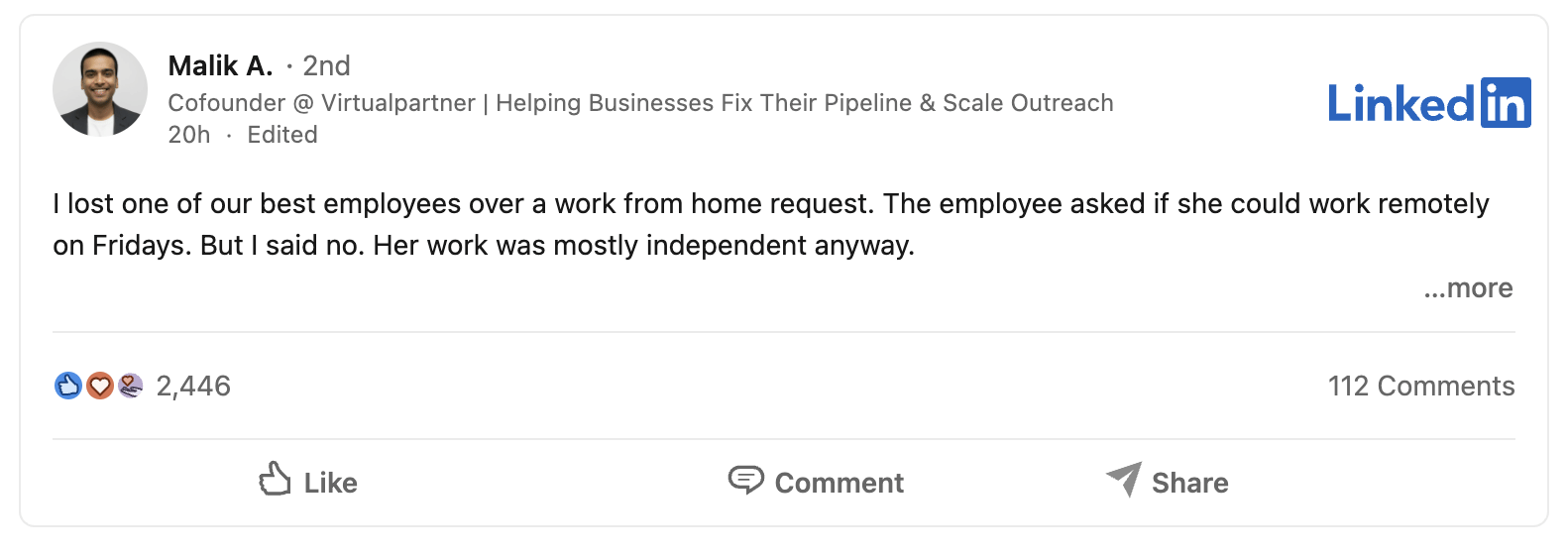
The employee’s role was largely independent, he wrote, but he feared setting a precedent. “I thought if I said yes everyone would ask. The office would be empty on Fridays. It would spiral out of control,” he said.
The employee did not challenge the decision. “She didn’t argue. Just said okay,” Malik noted. Two months later, she resigned.
During her exit interview, she referenced the rejected request. While not the sole reason for leaving, she said it marked the moment she realised her manager did not trust her.
The episode underscores a broader leadership tension: control versus trust in hybrid work models.
Malik later learned that the employee had been commuting two hours each way, with Friday traffic particularly heavy. “One remote day would’ve changed everything for her,” he reflected, adding that he had rejected the request over a problem “that didn’t even exist yet”.
Following the resignation, he said he began approving “every reasonable flexibility request”. Contrary to his earlier fears, he claimed employees did not misuse the policy. “The office didn’t fall apart. People didn’t abuse it. They just work better,” he wrote.
The post drew wide reaction on LinkedIn. Some users argued that companies often respond to employee concerns only after resignations. Others said remote work demands a different management style, warning that flexibility must be balanced with accountability.
The discussion comes amid continuing global debate over hybrid work policies, as companies attempt to balance productivity, culture and employee retention. Surveys across markets have shown that flexibility remains a key factor in talent decisions, particularly among high-performing professionals.
For leaders, the incident highlights how seemingly minor policy decisions can carry symbolic weight. In this case, what appeared to be a routine managerial call became, in the employee’s words, a signal of mistrust.
Malik concluded that the experience reshaped his approach to leadership. Rather than focusing on worst-case scenarios, he now evaluates requests based on individual responsibility and outcomes.
As companies refine post-pandemic workplace strategies, the episode serves as a reminder that flexibility is not only an operational issue — but a leadership one.
Topics
Author
Loading...