







Leadership
'We just want to have the right talent': TCS chief says no layoffs planned






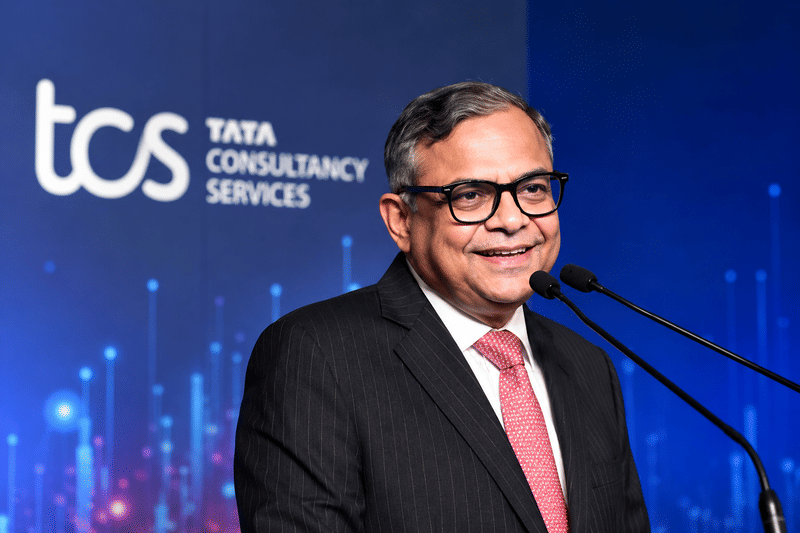
TCS Chairman N Chandrasekaran has ruled out workforce downsizing despite growing concerns around artificial intelligence and automation, while signalling a significant shift in how India's largest IT services company approaches hiring in the years ahead.
Tata Consultancy Services (TCS) has said it has no plans to reduce its workforce despite rapid advances in artificial intelligence, with Chairman N Chandrasekaran telling shareholders that the company remains focused on attracting the right talent rather than pursuing staff cuts.
Speaking at TCS' 31st Annual General Meeting, Chandrasekaran sought to address growing concerns across the technology sector about the impact of AI on jobs, stating that workforce downsizing is not part of the company's plans.
"There is no downsizing of staff. That is not planned at all. We just want to have the right talent," he said.
The comments come at a time when businesses worldwide are reassessing workforce requirements as generative AI and agentic AI systems become increasingly capable of performing tasks traditionally handled by human employees.
Hiring will continue, but the model is changing
While rejecting the idea of layoffs, Chandrasekaran also made it clear that hiring patterns at TCS are evolving.
According to remarks reported by The Times of India, the company will continue to recruit talent, but the era of large-scale workforce expansion may gradually give way to a more targeted approach.
"We want to use the agents. And we need to attract the best talent. The rate of addition of employees will not be as it used to be," he said.
Chandrasekaran also suggested that traditional recruitment metrics centred on hiring volume may become less relevant in the future.
"If the HR department of the company had a metric on their ability to hire a large number of talent, that metric will go away," he said.
The shift reflects a broader transformation taking place across the global technology industry as companies seek to balance AI-driven productivity gains with workforce planning and skills development.
Workforce numbers decline as AI adoption accelerates
TCS reported a decline in overall headcount during FY2026.
Key workforce figures include:
• Total employee count stood at approximately 5.84 lakh employees
• Overall headcount declined by 23,460 employees during FY2026
Despite the reduction, Chandrasekaran's comments indicate that the decline does not form part of a broader restructuring or layoff programme.
Instead, the company appears focused on recalibrating hiring priorities as AI becomes increasingly integrated into software development, technology operations and enterprise services.
AI emerges as a growth driver, not a disruption
A major theme of Chandrasekaran's address was the role of artificial intelligence in shaping the future of the IT services industry.
Far from viewing AI as a threat, he described it as one of the most significant growth opportunities the company has encountered.
"AI is the biggest opportunity TCS has had so far," he said.
The chairman revealed that TCS is investing heavily in developing AI agents for:
• Internal operations
• Solution frameworks
• Client-specific applications
• Enterprise workflows
According to Chandrasekaran, the future workplace will involve close collaboration between employees and AI systems rather than replacement.
"The company's employees and the AI agents will work together, and that will be the future," he said.
AI revenues gather momentum
The scale of TCS' AI business is already becoming visible in financial terms.
Chandrasekaran said the company's AI-related revenues reached close to $2.5 billion on an annualised basis during the last quarter.
He also projected that artificial intelligence will eventually become embedded across virtually all business activity within the company.
According to his forecast:
• AI revenue is currently approaching $2.5 billion annually
• By 2028 to 2030, 100 per cent of TCS revenue could have an AI component
The comments underscore how rapidly AI is moving from a standalone technology initiative to a core business capability across the IT services sector.
Reframing the debate around AI and IT services
Chandrasekaran also challenged the growing narrative that AI represents an existential threat to technology services companies.
He noted that concerns intensified in late 2024 when agentic AI systems began demonstrating capabilities such as writing code, testing software and managing technology operations.
Those developments triggered anxiety across global markets, contributing to a sharp decline in technology sector valuations.
However, he pointed to a disconnect between market sentiment and industry performance.
According to Chandrasekaran:
• Margins across the sector have remained resilient
• Revenues have continued to grow
• Deal pipelines remain strong
• Business fundamentals have held up
He attributed the gap to misunderstandings about the relationship between AI and IT services.
"AI tools reduce the need for human input in the building and maintenance of software. However, AI does more than reduce effort. It is not merely a technology. It is infrastructure, an infrastructure of intelligence," he said.
A new workforce equation takes shape
For TCS, the AI era appears less focused on workforce reduction and more centred on workforce evolution.
The company's message is that future competitiveness will depend on combining skilled talent with increasingly capable AI systems.
That approach suggests a shift in emphasis from hiring at scale to hiring for capability, adaptability and specialised expertise.
As enterprises accelerate AI adoption and demand more intelligent digital services, TCS appears to be positioning itself for a future where human talent and AI agents work side by side, creating new roles, new skills requirements and potentially new growth opportunities across the technology industry.
Topics
Author
Loading...