







Leadership
Who is Nandan Nilekani? The Infosys co-founder chosen to restore trust in India's public exams






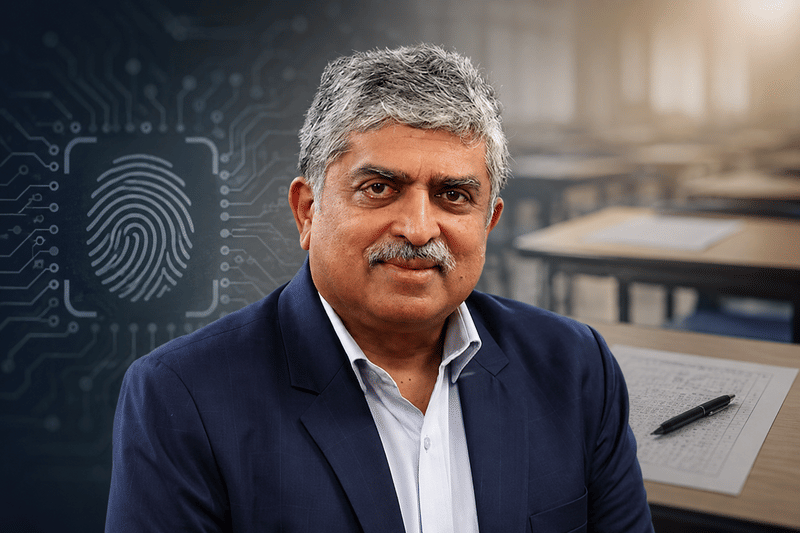
From building Infosys and Aadhaar to shaping India's digital public infrastructure, Nandan Nilekani has now been tasked with helping make the country's public examination system more secure and transparent.
Prime Minister Narendra Modi has turned to one of India's most influential technology leaders to help tackle one of the country's biggest education challenges. In a social media address on Sunday, the Prime Minister announced a high-powered technology task force led by Infosys co-founder Nandan Mohanrao Nilekani to explore digital solutions for making India's public examination system leak-proof and more transparent.
The announcement comes amid growing scrutiny of competitive examinations following allegations of paper leaks and irregularities in exams such as NEET-UG and UGC-NET.
According to the Prime Minister, technology should become a central instrument in restoring confidence in public examinations, while the government also plans to introduce legislation to strengthen action against examination malpractice.
A career built on technology at scale
Born on June 2, 1955, in Bengaluru, Nandan Nilekani graduated in electrical engineering from Indian Institute of Technology (IIT) Bombay before beginning his professional career at Patni Computer Systems in Mumbai in 1978.
His defining career milestone came in 1981, when he joined N R Narayana Murthy and five other colleagues to establish Infosys, a company that would become one of India's largest IT services firms.
Nilekani held several leadership positions before becoming Chief Executive Officer in 2002. During his five-year tenure as CEO, Infosys' revenues increased sixfold to nearly $3 billion.
In 2017, he returned as Non-Executive Chairman following the departure of former CEO Vishal Sikka, helping steer the company through a significant leadership transition.
The architect behind Aadhaar
While Nilekani built his reputation in the technology industry through Infosys, his most significant contribution to public administration began in 2009, when then Prime Minister Manmohan Singh appointed him Chairman of the Unique Identification Authority of India (UIDAI) with Cabinet rank.
He led the development and rollout of Aadhaar, which has grown into the world's largest biometric identity programme.
Today, Aadhaar supports identity verification, financial inclusion and direct benefit transfers for more than a billion residents. Although the programme has generated debate around privacy and data protection, it has also become a cornerstone of India's digital governance framework.
Driving India's digital public infrastructure
Nilekani has played a wider role in shaping India's digital ecosystem beyond Aadhaar.
His contributions include helping promote the framework that led to the development of the Unified Payments Interface (UPI), now one of the country's most widely adopted digital payment systems.
Over the years, he has also:
- Chaired multiple government technology committees.
- Served on the boards of leading policy institutions.
- Advised international organisations on technology and public policy.
- Invested in several Indian technology startups.
In 2014, Nilekani briefly entered electoral politics by joining the Indian National Congress and contesting the Lok Sabha election from Bengaluru South. After losing the election, he largely returned his focus to technology, digital public infrastructure and philanthropy.
Why the government chose Nilekani
The Centre's decision to appoint Nilekani comes as it seeks to strengthen confidence in India's examination system after repeated controversies over paper leaks.
According to the Prime Minister, the task force will develop technology-driven solutions to improve the integrity and transparency of public examinations.
The panel brings together expertise from technology, education, intelligence and science. Besides Nilekani, it includes:
- Former ISRO Chairman S Somanath
- Intelligence Bureau Director Tapan Deka
- IIT Madras Director V Kamakoti
- Former School Education Secretary Anita Karwal
- Higher Education Secretary Amrit Lal Meena
Nilekani's experience in designing digital platforms that operate at population scale is widely regarded as one of the reasons behind his selection.
Technology and stronger laws will work together
The announcement coincides with the government's proposal to strengthen the Public Examinations (Prevention of Unfair Means) Act, 2024 through fresh amendments aimed at making investigations and trials faster while imposing stricter penalties for organised examination fraud.
The proposed measures include:
- Fines of up to ₹10 crore for serious offences.
- Imprisonment of up to eight years.
- A Special Task Force to investigate examination-related offences.
- Mandatory completion of investigations within two months.
- Special Fast Track Courts to conclude trials within three months of filing a chargesheet.
- A dedicated appeal mechanism requiring High Courts to dispose of appeals within three months.
The government's approach signals a twin strategy. While stronger legislation seeks to deter organised paper leak networks, the technology task force will examine how digital systems can improve security, transparency and accountability throughout the examination process.
A new digital challenge
Over the past four decades, Nandan Nilekani has helped build one of India's largest technology companies, led the country's digital identity programme and contributed to its digital payments infrastructure.
His latest assignment extends that journey into another critical public system. If the proposed reforms succeed, technology could become central to rebuilding trust in competitive examinations for millions of students across India.
Topics
Author

Loading...