







Organisational Culture
Viral ‘Corporate Majdoor Janta Party’ turns workplace burnout into India’s latest LinkedIn trend






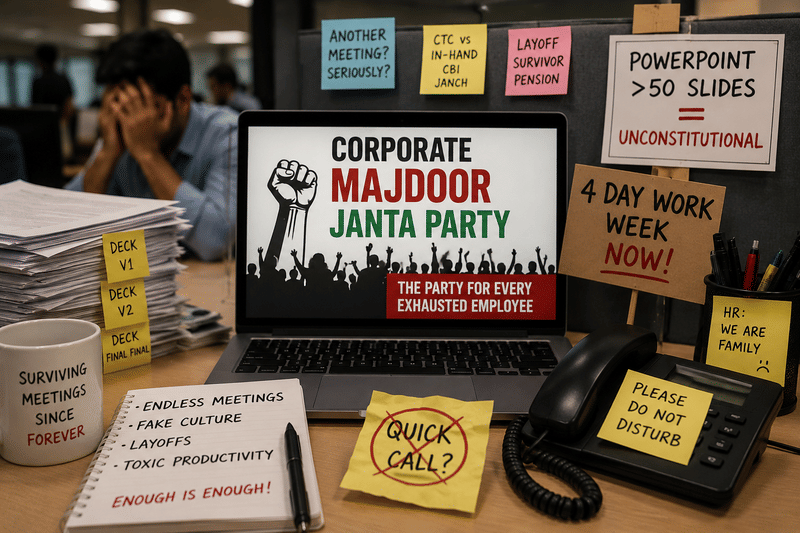
What started as a sarcastic LinkedIn post mocking meetings, HR jargon and burnout culture has snowballed into one of India’s most relatable workplace meme movements.
India’s exhausted corporate workforce may have just found its unofficial political movement, albeit a fictional one.
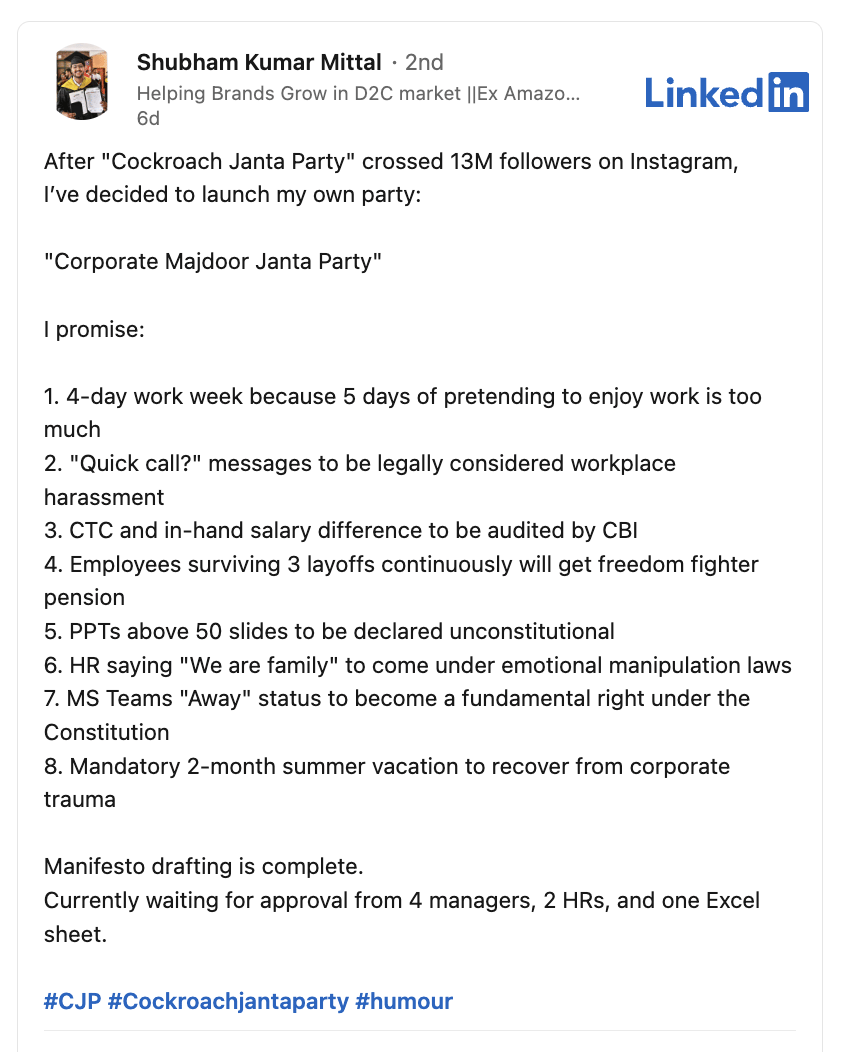
A satirical LinkedIn post by Gurgaon-based former Amazon employee Shubham Kumar Mittal has exploded across social media after he jokingly announced the formation of the “Corporate Majdoor Janta Party” or CMJP, a fake political party designed entirely around the frustrations of office workers.
What began as a sarcastic internet joke has quickly evolved into a larger online conversation around burnout, toxic productivity, performative workplace culture and employee exhaustion across India’s white-collar workforce.
The post, which first gained traction on LinkedIn before spreading across Instagram and X, resonated strongly with corporate professionals who described the mock manifesto as “too real” to ignore.
A manifesto built on corporate frustration
Mittal, who previously worked as a product manager at Amazon for nearly five years and now leads business growth and strategy at a botanical company, framed the satirical campaign as a response to the viral “Cockroach Janta Party” meme trend that has recently gained massive popularity online.
In his LinkedIn post, he unveiled a deliberately absurd but highly relatable “manifesto” targeting workplace culture and corporate bureaucracy.
Among the fictional promises made by CMJP:
- A four-day work week “because 5 days of pretending to enjoy work is too much”
- Declaring “Quick call?” messages as workplace harassment
- Asking for the gap between CTC and in-hand salary to be investigated by the CBI
- Providing “freedom fighter pension” to employees surviving three consecutive layoffs
- Declaring PowerPoint presentations longer than 50 slides unconstitutional
One line, however, appeared to resonate more strongly than the others.
“HR saying ‘We are family’ to come under emotional manipulation laws,” the post read.
The line rapidly circulated across LinkedIn comment sections and Instagram reposts, where thousands of users joked that the fake manifesto sounded more realistic than actual workplace policies.
Corporate humour meets burnout culture
The viral momentum reflects a broader shift in how younger professionals are publicly discussing work culture online.
Over the past two years, conversations around burnout, return-to-office mandates, layoffs, excessive workloads and workplace anxiety have increasingly moved from anonymous forums to mainstream professional platforms like LinkedIn.
What makes the CMJP trend notable is how openly employees engaged with it on a platform traditionally associated with polished professional branding.
Rather than corporate success stories or motivational posts, the conversation centred around:
- Endless meetings
- Workplace jargon
- Toxic positivity
- Salary opacity
- Layoff anxiety
- Exhaustion linked to modern corporate culture
Several users commented that the satire felt less like fiction and more like a summary of daily office life.
The joke expanded beyond LinkedIn
The trend did not remain limited to a single viral post.
Users discovered that a website carrying the “Corporate Majdoor Janta Party” name had also gone live, complete with a page inviting people to “join” the fictional movement.
The existence of the website added another layer to the internet frenzy, with many users questioning whether the joke had evolved into a larger parody campaign.
The meme ecosystem continued expanding after comedian Anmol Garg began posting videos online referencing a similarly named corporate workers’ movement, further amplifying the trend across social media platforms.
The humour may be exaggerated, but the reaction surrounding it reveals a deeper sentiment among younger professionals navigating uncertain economic conditions, rising performance pressure and increasingly blurred boundaries between work and personal life.
Why the trend struck a nerve
The popularity of the CMJP meme arrives at a time when workplace conversations in India are already heavily shaped by:
- Ongoing layoffs across technology and start-up sectors
- Growing discussions around work-life balance
- Employee fatigue linked to hybrid and always-on work cultures
- Frustration around corporate communication and HR practices
- Rising anxiety around job security amid AI-driven restructuring
The satire succeeds because it exaggerates familiar workplace experiences without entirely disconnecting from reality.
Even though the “party” itself is fictional, the reaction to it highlights how strongly corporate employees identify with conversations around burnout and emotional fatigue.
In many ways, the trend also signals how workplace discourse itself is changing. LinkedIn, once dominated by carefully curated corporate optimism, is increasingly becoming a platform where professionals openly joke about overwork, layoffs and dysfunctional office culture.
For now, the Corporate Majdoor Janta Party remains internet satire. But the speed at which it spread shows that India’s corporate workforce is more than willing to laugh at the pressures it deals with every day.
Topics
Author
Loading...