







Strategic HR
Why (Un)learning, not learning, is the HR Superpower of 2026






To lead in this decade, the CHRO must transition from being a Chief Learning Officer to becoming a Chief Unlearning Officer.
By: Raja Jamalamadaka
In the pantheon of corporate virtues, "Learning" has long held the central altar. For the past two decades, HR leaders and L&D architects have obsessed over acquisition: acquiring talent, acquiring skills, and acquiring data. We have built massive infrastructures-Learning Management Systems (LMS), AI-driven career pathing, and "always-on" micro-learning-all designed to fill the vessel of the employee. But as we navigate the complexities of 2026, we are discovering a profound and uncomfortable truth: The vessel is overflowing.
The most significant bottleneck to organisational transformation today is not a lack of new knowledge; it is the stubborn persistence of the old leading to highly intelligent organisations and leaders repeating deeply outdated behaviors. While computer scientists grapple with "Machine Unlearning" to make AI safer and more compliant, HR leaders must master "Human Unlearning" to make organisations more agile.
To lead in this decade, the CHRO must transition from being a Chief Learning Officer to becoming a Chief Unlearning Officer.
The Silicon Mirror: What machine unlearning teaches us
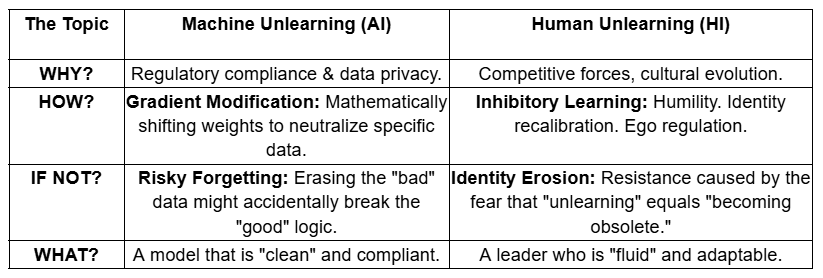
To understand the future of human talent, we must first look at silicon. When a Large Language Model (LLM) is found to have ingested copyright material, private medical data, or toxic biases, simply "deleting" the source file does nothing. The data is already baked into the model's 1.7 trillion parameters.
This has birthed the field of Machine Unlearning. It is the surgical process of modifying an existing model so that it behaves as if a specific subset of training data was never seen, all without retraining the entire model from scratch (a cost-prohibitive endeavor).
For the HR leader, the parallels are striking. Our “experienced” employees are essentially "high-parameter models." They have been "trained" on decades of market cycles, legacy leadership styles, and old operational playbooks. You cannot simply "input" a new digital transformation strategy and expect it to run if the underlying "parameters" (habits and mindsets) are still optimised for 2015 or earlier.
But why is human unlearning so difficult?
The Biological Barrier: Why humans struggle to "delete"
Unlike a machine, the human brain does not have a "delete" key. We operate on Synaptic Pruning and Active Forgetting because our brains are optimised for efficiency and survival.
For a seasoned professional, unlearning is not a cognitive task; it is a psychological one. Neurobiologically, we don't erase old memories; we create new, stronger pathways that compete with the old ones. Certainty rooted in past success is metabolically efficient. Challenging this certainty entrenched in existing beliefs requires cognitive energy, emotional discomfort and most important of all- human identity crisis. When a veteran leader’s sense of identity and "expert status" is tied to a legacy way of working, the brain perceives "unlearning" as a threat and identity crisis (“What else is my experience worth?”). Survival forces kick in, resistance grows and that notorious line takes over – “But this is how we’ve always done it.”
This is the Expertise Trap. The very knowledge that earned your senior talent their seats at the table is now the "noise" preventing them from hearing the "signal" of a changing market. In 2026, the cost of "Knowledge Debt"—the accumulated weight of outdated practices—is higher than the cost of technical debt.
Comparative Dynamics: AI vs Humans
The HR Roadmap: Strategies for selective forgetting
How do we build an organization that can unlearn as fast as it learns? It requires a fundamental shift in L&D philosophy.
1. Deconstruct the "Expert" Ego
In most organisations, we reward people for having the answers. To foster unlearning, we must reward people for questioning the answers they’ve held for a decade.
The Practice: Introducing “Who asked the best questions?” for legacy processes. Ask your senior teams: "If we were starting this company all over again, which of our current 'best practices' would you change and how?"
2. Avoid "all-or-none” syndrome
In AI, we worry that unlearning one thing will break another. In HR, we must be equally careful. If we ask a sales team to "unlearn" their aggressive closing style to move toward a "consultative" model, we must ensure we don't accidentally erase the resilience and grit that made them successful. Unlearning must be meticulous, not “All over the place”. .
Re-Introduce yourself Sessions - We are all familiar with corporate introductions – I am “Head of” with “xxx” years of experience. HR should incentivize a fresh introduction fun session shorn of “experience”, “titles”, “expertise”. That gradually reduces the attachment to the past and helps unlearning by choice.
3. Move from "Upskilling" to "Upsculpting"
Upskilling assumes we are adding a floor to a building. Upsculpting recognizes that sometimes to add something new, we must first take something away.
The Practice: Every time a new "Learning Module" is introduced, HR should mandate a “What will I STOP doing or do DIFFERENTLY” alongside the standard question “What will I START DOING?”
4. Create "Comfort” for “Letting go"
The greatest barrier to unlearning is fear. If an employee feels that letting go of a legacy skill makes them less valuable, they will cling to it.
The Leadership Mandate: HR must redefine "Value" from "What you know" to "What you didn’t know." We need to incentivize the "Adapt" of our senior leaders.
The CHRO as the "human model optimiser"
In the coming years, the most successful organisations will be those that treat their collective intelligence as a dynamic model. This requires us to look at our workforce through the lens of Weight Adjustment that Machine learning experts are familiar with. We aren't just looking for "fresh blood" (new people). We are looking to recalibrate our "veteran weights" (change what gets “weightage” from existing leaders). We need the wisdom of experience, but we need it stripped of the ego baggage of "how we've always done it."
The irony of the AI era is that it highlighted to humans the most “human” of traits: our ability to evolve - through unlearning.
About the author: Raja Jamalamadaka is an industry recognized leadership thinker, neuroscience researcher, and global executive exploring the intersection of human behavior, leadership, and artificial intelligence. His work focuses on translating neuroscience and human behavior into intuitive, practical insights that help organizations and leaders navigate the "Cognitive Transition" and leverage Human Potential to its fullest in the era of Artificial Intelligence.
Loading...