India’s labour landscape is entering a significant transition. With the new labour codes and accompanying Central Rules sharpening employer responsibilities, childcare can no longer be viewed simply as a statutory requirement or an extension of maternity benefits.
It is increasingly connected to larger workforce priorities: gender equity, workforce participation, talent retention and organisational resilience.
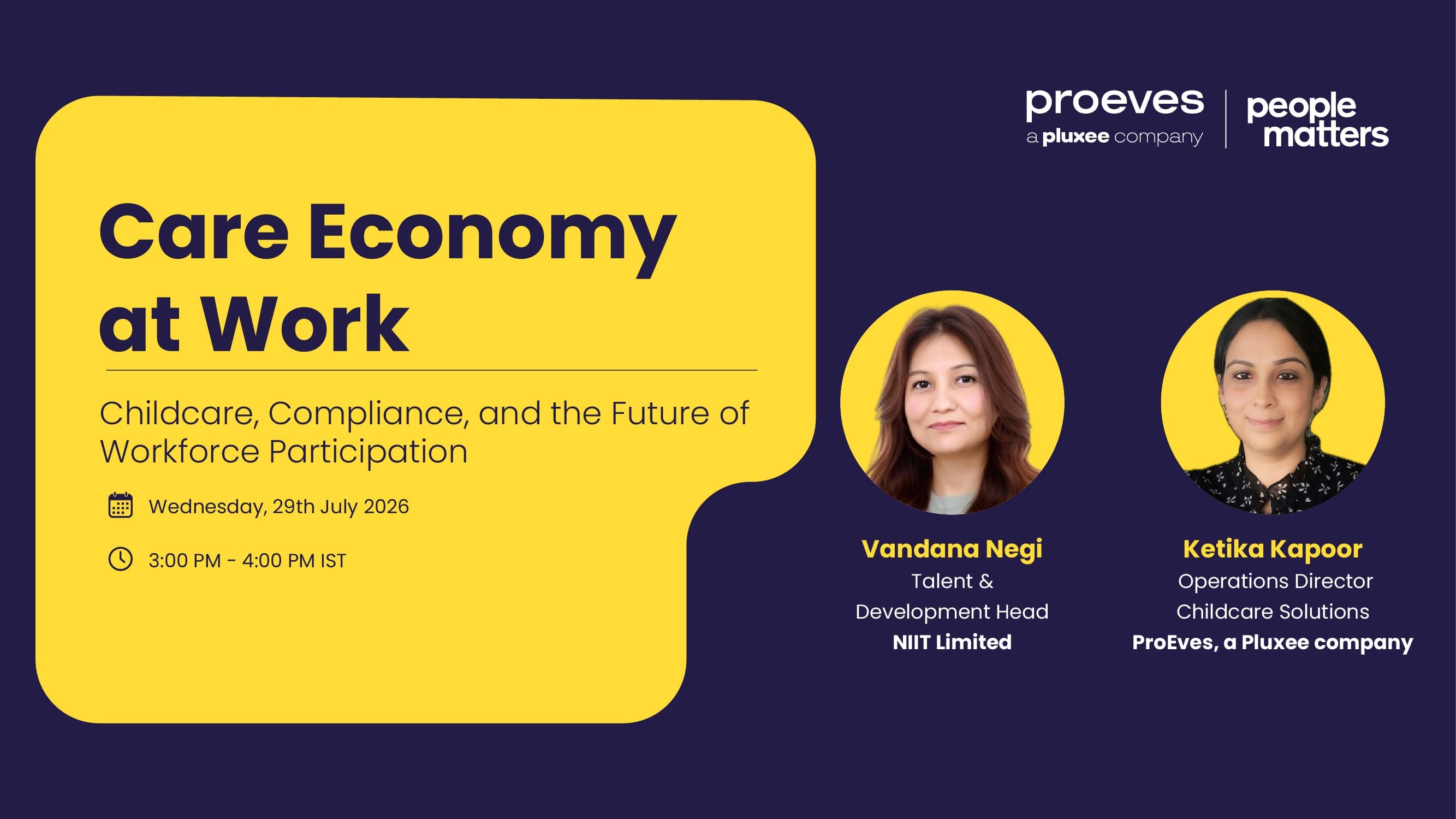
To understand what this shift means for employers, People Matters in association with ProEves, a Pluxee company, brought together Vandana Negi, Talent and Development Head at NIIT Limited, and Ketika Kapoor, Operations Director for Childcare Solutions at ProEves, a Pluxee company, for a conversation moderated by Jerry Moses from People Matters.
The discussion explored what employers need to prepare for, the childcare models available to them, and why implementation ultimately requires more than policy compliance.
What the new labour framework means for employers
The Code on Social Security and the Occupational Safety, Health and Working Conditions Code have further formalised employer responsibilities around workplace childcare.
Under the framework discussed during the session, establishments employing 50 or more workers must provide access to crèche and childcare benefits for parents of children between six months and six years of age. Importantly, the requirement is gender-neutral and extends across permanent and contract roles.
The framework also gives organisations flexibility in how they provide this support. Employers can establish their own facilities or access common crèche facilities operated by government bodies, private providers or groups of establishments.
For employers, this clarity changes the nature of the conversation. The question is increasingly moving from whether childcare needs to be addressed to how it can be implemented effectively across different workforce structures.
“The government has given the clause very clearly and with very clear specifics now for organisations to implement and endorse the policy, effectively removing the grey areas that previously caused hesitation,” Ketika noted.
Choosing the right childcare model
No single childcare model works for every organisation. During the discussion, three broad approaches emerged.
On-site childcare provides employees with a crèche within the company premises. While convenient, it can require substantial infrastructure, space, and capital.
Near-site childcare enables organisations to partner with centres located close to the workplace, offering access without requiring employers to build and operate their own facilities.
Distributed or network-based childcare extends access across multiple locations, including centres closer to employees’ homes. This can be particularly relevant for organisations with geographically dispersed, hybrid or remote workforces.
For companies operating across multiple cities and employee populations, the decision therefore needs to reflect workforce location, utilisation, cost and accessibility rather than simply defaulting to an on-site solution.
The growing availability of established childcare networks also gives employers a way to scale support without creating new infrastructure at every location.
Making childcare work operationally
The next challenge is execution. Many organisations are still determining how much they should fund, how benefits should be administered and how quality can be maintained consistently across locations.
Some employers may fully fund childcare, while others may adopt contribution caps or phased models based on regional costs and workforce requirements. But the discussion highlighted an important distinction: childcare support needs to translate into actual access to reliable care, rather than become another loosely administered allowance.
Governance therefore matters as much as funding. Employers need visibility into the childcare centres employees can access, service quality and utilisation, while avoiding an excessive administrative burden on internal HR teams. External childcare platforms and pre-verified networks can help organisations manage this complexity across cities and employee groups.
The aim should not simply be to create a benefit on paper, but to design an operating model that employees can realistically use.
How culture can determine whether the policy works
Even a well-designed childcare programme can fall short if the organisational culture does not support employees in using it.
Caregiving has historically been treated as a personal responsibility, often creating invisible barriers for employees navigating parenthood or returning after career breaks. Changing this requires organisations to normalise caregiving rather than frame it as an exception requiring special accommodation.
Managers are especially important. They are often the people employees interact with when requesting flexibility, taking nursing breaks, managing family emergencies or returning to work after parental leave. If managers do not understand the organisation’s childcare and parental-support policies, formal benefits may have limited impact.
“A mindset change has to happen, and a unified culture has to be set across the organisation so that caregiving is normalised rather than treated as a special accommodation,” Vandana said.
For HR leaders, childcare strategy therefore cannot sit only within policy or benefits teams. Manager education, leadership communication and everyday workplace behaviours need to reinforce the same intent.
What comes after childcare?
The care economy conversation is also beginning to extend beyond physical crèches.
Technology can simplify how employees discover, evaluate and access childcare through digital booking, childcare matching and monitoring platforms. At the same time, organisations are widening their approach to include flexible working arrangements, family-friendly leave, parental coaching and support networks.
“Childcare is the first step, but the ultimate evolution leads toward comprehensive parental wellness programmes, coaching support and structured family care benefits that sustain workforce participation over the long term,” Ketika concluded.
That may ultimately be the larger shift for employers.
The new labour framework creates an important compliance imperative. But organisations that stop there risk missing the bigger workforce opportunity. The more strategic question is how childcare and family support can help employees remain productive, engaged and connected to work through different stages of their lives.
For HR leaders, the next step is not simply to introduce another benefit. It is to build a care infrastructure that employees can access, managers can support and organisations can scale.
Watch the complete conversation here: