








We live in a world where software can reason, make decisions, create art and even think, thus pushing aside the idea that the Cartesianism of cogito ergo sum applies only to us, humans. The world seems to be undergoing a renaissance similar to that over the Industrial Revolution. Whereas automated machines replaced, displaced and disrupted a few processes and roles then, synthetic intelligence is creating disruptive waves in the world of work today.
Artificial Intelligence (AI) seems to be making inroads into every aspect and process at work. HR processes are no different. There are intelligent and self-learning software that claim to be capable of replacing multiple HR functions, even recruitment – and not just the routine, mechanical tasks but the human side of it too. That said, while AI cannot (as of now) completely negate the need for a human recruiter, it could surely alter the role that a recruiter plays.Analysts are of the view that it is safe to predict that AI will salvage 6.2 billion hours of human output by 2021 and the work hours put in by the average recruiter would be a part of that metric.
Katie Waldo, People Center Manager at H&R Block stated, “AI in talent acquisition is not going to replace the recruiter. It is creating a shift for the recruiter to focus on more value-add activities.”
Employee experience the AI way
While employee experience is progressively being regarded and understood as not just an HR objective but rather a business initiative as well, HR process remain the means to the end, (or rather the beginning of) the perfect employee experience. AI-powered chatbots and virtual assistants used by EY and Buzzfeed contribute to the business by allowing HR to break free from the administrative tasks to focus more on strategic initiatives. These chatbots prove that, ironically enough, increased contact with non-human AI can improve the employee experience during onboarding by making new recruits feel that they can always reach out to someone.
But the course of employee experience begins much before onboarding – when the employee is still one of the candidates. AI enables organizations in smoothening out the process of recruitment in its entirety. Recruiters can now collate unified profiles from an ever-growing mass of unstructured data sets while automatically matching skill sets required for an open role with the candidates’ skill profiles.
Moreover, by automating and AI-enabling the low-level tasks, the chance of human error can be reduced substantially if not eliminated altogether. This, in turn, leads to a better candidate experience while also working in favour of employer branding. There are also specialized tools that can test a precise set of skills like Filtered, for example, which helps in recruiting tech talent by auto-generating multiple coding challenges.
Thus, every interaction with the candidate can be regarded as a touch-point for improving the experiential aspect of the job and AI can aid greatly in that endeavor by not only reducing the administrative workload but also adding tangible value to the process.
Benefits galore
Incorporating artificial intelligence in recruitment, comes with the following primary benefits:
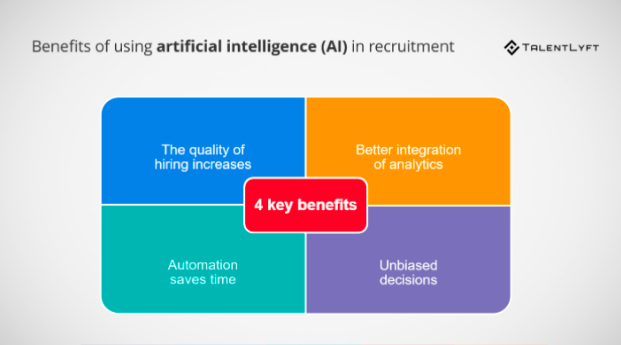
- The quality conundrum: While it might be unfair to say that AI recruiters can hire better quality talent than human recruiters, the combined force of both can definitely increase the value of talent acquisition. Not only can the process be more structured, but the amount of data that can be processed on each candidate can also be significantly varied and massive. Best-fit algorithms coupled with human understanding have the power to ensure the best hires without relying blindly on either human or AI.
- Integrated analytics: HR managers can now use predictive and integrated analysis to take the concept of PE (Person-Environment) fit from paper to practice. Not only can candidates be hired in accordance with the skills they possess but also be placed in roles where they can bridge skill gaps the best while adding and gaining the most value. When it comes to matching skills, AI tools have proved to be more accurate across a variety of situations than humans.
- All in good time: When it comes to amassing and analyzing big amounts of data, AI surely scores higher than the human recruiter. Time truly is of the essence in today’s instant world. From a cup of coffee, to downloading an app, booking flights to gaining business insight, our generation of impatience wants results at the touch of a button. AI allows businesses to deliver despite the time crunch and render the process of recruitment a lot less time-consuming without adding the risk of mistakes.
- An unbiased lens: With human intervention comes an undeniable level of bias. That cannot be said of an AI since even those that can practically achieve thought functions, are based on algorithms and unless they are taught to be biased, they would not pick that trait up automatically. That said, the algorithm itself could prove to be biased inadvertently as was the case with the Amazon recruitment tool, which turned out to be biased against women. Even in such cases, it is human intervention in the learning process of the AI that leads to any prejudice or partiality.
Adrian Tan, the Co-founder and Director at The Resource Group feels that the shift towards Ai is "inevitable and is the key to drive the next level of efficacy in recruiting as it allows for the combination of scale and speed that is unprecedented."
Best of both worlds
Today we have the convenience of progressive chatbots like Mya that can not only talk to candidates but also evaluate responses based on Natural Language Processing and thus assess whether a certain candidate demonstrates certain skills. Such AI tools also help recruiters in filling up gaps in résumés and thus access and assess a holistic view of all candidates instead of the usual 2-dimensional perspective that a CV offers. But could such bots and software replace and obliterate the importance of the human recruiter?
The answer lies in our collaborative future ahead where AI can be regarded not as a wave of change come to take over jobs but rather to enable people to do their jobs better. To be able to leverage the power of AI in recruitment, human recruiters need to be trained without the fear of being replaced. Tan also believes that the challenge is in securing sufficient data to train the AI with. Moreover these trainings needs to be localized since what applies to one country might not necessarily make sens in the context of another country.
While the shift of technology from being a means to greater output to being an enabler took decades, the jump from technology being an enabler to being a part of our everyday lives was almost as fast as our internet connections. With that view in mind, AI needs to be regarded as a part of everyday work and for the recruiter, I could be all that it is allowed to be – a reliable tool, a ready real-time reckoner and a step toward making the process of recruitment stronger than it is today.
Be a part of more discussions on AI in recruitment at TechHR Singapore on 28th February, 2019 at Marina Bay Sands, Singapore. Click here to register.
Image source: TalentLyft