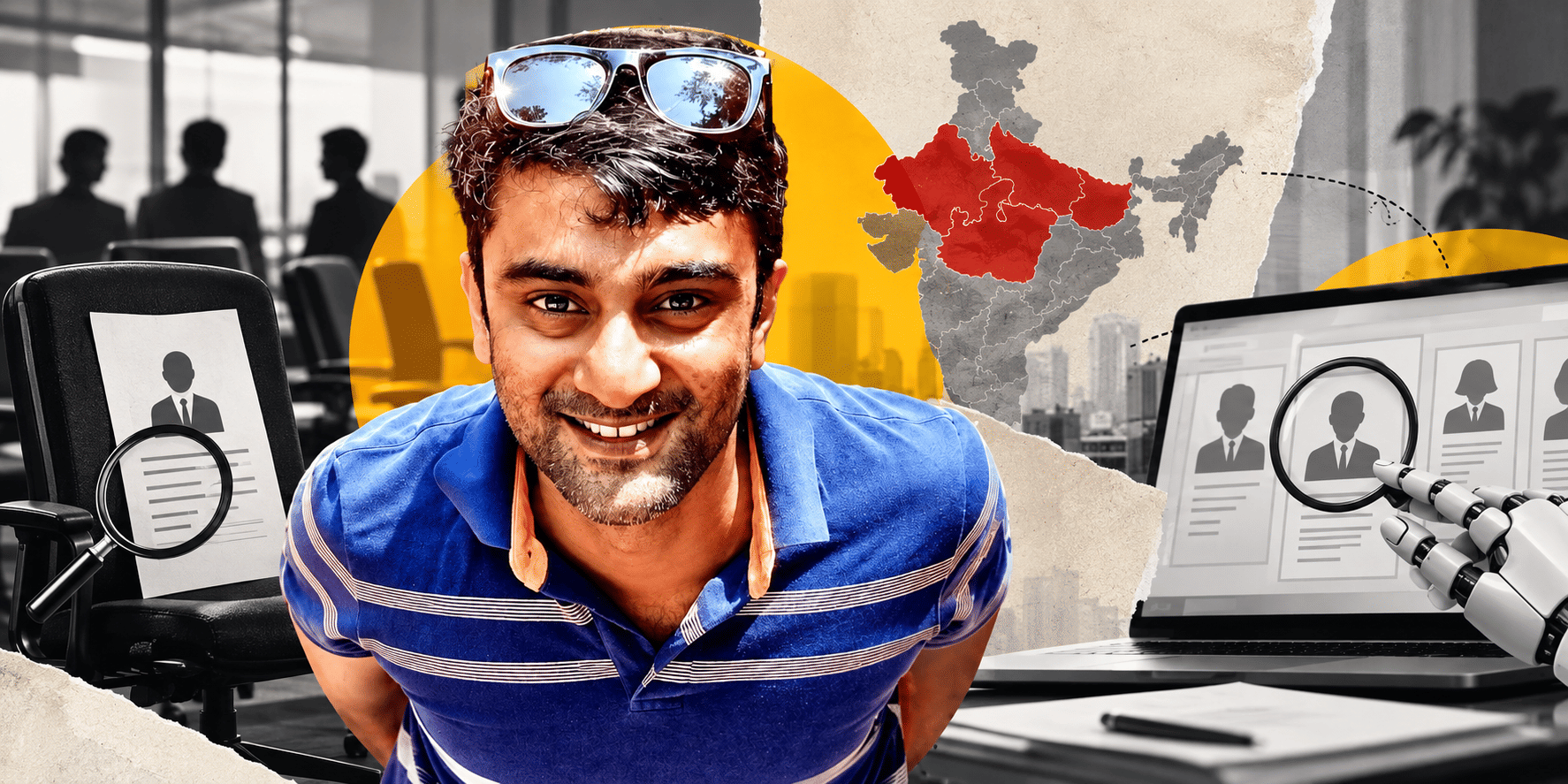
A Bengaluru founder's recent declaration that he would not hire men from Uttar Pradesh, Bihar, Rajasthan and Madhya Pradesh triggered exactly the reaction one would expect. Some defended the concern around safety. Most criticised the sweeping generalisation.
But once the outrage settles, there is a more interesting HR question worth discussing.
When employers are genuinely worried about workplace safety, misconduct, integrity or cultural fit, what is the right way to assess risk?
More importantly, can AI help HR make better hiring decisions without crossing ethical, legal or privacy boundaries?
The answer is both yes and no.
The problem with broad-brush hiring decisions
Let's start with the obvious.
Excluding candidates because of where they come from is a poor hiring strategy.
India's Constitution guarantees equality before the law, while several workplace laws and regulations promote fair and non-discriminatory employment practices. As India Briefing notes in its analysis of equal opportunity frameworks, employers are increasingly expected to rely on objective criteria such as qualifications, skills, experience and job requirements rather than characteristics unrelated to performance.
Even from a purely business perspective, regional exclusion creates more problems than it solves.
A hiring manager may reject thousands of capable candidates while gaining little meaningful insight into actual risk.
After all, misconduct, integrity issues and behavioural concerns are individual traits. They are not geographical traits.
The real challenge for HR is not identifying where someone comes from.
It is understanding who they are.
This is where AI enters the conversation
For years, background verification has largely been a manual process.
Employers verify education credentials, previous employment, criminal records where available, identity documents and references. The process often takes days or even weeks.
AI is beginning to change this.
Across the world, organisations are experimenting with technologies that can:
- Detect inconsistencies across resumes, applications and employment records.
- Flag suspicious credential patterns.
- Automate identity verification.
- Accelerate document authentication.
- Identify potentially falsified information.
- Improve reference verification workflows.
- Monitor compliance requirements across large hiring volumes.
In simple terms, AI can help organisations verify information faster and more accurately.
What it cannot do is determine whether someone from a particular state is inherently more trustworthy than someone else.
No responsible AI system can make that judgement because the data simply does not support it.
The danger of replacing human bias with algorithmic bias
Ironically, AI can also make hiring discrimination worse if organisations are careless.
The World Economic Forum, OECD and several global AI governance bodies have repeatedly warned that AI systems can inherit biases embedded in historical data.
If an organisation trains a hiring model on biased decisions from the past, the technology may simply automate those same biases at scale.
Imagine a company historically hiring candidates from a limited set of regions, colleges or social backgrounds.
An AI model trained on those patterns could incorrectly conclude that these characteristics predict success.
The result would not be better hiring.
It would be faster discrimination.
This is precisely why regulators globally are increasingly focusing on explainable, transparent and auditable AI systems.
What AI can realistically help with
The most valuable role for AI in recruitment is not deciding who deserves a job.
It is helping HR make more informed decisions.
Used responsibly, AI can support:
- Faster background verification.
- Identity and document authentication.
- Detection of fraudulent applications.
- Better skills matching.
- Structured candidate screening.
- Risk-based compliance checks.
- Enhanced hiring analytics.
Notice something important.
None of these functions require assumptions about caste, religion, gender, language, state of origin or ethnicity.
The focus remains on evidence, qualifications and behaviour.
That is exactly where hiring decisions should stay.
The bigger lesson for HR
The Bengaluru controversy is ultimately less about one founder and more about a challenge many employers face.
- Every organisation wants safe workplaces.
- Every organisation wants trustworthy employees.
- Every organisation wants to minimise hiring risk.
The temptation is to look for shortcuts. But shortcuts often lead to stereotypes.
Technology offers a better path, provided it is used responsibly.
The future of hiring is unlikely to be human judgement alone or AI alone. It will be a combination of both.
The strongest recruitment processes will use technology to verify facts, identify risks and improve efficiency while leaving final decisions to trained professionals applying consistent and fair standards.
Because the goal of hiring is not to judge groups.
It is to evaluate individuals.
And no algorithm, founder or HR leader should lose sight of that.