




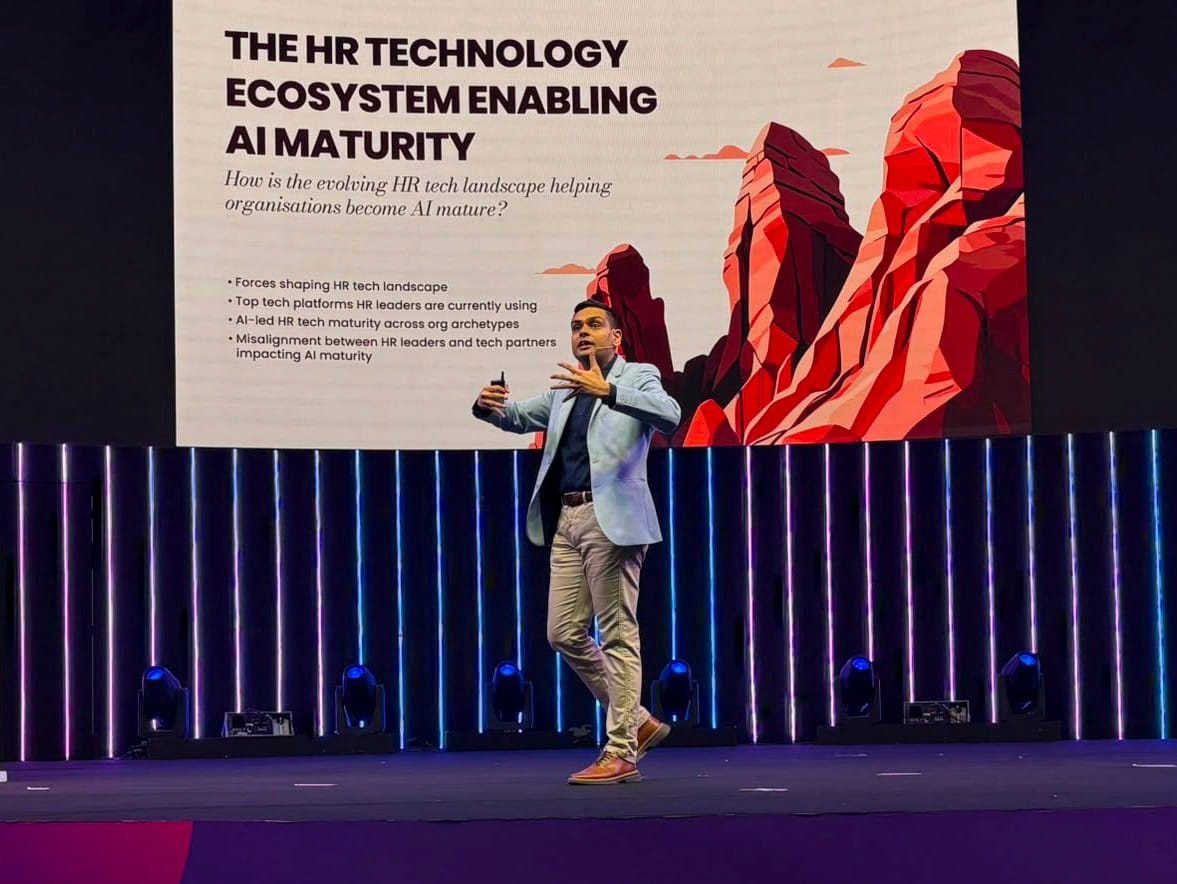
34% of HR leaders in India are actively experimenting with AI with isolated pilots across their HR functions, while 32% have already deployed it across select HR processes. AI transformation is no longer an experiment for leaders. While experimentation is driving AI transformation efforts, these experiments are not scaling to enterprise levels. Pushkaraj Bidwai, CEO of People Matters, says, "Earlier, technology transformation had a transition period of four to six years; now, technology is changing every year, leaving us with a faster transformation cycle"
India is at the intersection of strong market growth for HR tech providers who are expecting strong investor interest in their products, leading to a rise of AI native point solutions. In order to leverage this, HR leaders in India have to identify the right use cases they are exploring through AI and their significance to the overall HR function strategy.
This is where People Matters’ SHRPA HR Tech and Transformation 2026 Research can inform leaders of the key imperatives they need to drive for AI transformation success.
AI maturity in India is mostly dominated by organisations that are still experimenting with pilot programmes or have no implementation. These constitute 46% of all leaders surveyed, followed by 32% of leaders who have implemented at a functional level for part of the employee lifecycle.
Progressive organisations that have either scaled deployment across the HR function or enterprise transformation of AI make up only 22% of the leaders. This is a drop from the previous year in HR tech maturity as AI native solutions have started to form the bulk of HR tech offerings.
Where are HR Leaders finding the most value through AI?
The adoption and investment trends suggest that while HR leaders in India are looking at adoption through a short-term impact measurability lens, as observed in hiring and HR operations outcomes, long-term value realisation through learning and employee experience is yet to be considered in investment decisions, which will be signalled by higher interest in these areas in future.
How is HR Technology Landscape Responding to AI
While there is emergence of new solution providers in Agentic AI capabilities and workflow automation and AI native challengers, the HR tech landscape is seeing consolidation under large enterprises and development of a fragmented market with AI native point solutions happening at the same time. Organisations have to consider this while selecting their HR tech platform capabilities, to build an enterprise solutions-led strong core, with edge capabilities given from AI point solution platforms.
Orchestrating Enterprise AI Maturity
Organisations are finding it hard to scale AI pilots, drive sustained adoption and align the stakeholders for collective ownership of AI transformation efforts.
Pushkaraj Bidwai, noted, "Technology is not holding us back; our own capabilities are. We need to take the steps to plug this gap and build transformation success." These challenges can be attributed to a combination of factors that are essential to build a strong foundation of AI maturity in organisations.
Strategic Alignment between leaders and HR: The research finds that leaders find an HR effectiveness gap on alignment of the business implications of AI as well as the alignment of AI strategy with business and workforce outcomes. HR effectiveness in resolving their distrust of AI is also low.
Ownership of Transformation Efforts: Progressive organisations have reported a higher involvement of IT function leaders that has enabled them to scale their AI efforts. A co-ownership of AI adoption between HR and IT leaders could be a key enabler of successful AI transformation.
HR Technology Strategy: With new product offerings coming up in a growing HR tech market, there is a conflict between large established enterprises looking to consolidate the market and smaller point solution-based players trying to have a fragmented market.
Data Readiness Challenge: HR leaders have cited challenges in data as their top challenges to adoption of AI. Without the right data infrastructure to support it, leaders are likely to struggle in realising sustainable value from their investments.
AI Skills Readiness Challenge: The skill demands for AI have changed to a combination of deep expertise and AI fluency. Low AI fluency across organisations and a lack of skill intelligence capabilities in present HR technology offerings make this more difficult for HR leaders to build the readiness needed.
Reinventing HR Operating Model: For building AI maturity in organisations, HR leaders also need to make changes in their HR operating model. Steps like creation of AI-focused roles, consolidation of HR operations roles and making HR roles more strategic are a few steps that can enable a successful AI transformation in organisations.
Measuring Transformation Success
AI transformation success is mostly measured in the form of productivity improvements, cost reduction and quality of HR service delivery improvement. However, these are entry-level indicators that do not allow the measurement of long-term value realisation.
Organisations that are more advanced in deploying AI in their functions also consider business outcomes and employee experience as key drivers of transformation success, which work as key differentiators for them. Most progressive organisations assess the quality of decision-making augmented by AI and the reinvestment of time saved, which is leading to growing revenues for the business. This is where key value is created from AI transformation.
Pushkaraj Bidwai concludes, "Cost reduction is important, but the question we need to ask ourselves is whether it will help us in creating exponential value. Instead, we need to focus on collective time savings and channelise it towards making more business growth opportunities. "
Imperatives for HR leaders:
AI transformation has to be a co-ownership exercise between HR and IT stakeholders.
A strong AI transformation effort cannot proceed without the foundational underpinning of Data readiness and AI skill readiness.
Organisations have to move beyond productivity and cost metrics to measure the success of their AI investments and focus on business outcomes and employee experience.
Organisations are bullish towards AI but need strong proof of return on their investments in AI. People Matters’ State of HR Tech and Transformation Research has attempted to give HR Leaders the right context grounded in an objective ROI framework to assist leaders with their reservations.
For more detailed insights, download the report here