For Indian organisations, growth and transformation are increasingly occurring simultaneously. As businesses scale, adopt new technologies and respond to shifting market conditions, leaders are expected to deliver today while preparing their organisations for what comes next. This raises a fundamental question: how can leaders sustain performance when the conditions for success are constantly changing?
This is the question explored in Harvard Business Impact’s 2026 Global Leadership Study, No Stable Ground, which brings together responses from 1,139 senior leaders across more than 15 countries. The research examines a defining leadership tension for 2026: how to deliver current performance while continuing to reinvent for a future that remains difficult to predict.
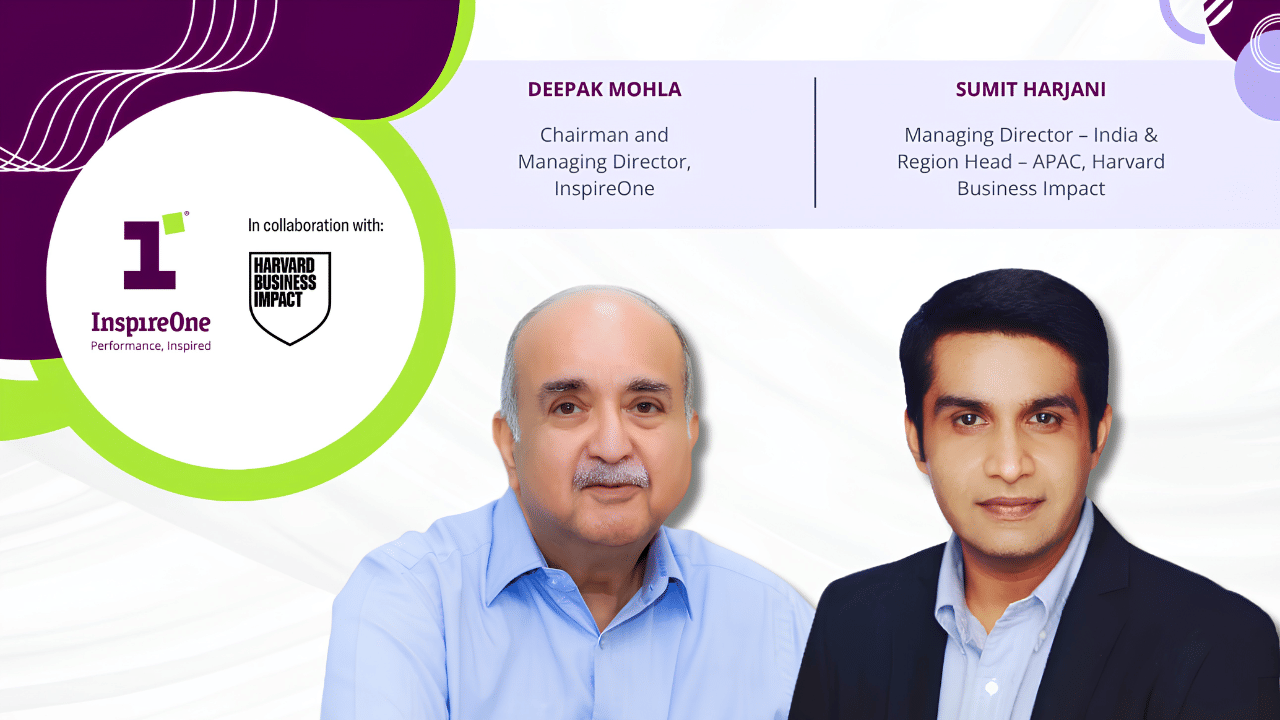
In this People Matters conversation, Deepak Mohla, Chairman and Managing Director, InspireOne, and Sumit Harjani, Managing Director, India and Region Head, Enterprise APAC, Harvard Business Impact, discuss what the study’s findings reveal about the evolving demands on leaders, what they mean for Indian enterprises, and how InspireOne, as Harvard Business Impact’s Distribution Partner in India, is supporting organisations as leadership expectations continue to shift.
Q. Indian enterprise has changed significantly over the past two decades. How has the wider spread of value creation changed what organisations need from leadership development?
Sumit Harjani: Indian enterprise has moved a long way from being centralised and concentrated within a relatively small set of large organisations. Large enterprises remain important, but growth and value creation now extend much deeper into the Indian economic system.
Over the past two decades, businesses have grown across Tier 1 and Tier 2 cities, and a new generation of entrepreneurs and organisations has created a much broader need for professional leadership.
This has expanded the demand for leadership development across more organisations, levels and locations. The need is not simply for more content. Organisations need learning that connects to their business priorities and their leaders' maturity.
Q. How is Harvard Business Impact’s global leadership thinking being translated for the Indian context, and what makes it relevant to organisations here?
Sumit Harjani: Through InspireOne, Indian organisations can access Harvard's leadership thinking in a way that reflects their business priorities, culture and leadership maturity.
Harvard Business Impact brings global research, content and digital learning solutions. InspireOne's role is to support local access and connect those solutions to the leadership priorities organisations are working to address.
Q. How can global leadership research and solutions be adapted to the different contexts and leadership needs of Indian organisations?
Deepak Mohla: For 27 years, InspireOne has worked with organisations across sectors, leadership levels and stages of growth. Our strength lies in our reach, our long-standing customer relationships and our understanding of the challenges organisations face as they scale, transform and navigate change.
Over the years, our partnerships with TACK TMI, Podium, IBM Kenexa and Master O have expanded the global legacy, specialist know-how and digital expertise we can bring to clients. Adding Harvard Business Impact's research-based leadership solutions to this ecosystem of global partnerships was a natural next step.
We also know that a startup has very different needs from a large enterprise, and that first-time managers, middle managers and senior leaders require different development experiences. We therefore bring clients an integrated solution, shaped around their people, their context and the business outcome they need.
Q. What does effective contextualisation look like when applying global leadership thinking to the realities and challenges of Indian organisations?
Deepak Mohla: It begins with the client’s reality.
For example, a middle manager in India may be dealing with growth pressure, team capability gaps, regional diversity, changing customer expectations and transformation priorities at the same time.
So we do not simply bring Harvard content into the room and expect it to work on its own.
We first understand what the organisation is trying to solve. Then we shape the examples, discussions, application tasks and reinforcement around that reality.
That is when global learning becomes practical for Indian leaders.
Sumit Harjani: Contextualization allows leaders to work with HBI ideas through the decisions and challenges they face every day, while preserving the integrity of the underlying research.
Q. How can organisations balance structured leadership capability building with continuous, self-directed learning as development needs evolve?
Sumit Harjani: Harvard ManageMentor helps leaders build practical management capabilities through structured learning. HBR Spark brings Harvard resources, AI-supported guidance and personalised learning pathways into the flow of work.
Organisations can use Harvard ManageMentor for structured capability building and HBR Spark for continuous, self-directed development.
Deepak Mohla: InspireOne helps clients determine who should use each solution, how it connects to other learning experiences and how managers reinforce application.
Q. What leadership priorities are Indian organisations bringing to you most often?
Deepak Mohla: The priorities are very clear.
Organisations want stronger managers. They want leaders who can communicate better, lead change, think commercially, build trust and execute with discipline.
The middle management layer is especially critical because this is where strategy becomes execution.
At the same time, senior leaders need stronger enterprise thinking and transformation readiness. So the need exists across levels, but the design has to be different for each audience.
Sumit Harjani: I would also add adaptability, judgment and scalability.
Harvard Business Impact's 2026 Global Leadership Study found that 80% of respondents see the ability to function effectively amid ongoing change, uncertainty and stress as very or extremely important. It also found that 96% expect leaders to work effectively in human-AI fusion roles.
Yet only 35% say leaders are fully prepared to integrate AI-generated insights, apply judgment and navigate the associated risks. These findings point to leadership development that strengthens adaptability, inquiry and judgment, and can scale across levels, locations and business units.
Q. Many organisations struggle to move from learning access to real adoption. How do you address that?
Deepak Mohla: Leadership development fails when it is reduced to access, completion or usage metrics alone.
Our role is to help organisations move beyond that.
We work with clients on communication, launch, audience segmentation, manager involvement, reinforcement and business application. The aim is not just content consumption. The aim is application and behaviour change.
Sumit Harjani: That implementation focus helps organisations move from learning access to leadership capability.
Q. Finally, what is the larger vision behind this collaboration?
Sumit Harjani: Our study shows that traditional leadership competencies remain necessary, but they are no longer sufficient. Leaders also need adaptability, judgment, comfort with uncertainty and the ability to work where technology and culture intersect.
The vision behind this collaboration is to make research-based leadership development more accessible and scalable for Indian enterprises, so organisations can prepare leaders for today's performance demands and tomorrow's reinvention.
Deepak Mohla: For InspireOne, this collaboration is about helping Indian organisations build stronger managers, more confident leaders and more future-ready cultures.
If we do this well, the outcome will not just be more learning. It will be better-led organisations.
The conversation reflects a broader shift in how Indian enterprises are thinking about leadership development. Building strong managers and deep technical capability remains essential, but leaders are increasingly expected to navigate ambiguity, exercise sound judgment and adapt as the context changes, capabilities that traditional competency models may not fully capture.
For organisations, this means moving beyond leadership development as a question of content or access. The focus must shift towards creating sustained opportunities for leaders to strengthen judgment, adaptability and readiness for a business environment that continues to evolve.
As Harvard Business Impact's distributor for India, InspireOne helps Indian organisations access HBI's research and learning solutions in ways that support their leadership priorities.