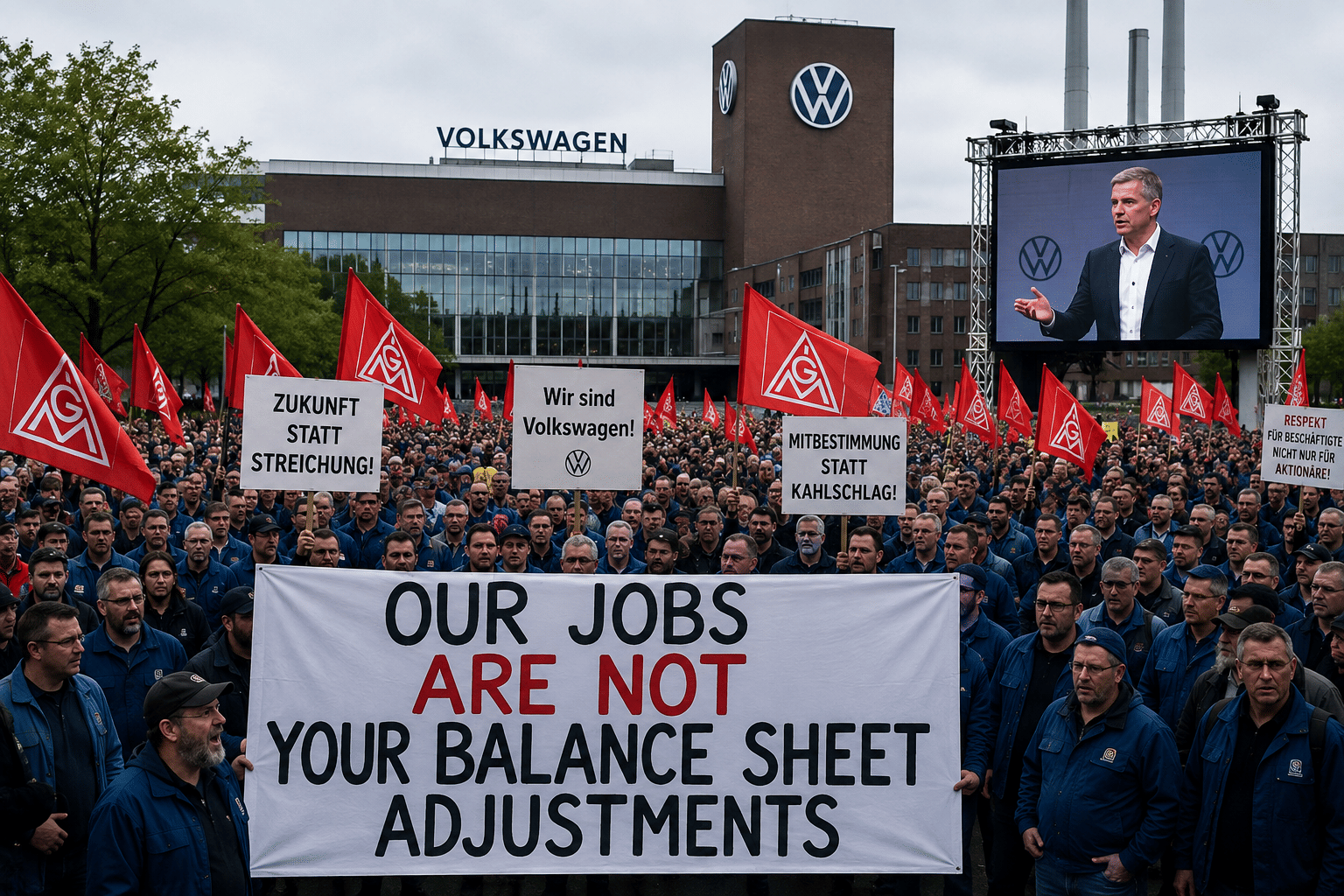
More than 10,000 Volkswagen workers confronted CEO Oliver Blume at the company's Wolfsburg headquarters this week, booing and protesting against a proposed restructuring programme that could lead to significant job losses and factory closures.
The backlash highlights the growing tension between management's push to cut costs and employees' concerns over the future of jobs across Germany and beyond.
The confrontation came during Blume's first public engagement with employees since details of Volkswagen's restructuring plans emerged earlier this year. According to reporting by The Guardian, workers held banners, whistled and shouted slogans, including "Our jobs are not your balance sheet adjustments", as the chief executive defended what he described as the most significant transformation effort in the company's history.
"Our plan for the future is the largest transformation programme in our company's history," Blume told employees. "To make this happen, everyone needs to pull together now."
Cost pressures drive overhaul plans
Volkswagen's leadership maintains that restructuring is essential to secure the long-term future of Europe's largest carmaker.
Blume said one of the programme's objectives is to create sustainable prospects for all manufacturing locations over the next six to 12 months. However, the proposed measures remain subject to approval from Volkswagen's supervisory board, which includes labour representatives, shareholders and the state of Lower Saxony.
Witnesses at the meeting reportedly described discussions as heated.
According to attendees cited by The Guardian, Blume indicated that around half of the expected workforce reductions could occur in Germany, with the remainder spread across Volkswagen's global operations.
Key proposals under discussion
- Potential workforce reductions reportedly estimated at around 50,000 jobs globally
- Voluntary workforce measures including phased retirement and mutual separation agreements
- Restrictive hiring policies and natural attrition
- Possible restructuring across approximately 170 companies worldwide
- Evaluation of future production plans at several German facilities
- Exploration of alternative manufacturing opportunities, including defence-related production and electric vehicle manufacturing
Blume stressed that the figure frequently cited for job cuts should not be viewed as a formal target. Instead, he described it as a theoretical calculation linked to Volkswagen's cost structure.
According to the CEO, Volkswagen's costs are currently about 30% higher than comparable competitors, creating pressure to improve efficiency and competitiveness.
Factory closures remain a contentious issue
Among the most controversial elements of the restructuring debate are potential factory closures.
Blume characterised plant shutdowns as the "last and most costly resort". Yet uncertainty continues to surround several manufacturing sites.
The Osnabrück facility could stop vehicle production as early as next year. Meanwhile, facilities in Emden, Zwickau, Neckarsulm and Hanover currently lack confirmed vehicle production plans beyond 2030.
The prospect of closures has drawn strong resistance from employee representatives.
Daniela Cavallo, head of Volkswagen's works council, said factory sites remain an integral part of the company's future and criticised management's handling of the restructuring discussions.
According to extracts from her remarks shared with the media by the works council, Cavallo said trust in Volkswagen's executive leadership had been damaged. She also criticised what she described as a lack of clarity around management's plans.
A company under mounting pressure
Volkswagen's restructuring debate comes at a difficult moment for the automotive industry.
The company is facing multiple challenges simultaneously:
- Intensifying competition from Chinese automakers in Europe
- Declining sales in the Chinese market
- US tariff pressures
- Falling profitability
- Persistent overcapacity across European manufacturing operations
Blume recently described Volkswagen's situation as "more than critical".
Previous efficiency measures have delivered only limited results. The company has already reduced costs at its German factories by an average of 20% over the past year, but management believes deeper structural changes are necessary.
The chief executive has repeatedly stated that Volkswagen has become too large, too slow and too complex to compete effectively in a rapidly changing market.
Workforce relations face a crucial test
The employee backlash in Wolfsburg marks the beginning rather than the end of discussions around Volkswagen's future.
Blume is scheduled to attend eight additional works council meetings across Germany, including stops in Braunschweig, Emden, Zwickau, Chemnitz, Dresden, Kassel-Baunatal, Salzgitter and Hanover.
The meetings are expected to shape negotiations between management and labour representatives over the coming months.
For Volkswagen, the challenge is balancing cost competitiveness with workforce stability. For employees, the concern is whether transformation can be achieved without sacrificing jobs and production capacity.
The outcome of those discussions could determine not only Volkswagen's restructuring strategy but also the future of one of Germany's most important industrial employers.