







AI & Emerging Tech
12 AI-powered workplace practices becoming standard across global organisations





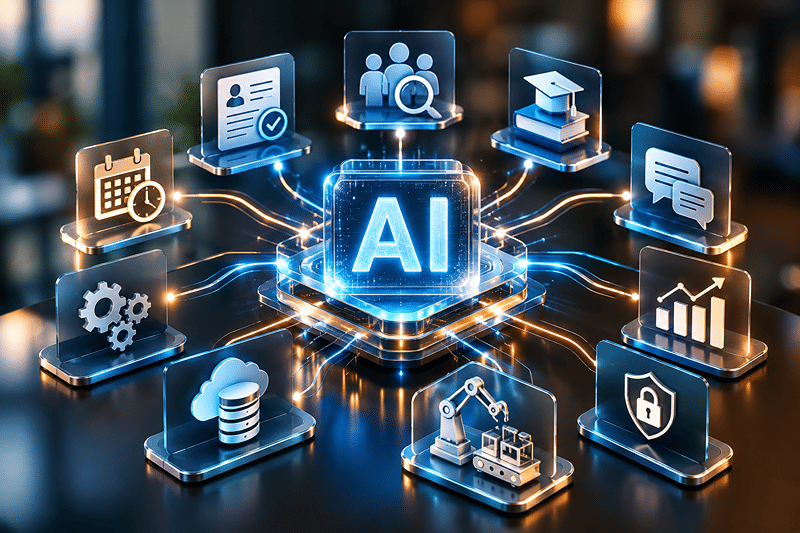
As enterprise AI adoption matures, organisations are embedding intelligent systems into recruitment, learning, operations, compliance and decision-making workflows.
Artificial intelligence is rapidly moving beyond pilot programmes and experimental use cases. Across sectors, organisations are increasingly integrating AI into core business processes, reshaping how employees work, collaborate and make decisions.
What was once limited to innovation teams is now becoming part of everyday workplace operations. According to research from organisations including McKinsey, Deloitte, PwC, Gartner, and the World Economic Forum, companies are increasingly deploying AI to improve productivity, streamline workflows, strengthen decision-making and enhance employee experiences.
The shift reflects a broader evolution in workplace technology. Rather than replacing entire functions, many organisations are using AI to automate repetitive tasks, augment human expertise and create more efficient operating models.
AI becomes part of everyday work
Enterprise adoption is increasingly focused on practical applications that deliver measurable business outcomes.
Several workplace practices that were considered emerging trends just a few years ago are now becoming standard capabilities across industries.
Key areas of adoption include:
- Talent acquisition and workforce management
- Employee learning and development
- Software engineering and product development
- Operational efficiency and workflow automation
- Compliance, governance and cybersecurity
Below are 12 AI-powered workplace practices gaining traction across industries.
How AI is transforming talent and workforce management
1. Automated resume screening
Recruiters increasingly use AI-powered applicant tracking systems to evaluate large candidate pools more efficiently.
These systems analyse resumes against predefined skills, experience requirements and job specifications, helping talent teams prioritise suitable candidates for further review.
2. Predictive retention analytics
Organisations are using machine learning models to identify potential turnover risks before employees resign.
These systems analyse workforce data, engagement trends, attendance patterns and other indicators to help HR teams intervene proactively when retention risks emerge.
3. AI-driven onboarding support
Many employers now deploy conversational AI assistants to guide new hires through onboarding activities.
These tools help employees complete documentation, access training resources, understand company policies and navigate workplace systems more efficiently.
Productivity tools move into the mainstream
4. Automated meeting summaries
AI-powered meeting assistants have become increasingly common across corporate workplaces.
These tools can transcribe conversations, generate summaries, capture key decisions and assign action items, reducing administrative workloads for employees.
5. Intelligent communication management
Email and collaboration platforms are increasingly incorporating AI features to help employees manage information overload.
Capabilities often include message prioritisation, draft generation, task identification and contextual recommendations.
6. Personalised learning pathways
Organisations are using AI to create customised learning experiences based on individual employee needs.
Learning platforms can assess skill gaps and recommend relevant training modules, certifications and development opportunities aligned with career objectives.
AI reshapes specialised and technical functions
7. AI-assisted software development
Generative AI coding assistants are becoming common tools within engineering teams.
Developers use these systems to generate code suggestions, identify errors, automate documentation and accelerate development cycles while maintaining human oversight.
8. Synthetic data creation
Industries handling sensitive information are increasingly exploring synthetic data generation for testing and research purposes.
AI-generated datasets allow organisations to conduct experimentation and model development while reducing exposure to real customer or patient information.
9. Predictive maintenance systems
Manufacturing, logistics and industrial companies are combining AI with connected sensors to anticipate equipment failures.
By identifying anomalies before breakdowns occur, organisations can reduce downtime and improve operational reliability.
Governance and risk management gain new capabilities
10. Real-time compliance monitoring
Companies are increasingly deploying AI systems to review large volumes of documentation and transactions continuously.
These tools can help identify potential compliance issues, policy violations and operational risks more quickly than traditional manual reviews.
11. Augmented project management
Project management platforms are increasingly incorporating predictive analytics and AI-driven recommendations.
These capabilities help managers forecast timelines, identify resource constraints and anticipate delivery risks before they affect outcomes.
12. AI-enhanced cybersecurity operations
Cybersecurity teams are relying more heavily on machine learning systems to identify unusual network activity.
AI-powered threat detection tools can analyse vast amounts of security data and flag potential threats faster than traditional approaches.
Adoption comes with responsibility
While AI adoption continues to accelerate, organisations are also facing growing expectations around governance, transparency and responsible deployment.
Research from global consulting firms and industry analysts consistently highlights the importance of human oversight, data quality and ethical safeguards when integrating AI into workplace processes.
Many employers are therefore adopting a hybrid model where AI handles repetitive and data-intensive tasks while employees remain responsible for judgement, strategy and relationship-driven decisions.
The next phase of workplace AI
The future of workplace AI is increasingly centred on augmentation rather than full automation. Organisations are focusing on technologies that help employees work more effectively rather than simply reducing headcount.
As AI capabilities mature, the competitive advantage is likely to come not from using AI itself, but from how effectively organisations integrate these tools into everyday workflows, decision-making processes and employee experiences.
Topics
Author
Loading...