







AI & Emerging Tech
Reinventing Work: An exclusive look at Accenture's AI-first talent strategy





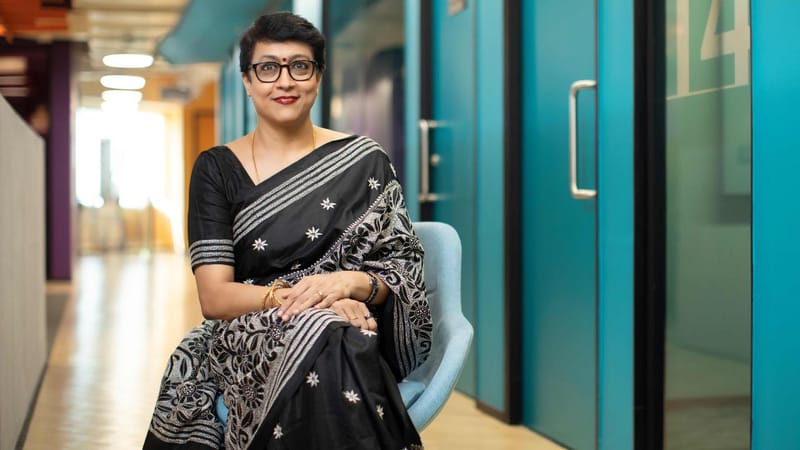
As a talent-led organisation, we continually invest in helping our people develop future-ready skills and achieve their aspirations, believes Lakshmi C.
Artificial Intelligence (AI)-led reinvention is not just about efficiency; it's about unlocking a new performance frontier for businesses and their people. The key to this transformation is a commitment to talent. Accenture, globally invests over $1 billion annually in learning and development to help its people build future-ready skills. This includes training more than 500,000 employees in the fundamentals of AI. The organisation is also strategically growing its data and AI workforce, which currently stands at 75,000, with a clear goal to reach 80,000 by the end of FY 2026.
In this exclusive People Matters interview, Lakshmi C, Senior Managing Director and CHRO at Accenture in India, shares her unique perspective on the profound impact of AI on the modern workforce. She offers a clear vision of how organisations must reimagine work to integrate human and machine capabilities effectively. The leader discusses Accenture's strategies for leveraging AI not just for automation, but for creating a future-ready, high-performance culture. The conversation also delves into the essential "human skills" needed in an AI-driven world, the evolving role of the Chief Human Resources Officer (CHRO), and how the company is preparing its massive Indian workforce for an era of continuous transformation. Edited excerpts
AI is fundamentally reshaping the workforce. From your vantage point, what key changes are essential for organisations across industries to manage the integration of human and machine capabilities effectively?
Generative AI is transforming organisations more profoundly than any other technology in recent times – transforming how we deliver value, drive innovation, and create better experiences for our people and clients.
To truly harness this, organisations must reimagine work itself – redesigning end-to-end processes and workflows, and building resilient cultures that are continuously learning and adapting to this ongoing change. Leaders need to be deeply conversant with the technology so they can scale responsibly and inspire confidence in their people. At the heart of this transformation is talent. We need to develop agile workforce models that anticipate changing roles, foster cross-functional collaboration, and most importantly, actively involve people in the change journey. Transparency and trust will be key.
Equally important is preparing talent through continuous reskilling and upskilling so they have market-relevant skills in an AI-enabled world. Giving people access to the right tools and the autonomy to innovate responsibly with them will unlock both confidence and creativity.
Ultimately, it's about ensuring that human potential and machine intelligence work together to shape a more inclusive and future-ready workplace.
AI is often discussed in terms of its potential to automate jobs. From your perspective, how is Accenture leveraging AI to reinvent work, and what measures are you taking to ensure that employees feel equipped and confident to work alongside these new technologies?
AI-powered reinvention is not just about automating jobs to increase efficiency; it is about unlocking a whole new performance frontier for businesses and their people. We are leveraging AI to make functions across the business more strategic, intuitive, and impactful, enabling growth and agility while also improving employee experiences in a rapidly evolving world.
However, the success of AI-led reinvention depends as much on our people as on the technology. As a talent-led organisation, we continually invest in helping our people develop future-ready skills and achieve their aspirations. Globally, we spend over $1 billion annually on learning and development, and more than 500,000 of our people have already been trained in the fundamentals of AI. We have also increased our data and AI workforce to approximately 75,000, continuing to progress against our goal of 80,000 by the end of FY 2026.
We are leveraging AI to enable our people with personalised learning that is contextual and role-based, making training faster, relevant, and actionable.
Central to our strategy is enabling a cultural shift where AI is embraced as a trusted collaborator and our people are encouraged to leverage AI tools as part of their day-to-day work, integrating their judgment with its outputs, and continuously learning alongside these systems.
Our goal is clear: to create a future-ready workforce that feels confident and empowered working with AI.
The skills gap is a perennial challenge, but AI has accelerated it exponentially. What are the universal "human skills" that you believe will become most critical across sectors, and how can organisations proactively develop these in their employees?
Yes, with technology continuing to evolve at the pace it is, skill gaps will remain a perennial challenge. What organisations need to ensure they hire for and retain are the human skills you refer to, including learning agility, critical thinking, adaptability to new ways of working, resilience, emotional intelligence, and empathy. Most important, in my view, is ethical reasoning - humans bring their judgement and innovation to technology-led work. The ability to build trust and meaningful connections becomes a largely human responsibility.
Organisations can develop these skills by connecting people with mentors, coaches and leaders who nurture these behaviours through a culture of continuous feedback. By thoughtfully integrating human connection, purposeful leadership, and intelligent technology, organisations can empower their people to grow, innovate, and lead effectively through change.
Accenture has a massive workforce in India. How do you build a unified, high-performance culture across such a diverse and distributed employee base?
With over 350,000 people in India, our strength lies in our diversity of backgrounds, perspectives, and skills, which creates a culture where people can thrive. Building a unified, high-performance culture across a large and distributed workforce requires an intentional approach. We are achieving this by empowering our people to innovate, collaborate, and drive results.
Each one of our people has clearly identified priorities aligned to the business strategy. Our performance management system, along with our AI-powered "Feedback Coach", enhances feedback quality with real-time personalised suggestions. Our career development framework is designed to empower our people to achieve their aspirations, whether that's by moving into a new role, developing new skills, or taking on additional responsibilities. Our people can, at any time, view available opportunities, raise their hands, and participate in an internal careers marketplace.
Our front-line supervisors play a critical role in driving this high performance, and we empower them with the tools, training, and resources they need to succeed. Supervisors are encouraged to take an active role in career development conversations with their team members, helping to identify areas for growth and development.
Further, we foster a culture of high performance by recognising and rewarding employees who demonstrate exceptional skills and impact.
Employees, particularly younger generations, are increasingly evaluating companies based on their commitment to social purpose and environmental sustainability. How can organisations and HR leaders actively drive and embed sustainability into the corporate culture?
We are committed to fostering a workplace culture that not only reflects our values but also empowers our people to drive meaningful change. By integrating our ESG goals into our daily operations, we align individual purpose with organisational objectives, creating 360-degree value.
Through initiatives like 'Season of Impact', this year, over 81,000 of our people globally contributed 75,000 hours to various social and environmental causes. Additionally, our 'Skills to Succeed' initiative in India has had a significant impact, upskilling disadvantaged communities to enhance their employment and entrepreneurship opportunities.
When people see their values reflected in the workplace and feel they have a role in driving change, it builds a responsible and deeply resilient culture.
Looking ahead, what do you believe will be the single most defining characteristic of a successful workplace in the next 5-10 years, and how is Accenture preparing for it today?
The single most defining characteristic of a successful workplace will be its ability to learn, adapt, and evolve continuously. At Accenture, we have always prioritised investments in our people's learning, and we continue to do so across industry, function, technology, and professional skills. We are being very intentional about helping them SHIFT so they build the Skills they need to stay relevant, embrace a tech-led, Human-enabled mindset, lead with Influence, have the Fortitude to stay the course through these challenges, and above all, commit to doing it Together.
By focusing on skilling and reskilling, we're building a workforce that remains relevant, marketable, and ready to drive business outcomes in an AI-driven world. This culture of continuous skilling is also central to building resilient organisations. The future of work will be shaped by technological advancements and by prioritising skilling and creating a culture of constant learning, we are positioning Accenture for long-term success and enabling our clients to achieve their business objectives in a rapidly changing world.
How is AI transforming the HR function?
At Accenture, AI has always been a powerful enabler for the HR function, offering predictive insights to identify skill gaps, future talent needs, and even areas of attrition risk. With Gen AI and agentic, there are many more opportunities for integrating them into talent processes, creating better experiences, efficiencies, and capacity for HR professionals to connect, engage, and shape talent strategies.
To share a few examples, we have integrated gen AI and agentic AI across workflows to enhance routine but important tasks, making them more efficient. Our feedback coach helps our people supervisors enhance the quality of their feedback with personalised suggestions. Our AI-powered staffing agents are revolutionising career development and talent management by providing our people with personalised suggestions on open roles that align with their skills and aspirations and analysing data, including skills, experience, and career goals.
As we continue to leverage the power of AI in HR, we are not just automating processes – we are reimagining and reshaping the future of work.
How has the CHRO's role evolved from being a traditional HR leader to a strategic partner driving enterprise-wide transformation? What is the most critical skill for a CHRO today? How has your role evolved in recent years?
To drive meaningful transformation, today's CHROs and HR teams must strike a balance between empathy and strategic insight, leading with both compassion and clarity.
In my view, the most critical skill for a CHRO today is the ability to connect human potential with technology and business strategy. This means leveraging data and AI to inform talent decisions, reimagining work to drive agility, and fostering a culture where people feel empowered to continuously adapt and grow.
For me personally, the role has evolved to being not just about HR, but about reinvention at scale — shaping how we unlock growth, embed innovation, and build inclusive cultures that put people at the centre. The CHRO today must be a business leader, a culture shaper, and a change agent — helping organisations and their people thrive in an era of continuous reinvention.
Topics
Author

Loading...