







AI & Emerging Tech
What does consistency look like in an AI- and automation-driven workplace? Tina Vas answers
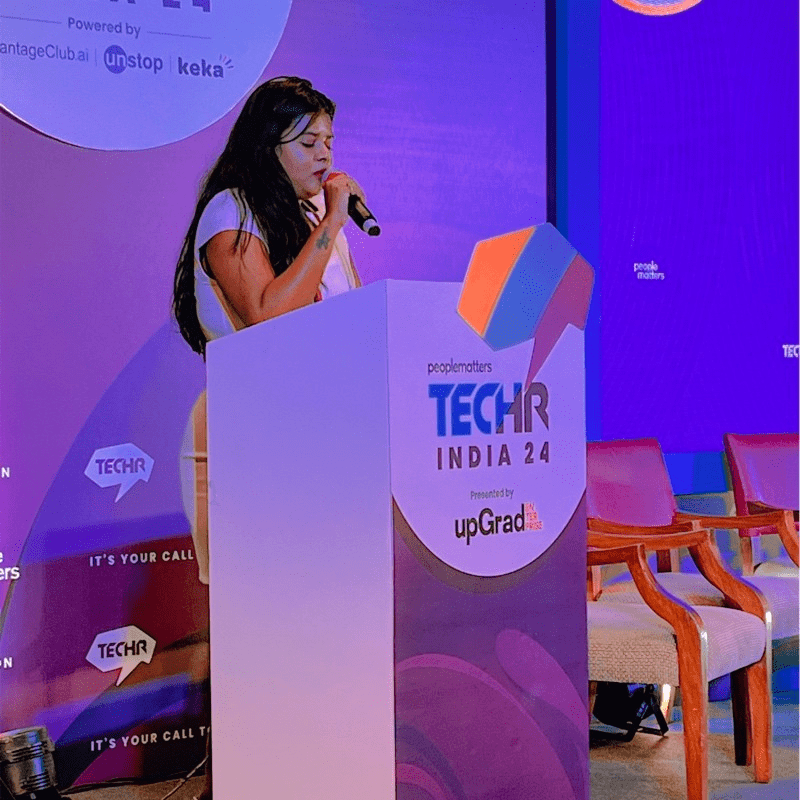






As organisations scale across geographies and adopt automation, consistency is becoming less about standardised processes and more about operating model design, data-driven leadership, and central stewardship, says Chief Human Resources Officer at Sagility.
Maintaining consistency has long been a priority for large service organisations. Yet as businesses expand across geographies, digitise operations, and embed automation into workflows, the challenge is becoming more complex.
According to Tina Vas, Chief Human Resources Officer at Sagility, the issue is no longer simply about whether processes are standardised. The real challenge lies in ensuring that quality, decision-making, and outcomes remain aligned across different operating environments.
In an interaction with People Matters, Vas outlined how organisations are rethinking delivery structures, why managers are evolving from supervisors into orchestrators, and what operating models are needed to balance consistency with agility.
Why scale makes consistency harder
As organisations grow, maintaining consistent output quality becomes increasingly difficult even when formal processes remain unchanged.
Vas said the challenge stems from the variability of execution environments rather than the absence of structure.
She pointed to several factors that can influence how work is delivered:
- Cultural context
- Talent maturity
- Client expectations
- Local operating conditions
These differences can create subtle variations in how standardised processes are interpreted and executed.
As a result, she said, standardisation of processes alone is no longer sufficient to guarantee uniform outcomes.
To address this, organisations are increasingly moving towards delivery structures built around a central point of accountability.
"While execution may be distributed across geographies, the ownership of quality, decision-making, and overall outcomes is centralised to ensure consistency," Vas said.
This approach reflects a broader shift in organisational design. Rather than treating people, processes, and technology as separate components, organisations are seeking to integrate them into a single operating system focused on client outcomes.
Vas noted that consistency is increasingly being driven through:
- Central stewardship of quality and outcomes
- Integrated operating models
- Client outcome-focused delivery structures
- Flexible execution supported by governance
In this model, consistency comes less from rigid adherence to process and more from alignment around a shared definition of quality.
The changing role of managers in a digital workplace
The growth of digitisation and automation is also reshaping how organisations maintain consistency.
Historically, managers and supervisors acted as the primary custodians of quality. Their responsibilities included ensuring adherence to processes, monitoring outcomes, coaching teams, and maintaining common standards of behaviour and judgment.
"Consistency has been driven through a combination of process discipline, outcome monitoring, and the ability of managers to coach and calibrate their teams," Vas said.
Automation is changing that dynamic.
Managers now have access to significantly richer operational data and insights, enabling them to identify deviations earlier and intervene more effectively.
According to Vas, this is creating a fundamental shift in the nature of managerial work.
"As a result, the role of managers is evolving from one of oversight to one of orchestration."
Rather than relying primarily on manual supervision, managers are increasingly expected to design and manage systems that create consistency by default.
Their focus is moving towards:
- Interpreting operational data
- Managing exceptions
- Reinforcing decision-making guardrails
- Building team capability
- Supporting complex judgment-based work
The implication is that consistency becomes embedded within the system itself.
"In this new paradigm, consistency is no longer enforced through control alone, but is embedded into the system through a combination of technology, thoughtful design, and informed leadership," Vas said.
Rethinking operating models for consistency and agility
The challenge for large healthcare and service organisations is not simply maintaining consistency. It is doing so without compromising responsiveness.
Vas believes this requires a different approach to organisational design.
She said large service organisations need to move towards matrix structures that balance multiple dimensions of accountability while remaining flexible enough to respond to changing demands.
These structures typically bring together three interconnected dimensions:
- Geography
- Domain expertise
- Client alignment
The objective is to ensure decisions reflect both global standards and local realities.
However, Vas emphasised that matrix models only work when governance structures are clearly defined.
"The effectiveness of this approach depends on clearly defined charters, governance mechanisms, and alignment across leadership layers."
She added that organisations must establish clear decision rights and responsibilities across each dimension to avoid ambiguity and fragmentation.
Leadership alignment is equally important. Goals across geographies, functions, and client teams must connect directly to broader business objectives.
Vas also highlighted the importance of integrating strategic partners and cross-functional teams into the operating model. Combined with metrics-driven frameworks and support from people functions, this creates a common lens for evaluating performance while preserving execution flexibility.
The aim, she said, is to create organisations that are globally consistent in intent but locally adaptive in delivery.
"Agility is not achieved by loosening structure, but by designing systems that are inherently responsive and interconnected."
Consistency as a design challenge
The conversation reflects a broader shift underway across large enterprises.
As automation becomes more embedded in day-to-day operations, consistency is becoming less dependent on individual supervision and more dependent on organisational design.
For leaders, the challenge is no longer simply standardising processes. It is creating systems, governance structures, and decision-making frameworks that can deliver consistent outcomes across diverse environments while remaining adaptable to change.
In that context, consistency is increasingly becoming a function of stewardship, orchestration, and operating model design rather than process compliance alone.
Topics
Author
Loading...