







Leadership
“Do not do any learning if it doesn't lead to earning”: Allwyn Dsilva on the future of L&D





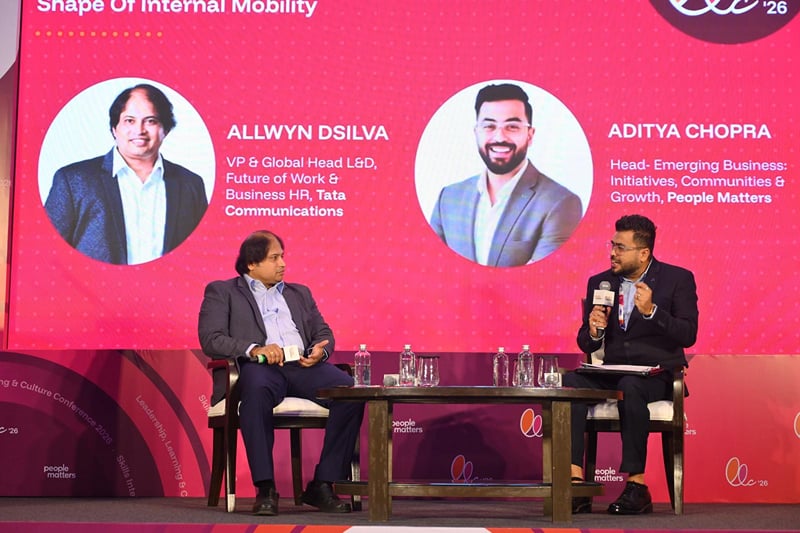
At People Matters LLC 2026, Tata Communications' Allwyn Dsilva outlined why learning must be tied directly to career outcomes, internal mobility and business value, rather than content consumption or training completion.
Learning has long been measured by participation rates, course completions and certification numbers. Allwyn Dsilva believes those metrics are no longer enough.
Speaking at the People Matters Leadership, Learning & Culture Conference (LLC) 2026, Dsilva, Vice President and Global Head of Learning & Development, Future of Work and Business HR at Tata Communications, challenged organisations to rethink the purpose of learning. For him, the real test of any learning investment is whether it creates tangible career opportunities for employees and measurable value for the business.
"Do not do any learning if it doesn't lead to earning," he said during a fireside conversation with People Matters' Aditya Chopra.
The statement captured a broader shift taking place across corporate learning functions. As organisations invest in skills intelligence, AI-driven learning platforms and workforce transformation programmes, the focus is increasingly moving from learning activity to career progression and workforce mobility.
Why career outcomes matter more than learning activity
Dsilva's central message was straightforward. Employees engage with learning when they can see a clear connection between capability development and future opportunities.
Rather than positioning learning as an isolated function, Tata Communications has sought to connect it directly with career pathways and internal mobility. According to Dsilva, employees are more likely to invest in developing new capabilities when they understand how those skills can help them move into new roles or unlock future growth opportunities.
The objective is not simply to encourage learning. The objective is to create visibility into what comes next.
This philosophy has shaped Tata Communications' approach to skills intelligence over the past two years, with the company building systems designed to help employees identify career options, understand skill requirements and prepare for future roles.
Internal mobility has become a strategic priority
A significant part of the discussion focused on internal talent movement and its growing importance for organisations navigating rapid change.
Dsilva revealed that 65% of hiring at Tata Communications now takes place internally, highlighting the scale at which the organisation is leveraging existing talent pools rather than relying solely on external recruitment.
The company has developed mechanisms that allow employees to explore career opportunities across different functions and business areas while building the skills needed to make those transitions.
Key elements highlighted during the session included:
- Career pathway recommendations linked to future opportunities
- Visibility into both vertical and horizontal career moves
- AI-enabled support for role preparation and career planning
- Greater employee ownership of career decisions
The emphasis, according to Dsilva, is on helping employees navigate growth opportunities within the organisation before looking elsewhere.
His remarks reflected a growing recognition across industries that internal mobility is becoming a critical lever for retention, workforce agility and skills deployment.
Using AI to support movement, not replace learning
While AI formed an important part of the conversation, Dsilva positioned technology as an enabler rather than the centrepiece of workforce transformation.
He explained how Tata Communications has integrated AI into career navigation processes, including interview preparation for internal opportunities. The organisation has developed tools that help employees practise for internal interviews by simulating hiring-manager interactions and providing tailored preparation support.
The goal is not simply to automate learning experiences. It is to remove friction from internal movement and make career progression more accessible.
This approach aligns with a broader theme emerging across LLC 2026. Skills intelligence creates value when it influences employee decisions, talent deployment and workforce outcomes.
Technology, in this context, becomes a mechanism for connecting employees with opportunities rather than another standalone learning platform.
Building the foundations before adding AI
Dsilva also offered a practical message for organisations eager to invest in AI-driven learning solutions.
Before deploying sophisticated AI capabilities, organisations need strong foundations. Skills architectures, career frameworks and internal mobility systems must already be in place if AI recommendations are to deliver meaningful outcomes.
Without those structures, even advanced technologies risk generating activity without impact.
The discussion highlighted how Tata Communications approached this challenge by creating a broader ecosystem that connects skills, learning, career pathways and talent movement. AI was introduced as a layer that enhanced existing capabilities rather than replacing them.
For learning leaders, the implication was clear. Technology should accelerate well-defined talent strategies, not compensate for their absence.
L&D must spend more time in the business
One of the most direct observations from the session concerned the evolving role of learning leaders.
Dsilva encouraged L&D professionals to deepen their understanding of business priorities and organisational challenges rather than limiting their focus to traditional learning metrics.
"Spend less time with HR, spend more time in business," he said, reinforcing the idea that learning functions must increasingly operate as strategic business partners.
The comment reflects a wider shift within the profession. As workforce transformation becomes more closely linked to business performance, learning leaders are being asked to contribute to talent deployment, capability planning and organisational growth.
Success is becoming less about delivering training programmes and more about enabling business outcomes.
The next chapter for learning
The conversation at LLC 2026 reinforced a broader change underway across corporate learning.
For years, organisations focused on building content libraries, expanding course catalogues and increasing participation levels. Today, the emphasis is shifting towards helping employees move, grow and create value through the skills they develop.
Dsilva's message was ultimately a challenge to rethink how learning success is measured. Completion rates and certifications may remain useful indicators, but they are no longer sufficient on their own.
The future of L&D, he suggested, lies in connecting learning directly to opportunity. When employees can see a pathway from skill development to career advancement, learning becomes more meaningful for individuals and more valuable for organisations.
As businesses continue to invest in skills intelligence and workforce transformation, the organisations that succeed may be those that treat learning not as an end in itself, but as a catalyst for mobility, growth and business performance.
Author
Loading...