







Leadership
From efficiency to experimentation: Rethinking learning, leadership & culture




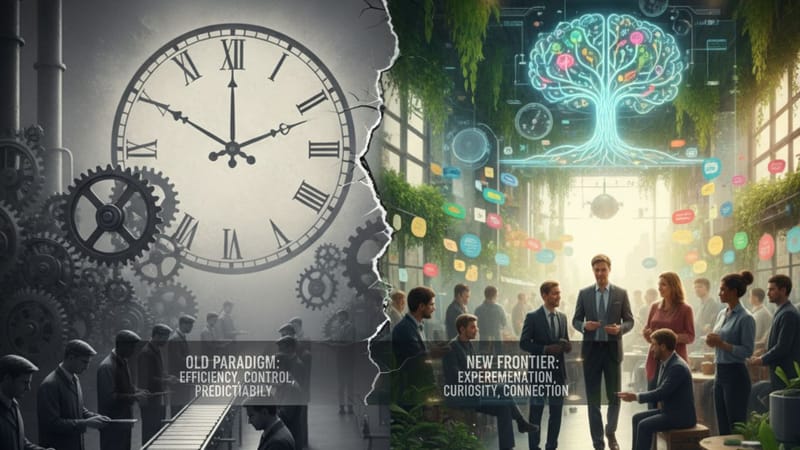
From control to curiosity, today’s future-ready organisations must move beyond efficiency and embrace bold experimentation in leadership, learning & culture.
For more than a century, organisations have worshipped at the altar of efficiency. Taylorism and industrial-era thinking gave us processes that prized predictability, repeatability, and control.
The measures of a successful organisation were always defined by the same questions: How streamlined are the processes? How optimised is the workforce? How predictable are the outcomes? Efficiency gave us scale, speed, and consistency. But it also narrowed our imagination.
Most modern workplaces still resemble finely tuned machines: optimised for output, engineered for scale, and measured by their ability to reduce friction. And while efficiency has brought us much, it has also constrained our ability to dream differently.
Today, the world is anything but predictable. Economic shocks, technological disruption, and shifting social expectations collide in ways that defy traditional playbooks. In this environment, efficiency alone is no longer enough. What we need instead is something far more dynamic: experimentation.
Experimentation is not about reckless trial and error. It is about cultivating the capacity to adapt, to question, and to reinvent. It is about leaders who connect rather than control, teams that thrive on curiosity, and cultures that evolve like living organisms.
What we need today is a new frontier of work: a move from rigid efficiency to bold experimentation.
The New Currency: Curiosity, Connection, and Culture
Experimentation doesn’t mean abandoning discipline or structure. It means designing systems of leadership, learning, and culture that are fluid enough to adapt, human enough to connect, and resilient enough to endure.
Leadership beyond authority: The leaders who will define the next decade aren’t those who bark orders from the top but those who connect with empathy, navigate uncertainty with agility, and inspire collective ownership. Authority no longer comes from titles but from trust.
Learning beyond playbooks: In an era where AI knows more than any individual, the differentiator is not knowledge but curiosity. Teams that obsess over questions rather than answers will outpace those who cling to best practices. The future belongs to the learners, not the knowers.
Culture beyond slogans: Culture is no longer about lofty values painted on office walls. It is about creating organisational ‘DNA’ that adapts like a living organism, resilient under pressure, inclusive by design, and courageous enough to experiment with new ways of working.
This shift doesn’t just reshape organisations; it reshapes how people experience work itself.
Redefining Progress in the Age of Uncertainty
The old metrics of success: efficiency ratios, quarterly outputs, headcount utilization, fail to capture the human dimensions that matter most today. Progress in a world of experimentation looks different:
A team that pivots gracefully when a market shifts.
A culture where failure isn’t a scarlet letter but a story shared and learned from.
A workplace where creativity, inclusivity, and emotional intelligence are as valued as technical skills.
A balance between technology and authenticity, where AI handles the routine and humans focus on what only humans can do.
The true productivity paradox is this: the more we chase efficiency at all costs, the less adaptable we become. Experimentation, on the other hand, may feel slower or riskier in the short term but it builds the resilience needed to thrive in the long run.
The Brave New Work Ahead
The big questions of our time: Will we work less or more? Will AI erase or enhance human contribution? Will leaders cling to control or embrace connection? - don’t have easy answers. And that’s the point.
The organisations that will lead the future are those willing to experiment with new forms of leadership, learning, and culture. They will test four-day workweeks, not because they’re trendy but because they challenge assumptions about productivity. They will design learning ecosystems that celebrate curiosity as much as outcomes. They will cultivate cultures that evolve like software, updating continuously as contexts shift.
The journey from efficiency to experimentation is not about abandoning what worked in the past, it’s about daring to imagine what’s possible in the future.
Because the next era of work will not be defined by how efficiently we run our machines, but by how courageously we evolve as humans.
Where Ideas Become Action: The LLC Conference
And this shift, from efficiency to experimentation, can’t happen in theory alone. It needs spaces where leaders, learners, and organisations come together to wrestle with tough questions, share what’s working, and imagine what’s next.
The People Matters Leadership, Learning & Culture (LLC) Conference is one such space. It brings together voices from across industries and generations to explore how leadership rooted in connection, learning driven by curiosity, and cultures designed for resilience can shape the future of work.
In many ways, the conference itself is a living experiment: open, dynamic, and human at its core. Not just refining what work has been, but daring us all to co-create what it can become.
The future of work is not written, it’s waiting to be imagined. The LLC Conference is where that imagination begins.
Author
Loading...