







Leadership
Inside the TechHR India 2026 experience: Building what others will inherit






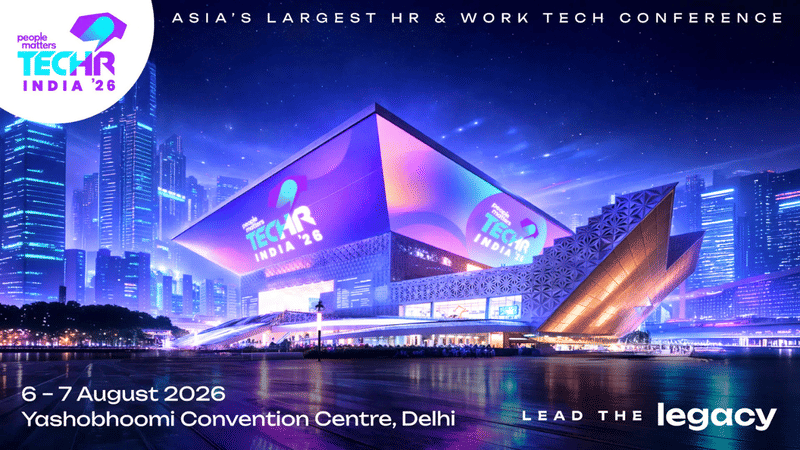
From pioneering HR tech conversations to AI-led transformation, TechHR India’s 13-year journey reflects how HR has evolved—and what today’s leaders must build for tomorrow.
Thirteen years is a long time in the world of work.
In 2014, when People Matters TechHR India opened its doors, social media, gamification, crowdsourcing and mobile-first experiences were still emerging ideas in the workplace. Today, artificial intelligence is reshaping jobs, organisations are industrialising AI and leaders are grappling with a more fundamental question: how do we ensure technology creates growth without losing the human edge?
The questions have changed. The technology has changed. The workplace has changed.
But one idea has remained central to People Matters TechHR India: the future of work is not something to wait for. It is something leaders build.
As TechHR India enters its 13th year this August, that philosophy comes alive through its 2026 theme, ‘Lead the Legacy’. It is less a look back at a conference’s journey and more a reflection on what the HR community has built together, and what today’s leaders will leave behind for those who follow.
From a conference to a community
TechHR India began in 2014 at a time when HR technology was still finding its place in the enterprise. Yet the inaugural conference was already experimenting with ideas that would later become defining features of the workplace.
The 2014 edition of the conference brought together more than 600 delegates and introduced an experience built around social interaction, gamification, crowdsourcing and mobile technology. The TechHR app enabled participants to connect with speakers and fellow delegates, while the #TechHR14 hashtag generated more than 2,000 tweets and over four million impressions in a month.
The design was intentional. TechHR was not simply asking HR leaders to discuss the future, it was allowing them to experience some of it.
Gamification turned participation into an active part of the conference experience. Leaderboards rewarded delegates for sharing, commenting and connecting, while simulation exercises put teams in the position of persuading a C-suite audience to invest in technology.
Crowdsourcing made the audience part of the conversation. Delegates voted through the app, participated in debates and contributed to sessions rather than simply listening from the sidelines.
The underlying proposition was simple but ahead of its time: technology could create a multiplier effect when people were given the tools to connect, collaborate and contribute.
It was also an early expression of a philosophy that would define TechHR over the years: the future has to be distributed, experienced and built collectively.
When HR and technology debated who needed whom
If 2014 demonstrated what technology could enable, TechHR 2015 went deeper into the question of what technology meant for HR.
The Big Debate asked a deceptively simple question: “Does HR need technology or technology need HR?”
The argument exposed a tension that continues to sit at the heart of HR transformation today.
The pro-HR side argued that HR existed before technology and that technology was ultimately an equaliser, while people remained the differentiator. The opposing view challenged HR to confront a changing world in which technology was increasingly connecting people and reshaping how work happened.
The debate was spirited, sometimes provocative and memorable enough to leave its mark, including Anand Pillai’s now-remembered “kar ke dikhao” remark.
But beneath the theatre was a serious question: who owns transformation? It was a question TechHR would continue to revisit, from different angles, as technology moved from being an HR enabler to becoming a fundamental part of business strategy.
Then the world reset
Few moments tested that philosophy like 2020.
The pandemic did not simply accelerate digital transformation. It dismantled assumptions about where work happened, how teams collaborated and what organisations needed from their people.
At a time when businesses were moving billions of employees to remote work and leaders were confronting unprecedented uncertainty, People Matters TechHR 2020 became a five-day virtual conference themed ‘AdaptableHR: The Great Reset’.
The format itself reflected the moment. The conference had moved from a physical gathering to a virtual experience, just as organisations everywhere were being forced to rethink their operating models.
More importantly, the agenda moved beyond responding to disruption. It asked leaders to think about the now and the next.
How could organisations manage distributed workforces while keeping people safe and productive? How would culture, leadership and engagement need to change? What would sustainable talent strategies look like? How could organisations restructure, reskill and reboot HR for the organisation of tomorrow?
And where would technology fit into that new equation? The questions were grouped around three ideas: AdaptableNow, AdaptableNext and AdaptableTech, reflecting the reality that the future could not be separated from the immediate challenges of the present.
TechHR 2020 was, in many ways, a defining moment for the conference itself. It demonstrated that when the playbook disappears, the role of a leadership community is not to pretend it has all the answers. It is to create the space to experiment, learn and build them together.
From adaptation to the next curve of change
By 2025, the world had moved into another phase. AI was no longer a distant possibility. Business models, talent strategies and leadership expectations were being reshaped at speed. The challenge was no longer simply how to adapt to change, but whether organisations could pivot quickly enough to remain relevant.
TechHR India 2025 put that challenge at the centre of its agenda with the theme ‘Pivoting to Ace the Next Curve of Change’.
The conference brought together the forces increasingly shaping organisational success: People, Technology and Work.
Its four agenda pillars reflected the widening mandate of HR.
- Strategic excellence became about connecting talent to business growth and positioning HR as a strategic adviser to the CEO.
- Functional excellence focused on creating more fluid and agile talent ecosystems.
- Innovation excellence put AI, automation, analytics and technology at the centre of smarter workforce decisions.
- And personal excellence recognised that leadership itself needed to evolve, with adaptability, trust, emotional intelligence and strategic thinking becoming increasingly important.
The shift was significant. HR was no longer simply responding to business transformation, but was writing the culture code, as it was increasingly expected to help design it.
2026: The age of the orchestrator
That brings TechHR India to 2026. The world has moved again. AI has progressed from experimentation to deployment, and organisations are now entering the harder phase: industrialising AI at scale.
But scale alone is not the destination. The central leadership challenge is how to orchestrate technology, people and business outcomes in a way that produces sustainable growth.
That is the thinking behind this year’s theme: ‘Orchestrating Growth With A Human Edge’.
In 2026, leaders are being asked to step into the role of the orchestrator—to curate, collaborate and connect the capabilities of technology with the uniquely human strengths of judgement, creativity, empathy, leadership and purpose.
It is a natural evolution of the questions TechHR has been asking since 2014.
- From Can technology transform HR?
- To How should HR adapt when the world changes overnight?
- To How quickly must organisations pivot?
And now: How do we orchestrate AI-led growth while keeping humanity at the centre?
The question is no longer whether AI will change work. It is how leaders will shape that change—and what kind of organisations they will leave behind.
Building what others will inherit
This is where ‘Lead the Legacy’ becomes more than a conference theme.
Legacy, in this context, is not about looking backwards. It is about recognising that every transformation creates something that outlives the moment in which it began.
The HR leaders who championed technology before it became mainstream helped create today's digital workplace. Those who experimented with new ways of working during the pandemic helped establish models that continue to shape work today. Leaders who began embedding analytics and AI into decision-making have helped move HR closer to the centre of business strategy.
Each generation inherits a workplace shaped by the decisions of the previous one. And each generation gets to decide what it will pass forward.
TechHR India's own evolution mirrors that journey. It began by putting emerging technology into the hands of HR leaders. It created a space for debate when the boundaries between HR and technology were still being contested. It reinvented itself when the physical workplace disappeared. It challenged leaders to pivot when change accelerated. And now it is asking them to orchestrate growth in an era where AI is becoming deeply embedded in the enterprise.
The conference has changed because the world has changed.
But its larger purpose remains remarkably consistent: bring leaders to the intersection of people, technology and business, and create a space where the next chapter of work can be questioned, explored and built.
What awaits at TechHR India 2026
The 2026 edition takes place on 6–7 August 2026 at Yashobhoomi Convention Centre, Delhi, bringing together more than 5,000 attendees, 175+ speakers, 150+ HR and Work Tech partners and 100+ learning hours.
But the numbers tell only one part of the story. The real experience lies in the conversations between those numbers, the leaders comparing notes on AI adoption, the practitioners sharing what worked and what did not, the debates around workforce transformation, and the ideas that travel back from the conference into boardrooms and workplaces.
A glimpse of the key speakers at People Matters TechHR India 2026 reflects the breadth of that conversation, bringing together leaders from across HR, business and technology as organisations navigate the next phase of transformation.
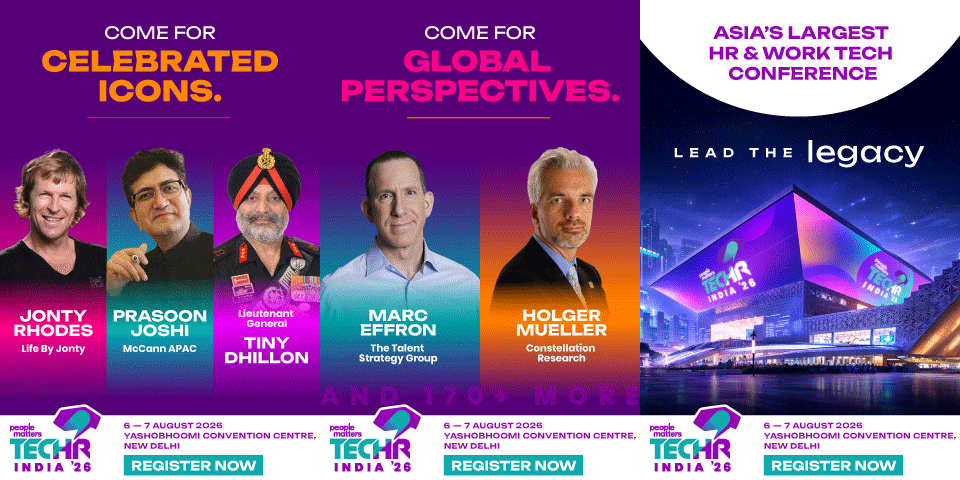
After 13 years, TechHR India is not simply arriving at another annual edition. It is arriving at a moment when the decisions being made today could define how organisations work for years to come.
And perhaps that is what it means to Lead the Legacy. Not to preserve what has been built, but to build something worthy of being inherited.
Author
Loading...