







Leadership
Leadership, learning and legacy: The final takeaways from TechHR India 2026






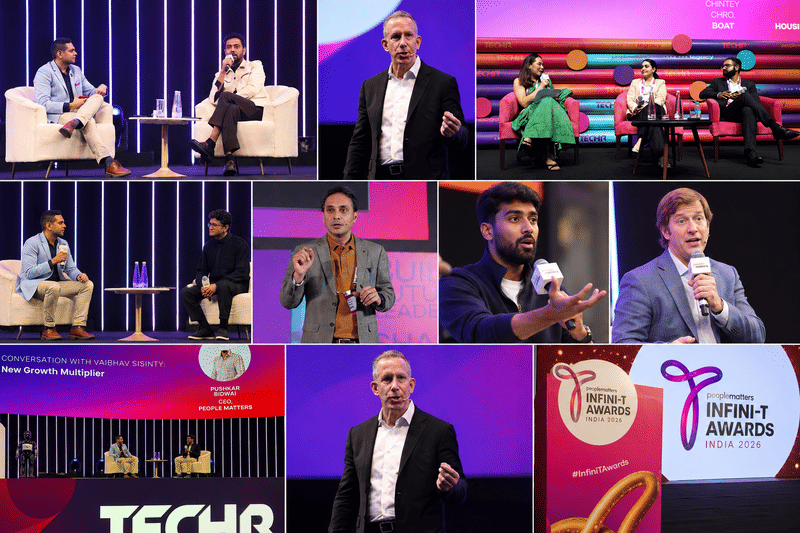
From AI accountability and workforce transformation to leadership, learning and human creativity, the final day of TechHR India 2026 closed with a clear message: technology may reshape work, but people will define its future.
TechHR India 2026 concluded with conversations that moved beyond the hype surrounding artificial intelligence and focused on a more pressing question: how organisations prepare people, leaders and cultures for a world of continuous disruption.
Across keynote sessions, fireside conversations, masterclasses and industry dialogues, speakers explored the intersection of technology, talent and human potential. While AI remained a dominant theme, discussions consistently returned to leadership accountability, workforce readiness, learning agility and the importance of preserving human judgement in an increasingly automated world.
The final day brought together business leaders, HR executives, entrepreneurs, creators, athletes and industry experts, offering a broad perspective on how work is being redefined across sectors.
AI moves from experimentation to organisational responsibility
The day opened with the launch of the People Matters SHRPA 2026 report, where Pushkaraj Bidwai, CEO of People Matters, highlighted a challenge many organisations continue to face.
"When everyone owns AI transformation, no one owns it."
The observation reflected a recurring theme throughout the event. Organisations are no longer debating whether to adopt AI. The focus has shifted towards governance, accountability and execution.
Several sessions reinforced the need for leaders to establish clear ownership structures around AI adoption, workforce transformation and enterprise technology investments.
In a leadership discussion, Puneet Chandok, President, Microsoft India & South Asia, and Rohit Chennamaneni, Co-founder of Darwinbox, examined how enterprises can remain resilient amid rapid technological disruption. The discussion focused on making deliberate choices around talent, culture and technology rather than reacting to change after it arrives.
A similar perspective emerged in a panel featuring Damayanti Bandopadhyay of Mahindra Group and Gurucharan Singh Gandhi of Vodafone Idea, moderated by Manish Shukla of Dr. Reddy's Laboratories. The discussion explored how leaders can balance innovation with accountability while ensuring human value remains central to AI-led transformation.
Learning emerges as a business priority
Learning and workforce development remained among the strongest themes of the day.
During a conversation with Pushkaraj Bidwai, Vaibhav Sisinty, Founder of Outskill, discussed how AI is changing career development and creating new opportunities for professional reinvention. The conversation highlighted adaptability as an increasingly important capability for employees navigating rapid workplace change.
The future of learning itself came under scrutiny during a masterclass led by Kuljit Chadha, Co-Founder and COO of Disprz.
The session explored how generative AI is beginning to influence learning design, content creation and capability-building programmes. Rather than replacing learning functions, the discussion focused on how AI could reshape the responsibilities of L&D teams and enable more intelligent learning ecosystems.
Across sessions, a common message emerged:
- Learning is becoming continuous rather than episodic.
- AI literacy is evolving into a foundational workplace skill.
- Adaptability is increasingly viewed as a competitive advantage.
- Workforce development is becoming a strategic business issue rather than a standalone HR initiative.
Creativity and meaning remain uniquely human
One of the most talked-about sessions of the day featured Prasoon Joshi, who joined Pushkar Bidwai for a wide-ranging conversation on creativity, culture and the future of work.
Joshi challenged the notion that AI can replicate every aspect of human creativity.
While acknowledging AI's growing capabilities, he emphasised the importance of lived experience, emotion, memory and cultural understanding in creating meaning.
His reflections extended beyond creative industries.
As organisations gain access to larger volumes of data and increasingly sophisticated AI systems, the ability to create context, trust and purpose may become an even more valuable human skill.
Joshi also described uncertainty as a productive state, suggesting that periods of confusion often create the conditions for innovation and new thinking.
The session reinforced one of the event's broader conclusions: AI can generate information at scale, but meaning remains a distinctly human contribution.
Leadership lessons from sport, science and entrepreneurship
The event also explored leadership through perspectives beyond traditional business settings.
Former international cricketer Jonty Rhodes joined longevity expert Dr Marcus Ranney for a conversation on performance, resilience and wellbeing.
Drawing from elite sport and health science, the discussion examined how organisations can create environments where people sustain high performance over time rather than pursuing short-term productivity gains.
Another standout session featured celebrity chef, restaurateur and author Ranveer Brar, who reflected on failure, reinvention and personal growth.
His message centred on learning through setbacks and remaining committed to continuous evolution.
Together, the conversations highlighted a broader shift taking place across organisations. Performance is increasingly being viewed through the lens of sustainability, wellbeing and long-term growth rather than output alone.
Talent strategy takes centre stage
The future of talent management also received significant attention.
Marc Effron, President of The Talent Strategy Group, argued that high-performing organisations distinguish themselves through clear talent philosophies.
He urged leaders to ensure alignment between organisational values and employee experiences, emphasising consistency in hiring, development, recognition and leadership decisions.
The conversation underscored how talent strategy is becoming increasingly important as organisations compete for specialised skills and navigate workforce transformation.
Meanwhile, discussions on employer branding and organisational culture featured leaders from Honasa Consumer, House of Chikankari and boAt, who explored how businesses can attract entrepreneurial talent while maintaining purpose-driven cultures.
India’s growth story remains a talent story
The Unconference track brought together leaders from sectors including manufacturing, aviation, energy, automotive and global capability centres.
The discussions focused on:
- Workforce readiness for India's expanding GCC ecosystem.
- Talent requirements for manufacturing growth.
- Skills transformation across industries.
- Inclusive workforce participation.
- Leadership development for emerging sectors.
Speakers highlighted how talent strategies are becoming central to India's economic ambitions, particularly as organisations scale operations and compete for specialised capabilities.
The conversations reflected growing recognition that workforce development will play a critical role in determining the country's long-term competitiveness.
Beyond technology, a focus on human connection
Not every conversation centred on AI.
Creative experiences such as the Eco Resin Art Masterclass, networking engagements, learning-focused expo experiences and the People Matters Infini-T Awards offered delegates opportunities to connect beyond formal discussions.
These moments reinforced another theme visible throughout the event: technology may change how work is organised, but relationships, creativity and shared experiences continue to shape workplace culture.
A closing message for the future of work
As TechHR India 2026 came to a close, the event left behind a consistent message.
AI is becoming embedded across every aspect of business. Organisations are redesigning jobs, rethinking learning models and re-evaluating leadership expectations.
Yet the most influential conversations of the final day focused less on technology itself and more on the people responsible for guiding its adoption.
From Prasoon Joshi's reflections on meaning and creativity to discussions on AI governance, workforce capability, leadership resilience and talent strategy, speakers repeatedly returned to the same conclusion.
Technology may determine what becomes possible.
Leadership, learning and human judgement will determine what organisations choose to do with it.
Author
Loading...