







Business
TCS Q2: Cuts jobs, books ₹1,135cr severance and launches $6.5bn AI push






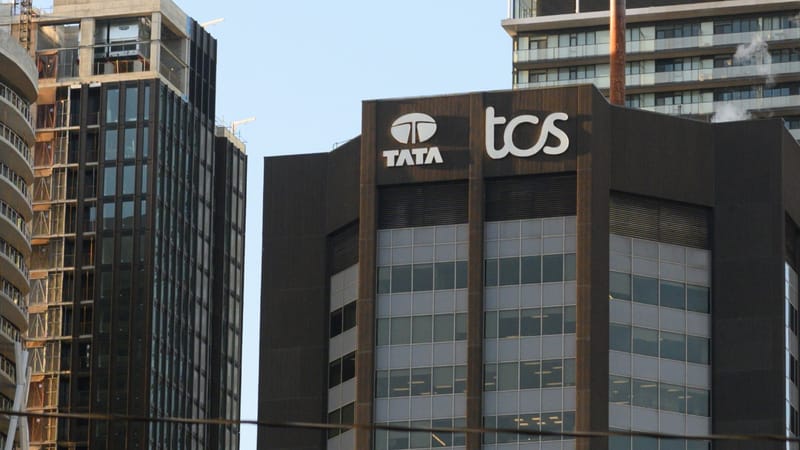
Profit inches up, headcount falls and a 1GW AI data-centre bet signals TCS’s pivot as HR disputes “exaggerated” layoff figures.
Tata Consultancy Services sent mixed signals to markets and employees on Thursday, pairing a modest profit rise and a $10 billion quarterly deal pipeline with confirmation of job cuts and a bold plan to build a $6.5 billion artificial-intelligence data-centre business.
Chief human resources officer Sudeep Kunnumal said the company had “released” about 1 per cent of its workforce—roughly 6,000 roles—mainly at mid and senior levels after redeployment efforts fell short. He dismissed circulating figures as “extremely exaggerated” and urged the public to disregard them, remarks carried by PTI.
The employees’ union offered a sharply different picture. The Nascent Information Technology Employees Senate said TCS’s reported headcount fell from 613,069 at the end of the June quarter to 593,314 in September—a net reduction of 19,755 in three months. Union president Harpreet Singh Saluja accused the company of downplaying redundancies, arguing that a decline in voluntary attrition undermines the idea that exits were routine; those criticisms were reported by Business Standard.
This marks the steepest workforce contraction at India’s largest IT services firm in more than a decade. TCS last undertook a major retrenchment in 2012, when about 2,500 employees were let go for underperformance, Business Standard reported. The scale and cost are clearer this time: severance expenses of ₹1,135 crore were booked in the quarter, indicating the restructuring was not business-as-usual churn.
Management has framed the exercise as skills rebalancing rather than a numbers game. Kunnumal said exits were handled with “respect and empathy”, with counselling and benchmarked severance, and noted that TCS honoured 18,500 offers in the quarter and will keep hiring based on demand rather than fixed targets—positions reflected in PTI’s coverage. The message to stakeholders is that TCS can be both a net job creator over the year and a near-term reducer of mid-senior roles as work shifts.
Financially, the September quarter was muted. Net profit rose 1.4 per cent year-on-year to ₹12,075 crore, slightly under consensus, while revenue came in at ₹65,799 crore and operating margin held at 25.2 per cent. Increments were rolled out to about 80 per cent of staff and variable payouts were maintained, but the severance charge dented sequential profitability. The margin puts and takes—wage hikes, the one-off restructuring cost, and offset from pyramid rebalancing—were outlined by chief financial officer Samir Seksaria and reported by Moneycontrol.
Strategically, TCS moved from people-intensive outsourcing towards capital-intensive compute. The company said it will set up a subsidiary to build a one-gigawatt AI data-centre footprint in India over five to seven years, with an estimated outlay of $6.5 billion funded through equity and debt. Chief executive K Krithivasan described “world-class AI infrastructure” that will serve start-ups, hyperscalers and government clients, with revenue beginning 18–24 months from kick-off; details from the post-results call were reported by Hindustan Times. Chief operating officer Aarthi Subramanian said the ambition is to span “the entire AI stack, from infrastructure to applications”, aligning with a broader Tata Group digital push.
The wider industry will treat this quarter as a bellwether. India Today noted ahead of the print that investors expected modest growth amid US demand softness, wage pressure and a deflationary shift from generative AI. With total contract value at about $10 billion and a marquee European insurance deal in the bag, TCS’s pipeline looks healthy, but the tension between near-term human cost and long-term AI capacity is now front and centre for India’s $250-billion IT sector.
The paradox is stark. TCS is shrinking in headcount while laying the groundwork for an AI-heavy future. Management calls it skills realignment; the union calls it displacement. For graduates and mid-career professionals, the signal is clear: the premium is shifting from scale of labour to scale of compute. For investors, the takeaway is a cautious one: steady margins, a strong TCV, and a capital plan that could redefine TCS’s profile—if execution and demand converge.
As the dust settles on the September quarter, TCS’s message is twofold: tighter benches now, bigger machines later. Whether that trade-off preserves trust across the shopfloor while satisfying the Street will define the next leg of India’s IT story.
By the numbers
Net profit: ₹12,075 crore, +1.4% YoY
Revenue: ₹65,799 crore; operating margin: 25.2%
Headcount: 593,314, −19,755 QoQ
Declared exits: ~1% (~6,000), mainly mid–senior
Severance charge: ₹1,135 crore
TCV: ~$10 billion for the quarter
AI data centre: 1GW in 5–7 years; $6.5bn capex
Topics
Author

Loading...