







Economy Policy
Employees across India rally against the government’s new labour codes






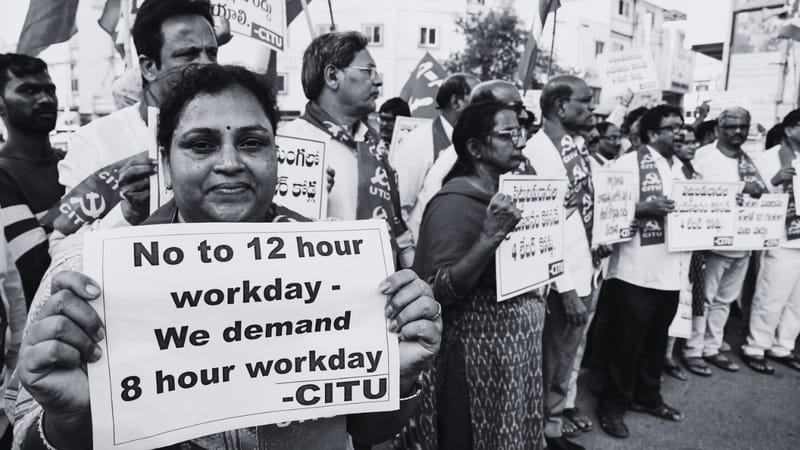
Trade unions and farmer groups lead nationwide demonstrations calling for the withdrawal of India’s newly implemented labour codes.
Employees across India staged coordinated demonstrations on Wednesday to demand the withdrawal of the government’s newly implemented labour codes, which came into force on 21 November. Lakhs of workers from multiple sectors joined the action, the Indian Express reported.
The protests were organised by a platform of ten central trade unions alongside the Samyukta Kisan Morcha (SKM), a coalition of 40 farmer unions. The groups submitted a joint representation to President Droupadi Murmu outlining their objections and listing 16 demands, including a repeal of the four labour codes and the implementation of a national minimum wage of ₹26,000 per month.
Amarjeet Kaur, general secretary of the All India Trade Union Congress, told the newspaper that the demonstrations took place at staggered times to avoid disrupting essential services. “Some employees protested before their shift commenced while some opted to do it after duty hours,” she said. Participants wore black badges, carried placards, raised slogans and held sit-ins, she added.
Kaur warned that the unrest could build if the government does not reverse course. “The protests will continue and could culminate in a general strike unless the government rolls back the codes,” she said. She noted that employees from banks, insurance, electricity, water, education and coal were among those who took part.
The groups’ representation to the President included calls for stronger social security for all categories of workers, a pension of ₹10,000 per month, an end to contractualisation, and a withdrawal of the draft Labour Policy–Shram Shakti Niti 2025. The organisations also pressed for farmer-focused reforms, including comprehensive loan waivers and access to low-interest credit.
In a joint statement, SKM and the unions argued that the new labour codes undermine historic labour protections. They said the reforms “negate our right to strike, make union registration problematic, de-recognition of unions easy, [and] wind up labour courts,” replacing them with tribunals that give authorities broader discretion. The statement also criticised changes to wage definitions and the removal of scheduled occupations under the minimum wage framework.
Trade unions have voiced particular concern over changes to thresholds in the Industrial Relations Code and the Factories Act. They argue that raising the applicability threshold from 100 to 300 workers could push 70% of industries outside the scope of existing labour protections. Increasing factory thresholds—10 to 20 workers where power is used and 20 to 40 where it is not—would exclude large sections of the workforce from statutory safeguards, they said.
“This gives employers wide discretionary powers to repress and exploit,” the unions charged.
Alongside AITUC, the protest platform includes the Indian National Trade Union Congress, Centre of Indian Trade Unions, All India United Trade Union Centre, Hind Mazdoor Sabha, All India Central Council of Trade Unions, Self-Employed Women’s Association, Trade Union Coordination Centre, Labour Progressive Federation and United Trade Union Congress.
With demonstrations taking place across states—including visible mobilisations in Assam and Odisha—union leaders signalled that Wednesday’s action may be an early step in a broader campaign. Further industrial action remains on the table as negotiations with the government stall.
Photo courtesy: The Wire.
Topics
Author

Loading...