







Sustainability & ESG
Sridhar Vembu says Zoho will not expand WFH despite government push to cut fuel use







While rejecting broader WFH adoption now, Vembu said Zoho is continuing to explore alternative sustainability initiatives like evaluating electric bus fleets for employee transportation.
Sridhar Vembu has said Zoho will not expand work-from-home options for employees despite the Indian government’s recent push to reduce fuel consumption through remote work and virtual meetings.
The Zoho founder said the company internally evaluated the idea after his earlier comments on work culture triggered discussions online. However, he explained that the company ultimately decided against broadening remote work because face-to-face collaboration continues to deliver better productivity, particularly for research and development teams.
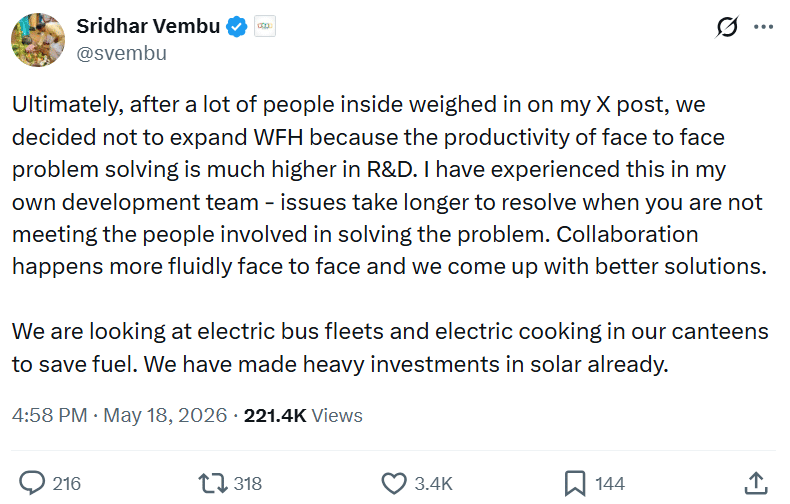
“Ultimately, after a lot of people inside weighed in on my X post, we decided not to expand WFH because the productivity of face to face problem solving is much higher in R&D,” Vembu wrote on X.
According to Vembu, his personal experience working with development teams has shown that technical issues often take longer to resolve remotely, while in-person collaboration enables smoother communication and faster innovation.
“I have experienced this in my own development team - issues take longer to resolve when you are not meeting the people involved in solving the problem. Collaboration happens more fluidly face to face and we come up with better solutions,” he added.
The comments come as Prime Minister Narendra Modi recently urged citizens and companies to reconsider some Covid-era practices, including work-from-home arrangements, online conferences and reduced travel, as part of efforts to lower fuel consumption amid ongoing global economic uncertainty linked to tensions in West Asia.
PM Modi framed the appeal as an economic and energy-security measure aimed at reducing India’s dependence on imported fuel and limiting avoidable petrol and diesel consumption.
“We must prioritise work from home, online conferences, and virtual meetings again,” Modi had said during a recent address. He also encouraged greater use of public transport systems, carpooling and reduced non-essential travel.
Interestingly, the latest remarks mark a contrast to a temporary remote work move announced earlier. In March, Zoho had asked most employees to work from home for two weeks starting March 16, citing operational considerations and the need to minimise employee commuting.
The temporary arrangement applied to most employees except those involved in business-critical operations, while essential teams were asked to coordinate with managers regarding office schedules. The company had also said a limited number of employees could still be required to work from office locations depending on operational needs, with cafeteria services operating on a limited basis during the period.
At the time, Zoho described the measure as a temporary operational adjustment aimed at reducing commuting and maintaining business continuity amid the prevailing situation, rather than a permanent change in workplace policy.
While rejecting broader WFH adoption now, Vembu said Zoho is continuing to explore alternative sustainability initiatives. He revealed the company is evaluating electric bus fleets for employee transportation and electric cooking systems in canteens, while also investing significantly in solar energy infrastructure.
“We are looking at electric bus fleets and electric cooking in our canteens to save fuel. We have made heavy investments in solar already,” he wrote.
Founded in 1996 by Sridhar Vembu and Tony Thomas, Zoho has grown into one of India’s largest privately held software companies, offering a wide range of cloud-based business applications across customer relationship management, workplace collaboration, accounting and enterprise software.
The remarks add to the ongoing debate around workplace culture across India’s technology sector, where companies remain divided over the long-term role of remote work years after the pandemic. While some organisations continue to support hybrid flexibility, others increasingly argue that office-based collaboration strengthens creativity, innovation and team coordination.
Vembu has also recently shared broader views on the future of work in the age of artificial intelligence. In another discussion on X, he argued that professions centred around caregiving, teaching, farming, spirituality and culture may continue to remain meaningful in an AI-driven world because they are rooted more in purpose than financial incentives.
His observations come amid growing global discussions around how AI could reshape employment and white-collar work, with tech leaders including Elon Musk and Jensen Huang also weighing in on AI’s long-term impact on jobs and workplace structures.
Author
Loading...