







Workforce Planning
Four labour codes live from 21 Nov: What it means for HR and your organisation







With the four labour codes now in force, India triggers a major reset in wages, social security, compliance and workforce governance.
India has activated its long-delayed labour reforms, enforcing all four labour codes with effect from 21 November 2025, marking the most significant restructuring of the country’s labour architecture in independent India.
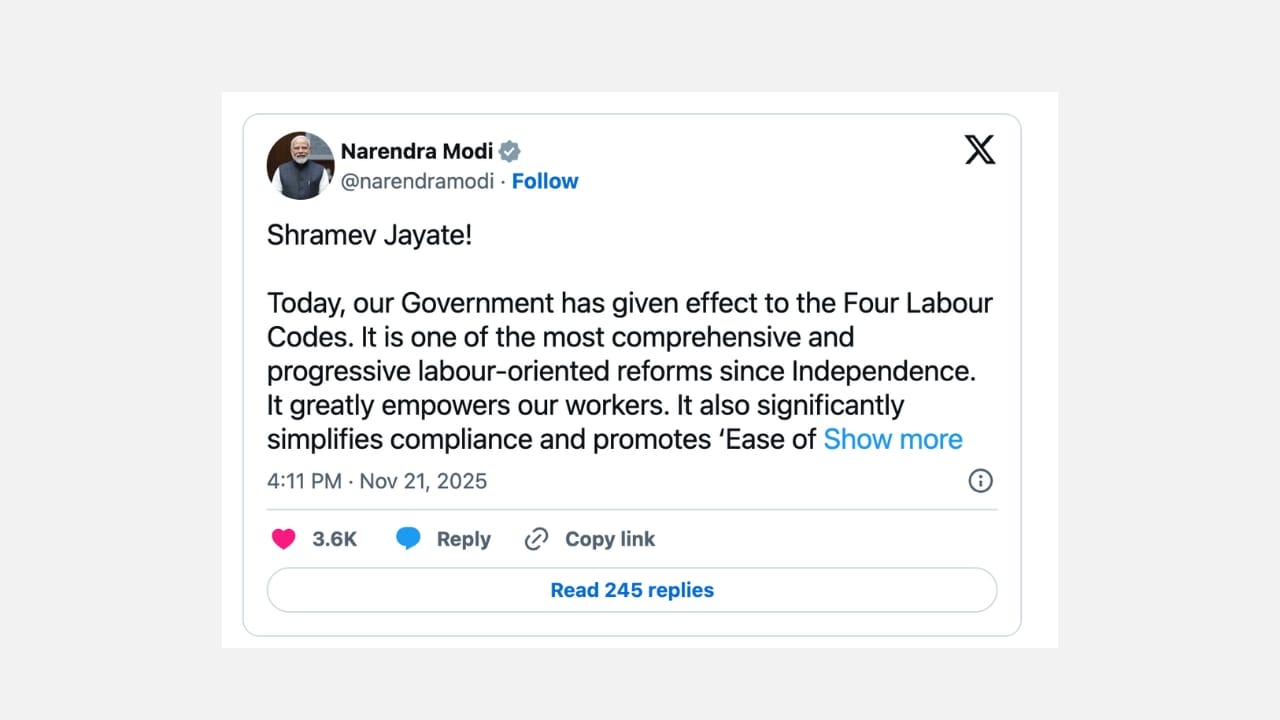
Prime Minister Narendra Modi confirmed the rollout on X, writing:
“Shramev Jayate! Today, our Government has given effect to the Four Labour Codes. It is one of the most comprehensive and progressive labour-oriented reforms since Independence. It greatly empowers our workers. It also significantly simplifies compliance and promotes ‘Ease of Doing Business’.”
For India Inc., the shift is more than legislative housekeeping. It rewires the underlying logic of hiring, wages, industrial relations, social security, workplace safety and compliance workflows — directly affecting CHROs, CFOs, operations heads and people managers across sectors.
The Ministry of Labour noted in its implementation statement that many of India’s labour laws were framed between the 1930s and 1950s — fragmented statutes that “struggled to keep pace with changing economic realities and evolving forms of employment.”
The new framework consolidates 29 central labour laws into four codes:
Code on Wages (2019)
Industrial Relations Code (2020)
Code on Social Security (2020)
OSHWC Code (2020)
The Core Shifts: What HR Leaders Will Feel Immediately
1. Universal Minimum Wage + National Floor Wage
Under the Code on Wages, every worker in every sector is entitled to minimum wages and timely payments. This ends decades of differential treatment between “scheduled” and “non-scheduled” employment.
A national floor wage will prevent sub-minimum pay across states, with state governments required to align upward—not downward.
2. Appointment Letters Become Mandatory for All
Every worker—permanent, fixed-term, gig-linked, contract or platform—must receive an appointment letter.
For HR leaders, this pushes full documentation, clearer contracts and elimination of grey zones around employment status.
3. Gig and Platform Workers Enter Social Security Law
For the first time, the Code on Social Security recognises gig, platform and aggregator-based work.
Aggregators must contribute 1–2% of annual turnover (capped at 5% of payouts) for gig-worker welfare.
Aadhaar-linked Universal Account Numbers allow portable benefits across states.
4. ESIC and PF Coverage Expands Nationwide
Even establishments with one employee engaged in hazardous processes fall under mandatory ESIC coverage.
Smaller units (<10 employees) may opt in voluntarily, widening India’s social protection net.
5. Women Can Work in All Roles, Including Night Shifts
Women are legally permitted to work night shifts, in hazardous roles and in mining, subject to consent and prescribed safety measures.
The Codes also mandate:
Equal pay for equal work
Gender-neutral, discrimination-free hiring
Women’s representation in grievance committees
6. Workplace Safety Standards Modernised
The OSHWC Code standardises working hours (8–12 hours/day; 48 hours/week), mandates safety committees in large establishments and introduces annual health check-ups for workers aged 40+.
7. A Single Registration, Single Return, Single Licence Regime
The new compliance structure sharply reduces administrative burden, replacing overlapping filings with a unified system.
The Inspector-cum-Facilitator model shifts inspections from punitive to guidance-oriented.
Sector-by-Sector Impact: A New Playbook for HR
Fixed-Term Employment
Benefits equal to permanent employees
Gratuity after one year, not five
Boosts direct hiring; reduces dependence on contractors
IT & ITES
Salaries must be released by the 7th of every month
Stronger harassment, discrimination and wage-dispute resolution rules
Women allowed night shifts with consent
MSMEs
Lower compliance burden
Guaranteed minimum wage
Access to welfare provisions like canteens, rest areas, safe drinking water
Plantations, Mines, Hazardous Work
Mandatory safety training
ESIC medical facilities for workers and families
Free annual health check-ups
Strict occupational safety standards
Gig, Contract, Dock, Textile, Export and Beedi Workers
All now receive formal recognition, guaranteed minimum wages, stricter safety norms and enforceable rights over overtime, leave, PF, ESIC and grievance redressal.
Before vs After: The Government’s Stated Differences
Before the Codes:
No mandatory appointment letters
Limited social security coverage
Minimum wages applicable only to select sectors
Gender restrictions in high-paying roles
Patchy workplace safety norms
Multiple licences, inspections and filings
After the Codes:
Appointment letters for all workers
PF, ESIC, insurance extend to every worker category including gig and platform
Universal minimum wage + national floor wage
Women permitted in night shifts and all occupations
Harmonised national safety standards
Single registration, single licence, single return
What CHROs Should Do Immediately
1. Revisit salary structures
The unified definition of “wages” may increase PF/ESIC liabilities where companies rely heavily on allowances.
2. Clean up employment documentation
Appointment letters, contractor agreements and vendor policies must be updated to Code-aligned formats.
3. Reassess gender inclusion policies
Night-shift readiness, transportation, safety protocols and grievance systems must be audit-ready.
4. Build gig-worker governance frameworks
Where applicable, define aggregator contributions, benefit eligibility and contractor communication.
5. Align safety and health protocols
Annual health check-up systems, safety committees and hazard assessments must be standardised.
Government data indicates social-security coverage has expanded from 19% in 2015 to 64% in 2025. The labour codes aim to accelerate this national shift toward formalisation, portability and universal protection.
Topics
Author
Loading...