Traditional approaches to compensation and benefits appear insufficient to attract top talent today. So how do we design a modern C&B value proposition?
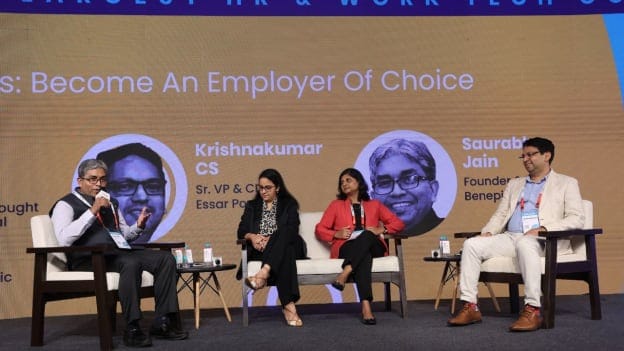
In a fireside chat at TechHR India 2023, on ‘New-Age Compensation & Benefits: Become An Employer Of Choice’, Saurabh Jain, Founder & CEO, Benepik kicked off a discussion by encouraging HR leaders to recognise their own efforts. Industry experts including, Poonam Chopra, Director of Total Rewards of SSA Region and AMESA Benefits Lead at PepsiCo, Lipika Verma, VP of Reward & Performance Innovation Thought Leadership, and Global Human Resources at Schneider Electric, and Krishnakumar CS, Senior VP and CHRO at Essar Power, shared valuable insights on the subject.
‘Personalised benefits’ for making organisation a workplace of ‘choice’
The role of HR is to transform the culture, practices, and policies in such a way that organisations are termed as an ‘employer of choice’. In achieving this, compensation and benefits play a vital role. Moreover, traditional benefits like retirement and health with a focus on health, flexibility, and personalisation, have evolved with current requirements, especially post-COVID. Therefore, HR bridges the gap between ROI and new ‘personalised’ initiatives for an enriching employee experience.
Poonam shared, “We consider market benchmarks a crucial factor in shaping our policies and programs. Seeking insights on, 'What is the current market practice? Are we aligning ourselves with the industry standards?' As HR and compensation leader, I've spent a significant part of my career looking at what's happening in other parts of the world at PepsiCo, market practices, our existing programs, legacy, and precedence. We've always focused on 'What is.' However, we realized that to stand out in the benefits space, we needed to start asking 'What IF?' What ‘if’ we designed something that didn't conform to market norms? What ‘if’ we created a benefits program that incurred no additional costs for the company? Could we do it? What ‘if’ we actually listened to our employees and asked them what they wanted, instead of following market trends? These 'What if' questions fueled our innovation. One year later, we've implemented a fully flexible benefits program in three countries—no limits, no budgets, and no caps, except for insurance, where governance is essential. It's akin to a shopping basket approach. We allocated a budget we were already spending, particularly in markets like India and Saudi Arabia, where flexibility was unheard of.
- In these markets, we hadn't witnessed such flexibility, not even in compensation. Nevertheless, we took the leap and introduced flexible benefits.
- In India, where flexibility is well-received, nearly 89% of our employees make personalised choices regarding their benefits.
- Surprisingly, even in a Middle Eastern country where flexibility was a novel concept, 82% of our employees actively selected their preferred benefits options over default choices.
The feedback has been overwhelmingly positive, affirming our belief in continuing this approach in other Middle Eastern markets where flexibility is yet to be introduced."
In the context of the COVID pandemic, organisations have restructured compensation, benefits, and culture according to employees' requirements. The need for flexibility in personalising benefits programme for employees is at an all-time high," said Lipika, adding, “We're working on a benefits program that involves co-creating it with employee feedback, considering their various life stages and ages. This aligns with the current trend of personalised benefits. From Schneider's perspective, we're proud of our sustainability efforts and being recognised as the world's greenest company. We've introduced a global family leave policy as an example of our commitment to being a caring and responsible employer. This policy combines maternity and sick leave into a more inclusive parental policy, applicable to primary and secondary caregivers, regardless of gender. We've also renamed sick leave as care leave to encompass not only self-care but also caregiving for family members, including pets. This approach caters to the diverse needs of our workforce across generations. The uptake of these policies has been substantial, and we recognize the need for technology to support these initiatives as we strive to be a caring and responsible employer."
Enhancing benefits for community building in traditional industries
Providing insights on the DEIB initiatives and benefits for employees in traditional industries, Krishnakumar shared, “The pandemic has been an eye-opener in many ways. Benefits, something often taken for granted by employees, became a challenge during the pandemic. Most organisations typically provide benefits to those on their payroll. However, at a power plant, there are many individuals who are not part of our payroll, including day labourers and technicians.
- We had to make efforts to include them in our benefit programmes, which included providing accommodation, transport, and food, not just for the workers but also for their extended families. We had to take care of the entire community surrounding the power plant.
- Regarding vaccinations, we were privileged to receive them early due to our essential sector status. However, we ensured that everyone entering the power plant, regardless of their employment category, had access to vaccinations alongside our regular employees.
- In the traditional sector, we may have been slow to adapt to certain changes, but we've started identifying areas for improvement. We've also implemented a universal policy where there are no restrictions on forming groups or initiatives. This marks the beginning of our journey to enhance our offerings."
Launching new initiatives? First, think like a CFO
HRs proposing new initiatives but being shot down by CFOs and CEOs owing to budget constraints is a common occurrence, Poonam shared, “What I've learned over time, which has significantly contributed to the success of our proposals for new initiatives, is the importance of considering the organisation's owner's perspective. When I sit in my HR role and receive requests for new employee benefits, I don't view it solely as a cost to the company that I need to design. It's not just my problem if finance says no. This mindset doesn't work. When we talk about HR having a 'seat at the table,' it means more than merely representing HR; it means being on the table with equal authority and responsibility for the organisation's success. So, think like a CFO if necessary.
- Secondly, support your finance colleagues with comprehensive cost modelling. When you're preparing a proposal, you must create various cost models. These models should clarify the cost of the new program, identify any existing costs being replaced, calculate the net delta cost, express it as a percentage of net revenue and total payroll cost, and include ROI metrics. Even if these metrics are speculative, such as expecting a 5% reduction in attrition, they are vital for decision-making. You can stand by your models and continuously assess the success of your assumptions.
- Thirdly, introducing a new program doesn't always require additional expenses. Take our flexible benefits program in India, for example. The additional cost was negligible, having no significant impact on the balance sheet. Instead, we consolidated all our existing benefit expenses into one lump sum. We presented this to employees and said, 'Here's the pot of money you might not have seen before, as it was spread across various benefits like insurance, health check-ups, life insurance, and office wellness facilities. Now, you decide how to allocate it.' This approach led to higher satisfaction and engagement without any extra expenditure.
In conclusion, it's important to understand that decisions, including benefit programs, don't always need to translate into increased costs. This is especially relevant in cost-conscious organisations like ours. All our proposals align with these three principles: CFO-level accountability, comprehensive cost modelling, and a focus on innovation that doesn't necessarily incur additional expenses."
Lipika illustrated, “Back in 2013, to launch a few initiatives within China, we approached our CEO and the CFO for a budget but it was a straight NO. And so, as we were figuring out how to go ahead with a compelling proposition, we started small. The focused dimensions of well-being were physical, mental, social, emotional, and financial. We picked up physical well-being and started doing a few interventions in baby steps. We observed positive results within a year of launch. Be it a lesser premium in the next year or the health index on a quarterly basis. And these interventions along with the ROI, provided funding for the upcoming year. So I would suggest, starting small with the interventions for the leaders to say YES.
With policies, it is never an easy task. Especially in a manufacturing setup, where we want to include new employees in the massive policies. For example, it took almost 18 months to launch the Global Family Leave Policy. But, that's the kind of resilience and impact that we try to create all the various elements around enhancing employee engagement. also from a perspective of attraction, retention motivation, and talent. To conclude, launching a policy that can create an emotional connection between employees and the organisation takes us a long route convincing the CFO and the CEO.”
Benefits amid layoffs - How to make it work?
Sharing strategies to manage the impact of layoffs with benefits, Krishnankumar said, “I would suggest to manage layoffs, use human part. When you do a downsizing or a rightsizing, it becomes the HR manager’s responsibility. Because the business leaders don’t become part of the process. They are part of the decision-making process. To begin with, we need to familiarize business leaders with the consequences. And the next part is to manage that exit where it becomes comfortable. You may have a 1-month notice period, but can you extend it? Can you extend it for 3 months? Can you give prior information without making an enormous noise within the system? Because people find it easier to find a job when they have a job. They don’t have a job and they go out to the market. Its a typical HR way of handling it. So it’s easier for somebody to find a job when they have no job. So look at it that way. And can you extend benefits to them? So instead of the Medicare policy, extend it further. Entry in the first month or the 12-month after exit. Can you extend it for a certain period? So there is a certain amount of comfort he will get by doing these things. That’s one major aspect which I find will be helpful for people who are part of that.”
Poonam added, “The important part of layoffs is, counselling support provided to the affected employees. We've not had such a situation in PepsiCo though. However, if such a situation arises at PepsiCo, our employee wellness program can counsel the affected employees, emotionally, financially, as well as, physically. Moreover, this programme can extend to the dependents of the affected employees. So when a layoff happens, it's not an individual problem. Not only do the employees overcome the trauma, but it is also challenging for the affected family. So if there is counselling required by any of the family members, that's also extended. And that is how we should be standing in to support the employee should a situation like this arise.”
Inclusive caregiver policies for multi-generation
How accommodating caregiver initiatives for enriching employee engagement and experience including Gen Z, can make organisations an 'employer of choice', Lipika explained, “We offer a range of flexible benefits designed to accommodate individuals at different stages of their lives and careers. Let me illustrate this with a couple of examples.
- Firstly, new employees, such as graduates and management trainees, often start their careers at an age when their parents still have them covered under their medical insurance plans. In such cases, we provide the option to refund the premium amount to these younger employees, allowing them to allocate these funds to other purposes, like acquiring a club membership or other personal investments. On the other hand, for our more senior employees, we offer the opportunity to purchase higher coverage medical insurance, tailored to their needs. These examples demonstrate our commitment to creating benefit policies that cater to all generations within our workforce, rather than solely focusing on one generation, like Gen Z.
- Second, we recognize that many employees find themselves in situations where they need to care for ageing parents, especially when they are dealing with terminal illnesses. Our sabbatical policy is designed to address this need, allowing employees to take sabbaticals for caregiving responsibilities. This policy has resonated particularly well in the Indian context, where family care is highly valued. It's a relatively simple initiative to implement, and it has garnered positive feedback, significantly boosting employee engagement within our Indian offices”