









Some of the world’s leading innovative companies are known as Factory for Leaders. They have been at the forefront in innovation in leadership development. In this researched article, there is an attempt made to pick out few critical design elements in innovation in leadership development from such companies, personal experiences, observations and research on leadership development interventions.
Various researches have proved that the best leadership development initiatives are designed around an understanding that leadership development is a continuous, life-long process rather than a single event or program.These leadership initiatives deploy more interventions like assessments, feedback, action learning, trigger events, education, formal coaching and follow-up support systems; and they do so with great rigor.
Innovation in leadership development can happen when there are practices and applications that allow and create a breakthrough in design elements in selection of potential leaders, experiences, conversations and actions for leadership development. These experiences, conversations and actions have the potential to enable the development of new mindsets that are needed at the next vertical level and not just skills-based horizontal development.
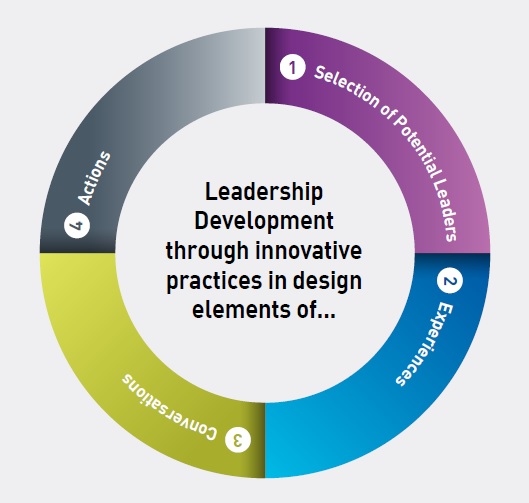
1. Selection of potential leaders. In the design for selection of leaders as participants, the leadership development team has to first explore and understand the development readiness of the participants. The participants of leadership development interventions should have motivation to lead, learn, and to develop others as leaders.The participants who are selected for leadership development interventions need to have a strong desire and passion for collaborative leadership.
Opinion leaders or informal influencers who may not have the formal title and designation and who have a huge informal network and followers are a good population to target at.
The leaders for development need to beselected from the pool of opinion leaders and informal influencers and need to be identified from performance evaluation and rewards monitoring system, social media, blogs, followers and comments.
Many leaders can also be identified based on mapping the various hardships, challenges which helped some of them to come up in life. Analytics on this could be collated right from the time of selection interviews. The selection process and interviews need to be designed to capture the life history and should also demonstrate leadership anecdotes related to the candidates.
2. Experiences. The origins of the word “experience”, from the Latin roots ex-, “out of”, and periri, “to go through”, suggests gaining knowledge by going through trials, being tested. In their book “The Talent Masters”, leadership practitioner Bill Conaty and leadership guru Ram Charan cite several experiences for leadership development from recognized companies that are known for leadership development. For example, P&G has for decades produced managers who are great general managers. However, to move up, they have to demonstrate expertise in consumer insight, drive innovation, and be “globally effective” – meaning, they need to be able to lead in cultures other than their own.
The company regards choosing the right assignments for managers as a crucial part of building its leadership DNA. A mix of assignments or’ “accelerator experiences’ gives managers both depth and breadth of experience.
Developing leadership talent through experiences expands capability and capacity in the four major components of talent – personal traits, skill mix, relationship building and judgment about people and business. Thus, the company provides its managers with assignments on which they could grow exponentially in all four areas in a short period of time. Here are few specific elements of experiences that could be included in design of innovative leadership development interventions.
- Leadership projects. In the design, great care has to be taken while selecting leadershipprojects. The projects should address organizational challenges or opportunities. The participants work on such projects with defined project outcomes which allow them to reflect on their decisionsand present it to the top leadership team for further implementation.
- Community volunteering projects. In the leadership development design, inculcate volunteering opportunities. Participants could be allowed to find skilled volunteering opportunities or pursue pro-bono projects instead of only university or standard programsfor their leadership experience.
- Shadowing leaders. The design of leadership development interventions should allow participants to watch and work along with exemplary leaders. They may work together in presenting strategies or negotiating in Board or strategic meetings, handling various issues with government authorities or understanding various perspectives for a new product design and launch.
- Moral centeredness. The design of any leadership development interventionmust provide opportunities and events to build a higher moral perspective which will help in judging and taking decisions in the larger interest of the society.
- Booster or trigger events. Bruce Avolio, a leadership scientist from the University of Washington suggests creating trigger or booster events which are also labelled as ‘micro-interventions’. These booster events are designed to be short triggers lasting, at most, minutes rather than hours. They are designed for individuals to continue reflecting on and also working on changing these states. Most leadership development practices do not follow a simple lock-step fashion and that a trigger can promote non-linear as well as linear growth. Keeping this focus, one could develop online materials, stories, cases and measurement tools that when reviewed, trigger a particular action. These triggers can be delivered face-to-face, or even through followups after a face-to-face program using mobile technology such as cell phones.
3. Conversations. Various researches in cognitive science have shown that mental shifts take place through metaphors, stories and imageries. In many of the well-known leadership development interventions, conversations are embedded in the design. These conversations are held with senior exemplary leaders from the same company or iconoclastic leaders from even outside the company. However, the following care has to be taken in choosing leaders for such leadership conversations during the intervention.
- Ensure that role-model leaders act as mentors and speakers in leadership development interventions. Modelling by top leaders becomes critical in determining the success of leadership intervention if they are the sponsors or mentors. Otherwise it could result in cynicism and little motivation in participants to apply the learnings when they are back at workplace...
- Allow role-model leaders to act as facilitators and mentors in the leadership development design.
- Shared Purpose. The role model leaders should share and talk about their vision and values and how they aligned it to the shared purpose of the company. They could guide the participants of the leadership development interventions to align their vision and connect to the shared purpose of the company and its values.
4. Actions. Many of the leadership development interventions receive flak due to unsuccessful implementation of learning by the participants. Most of the leadership programs and interventions fail when it comes to implementation. The daily challenges and time demands of a major change effort, added to one’s regular work can result in inertia to implement. In an interview of six top executives from some of the most innovative companies in the world, each spoke about the importance of follow-up to the success of any leadership development intervention. The following measures can help in successful implementation of learning from leadership development interventions:
- Encourage the identified pool of leaders to create their own leadership development plan which is not forced by their supervisors or is an HR mandate. Autonomy in choosing their own development paths will help in the long run for this pool of leaders to take action.
- Orient the senior leadership and supervisory team for reviews and follow ups. The top leadership team cannot overlook the need for followup and reinforcement which could result in tremendous waste of organization’s time and efforts in leadership development. There is a need to review progress on actions and projects on a regular basis through leadership analytics on the organizational dashboard.
- Align organizational systems to develop leadership culture.The best leadership interventions succeed because they ensure systemic change across a number of important organizational HR systems. Performance measures, job assignments, incentive systems, followup trainings and organizational structures and reporting relations may need to be realigned to support the larger leadership development change initiative.
As information technology becomes more agile and mobile, leadership development design team needs to embed learning more effectively in the workplace and cultural context of the participants to ensure actions are taken.
To summarize, there is a need to innovate the leadership development design elements & its contents to address the ‘leadership talent’ gaps that various organizations are facing. The leadership development design team and their current leaders can take a holistic approach to design innovatively the selection of right set of potential leaders as participants, experiences, conversations and actions to develop ethical and transformational leaders.