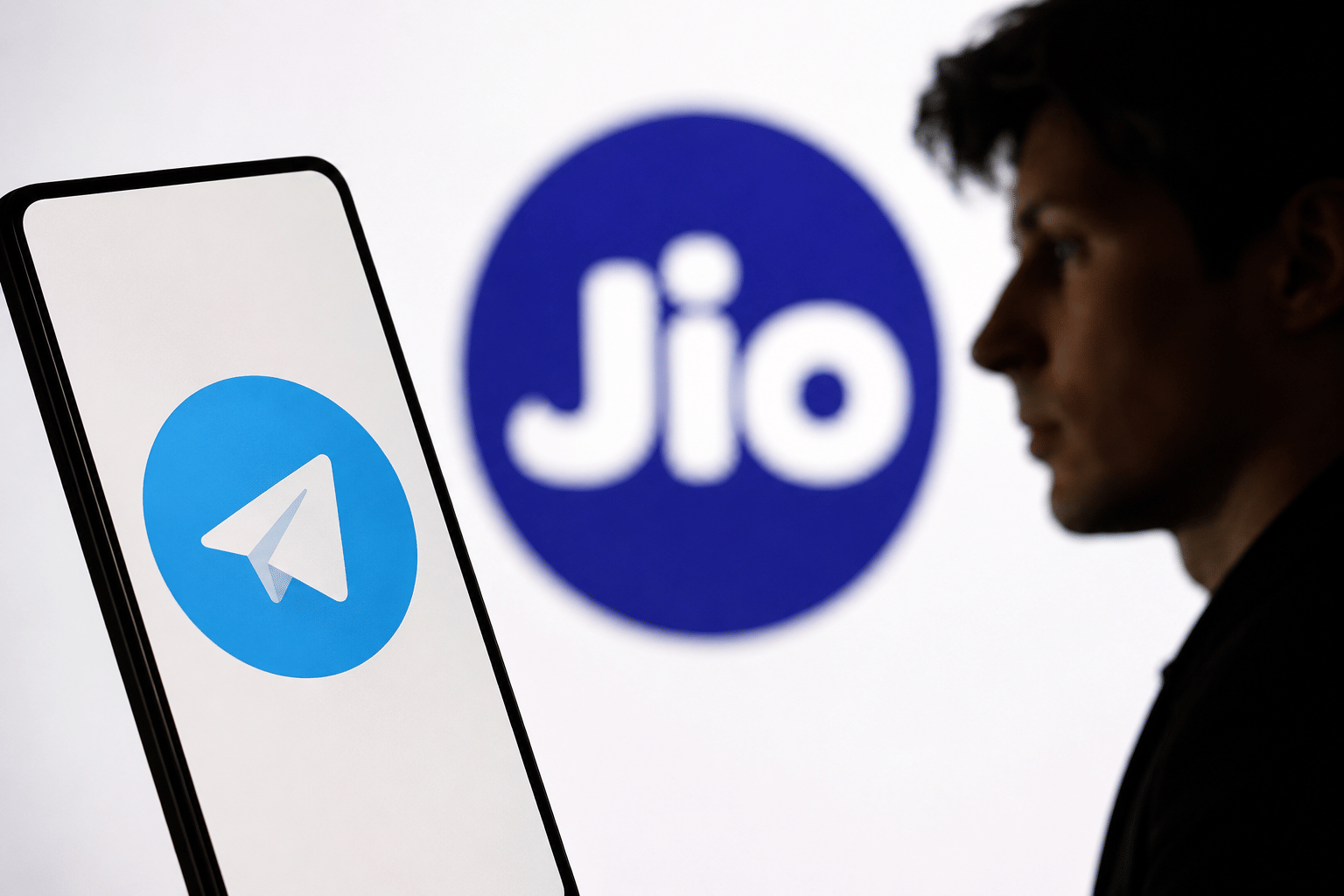
Telegram founder Pavel Durov has accused Reliance Jio of disrupting access to the messaging platform for users outside India through a technique known as Border Gateway Protocol (BGP) hijacking, triggering a public dispute between the messaging company and India's largest telecom operator.
The allegations were made as Telegram remains subject to a temporary government-ordered block in India linked to concerns over the circulation of purported NEET examination papers through channels on the platform.
Reliance Jio has rejected Durov's claims, saying it had no involvement in any BGP route misconfiguration and that its network continues to operate in line with global internet routing standards.
Durov alleges disruption beyond India's borders
In a post on X, Durov claimed that internet users outside India, including those in the United Arab Emirates, were affected by disruptions to Telegram access.
He alleged that the incident involved a "rogue method" known as BGP hijacking, a process in which internet traffic is redirected by falsely advertising network routes to websites or online services.
According to Durov, the alleged disruption affected millions of Telegram users outside India, where Indian government restrictions on the platform do not apply.
He also suggested the incident could be linked to a broader competitive dispute involving messaging services and claimed that Reliance was partly owned by Meta, the parent company of WhatsApp.
Jio rejects allegations
Responding to the accusations, Reliance Jio Infocomm issued a statement denying any involvement in a BGP routing incident.
The company said recent social media posts had fuelled speculation regarding a possible route misconfiguration associated with its network, but maintained that the allegations were unfounded.
In its statement, Jio said:
• It was not involved in any BGP hijacking incident
• It had no role in any alleged route misconfiguration
• Its network continues to operate according to global internet routing best practices
• It remains committed to reliability, security and transparency
The telecom operator described the claims as speculation and rejected suggestions that its network was responsible for disrupting Telegram access.
Technical dispute centres on internet routing
BGP serves as one of the internet's core routing mechanisms, directing traffic between networks and online services worldwide.
In a BGP hijacking event, a network falsely presents itself as the preferred route for internet traffic, potentially causing traffic to be diverted, delayed or interrupted.
According to reporting by Business Today, the network referenced by Durov may not belong to Reliance Jio. The publication reported that publicly available internet routing databases indicate the network could instead be associated with Reliance Communications.
Jio reiterated in its statement that it had no involvement in any BGP routing issue.
Telegram faces scrutiny in India
The dispute comes against the backdrop of regulatory action against Telegram in India.
According to India Today, the Ministry of Electronics and Information Technology (MeitY) on Tuesday ordered a temporary block on Telegram until 22 June, following a recommendation from the National Testing Agency (NTA).
The order was linked to allegations that Telegram channels were being used to circulate claims of leaked question papers related to the NEET examination conducted on 3 May and a re-examination scheduled for 21 June.
The NTA said several Telegram channels had allegedly sought payments from students and parents in exchange for access to purported examination papers.
Authorities have also directed Telegram to disable its message-editing feature until 30 June, citing concerns that it could be misused to spread misinformation.
Public dispute unfolds amid regulatory pressure
The disagreement between Durov and Reliance Jio has added another layer of controversy to Telegram's challenges in India.
At the centre of the dispute are unverified allegations of internet routing interference made by Telegram's founder and a categorical denial from India's largest telecom operator.
With Telegram currently facing temporary restrictions in India and questions being raised about internet routing disruptions outside the country, the episode is likely to attract continued attention from regulators, telecom operators and digital rights observers in the days ahead.