








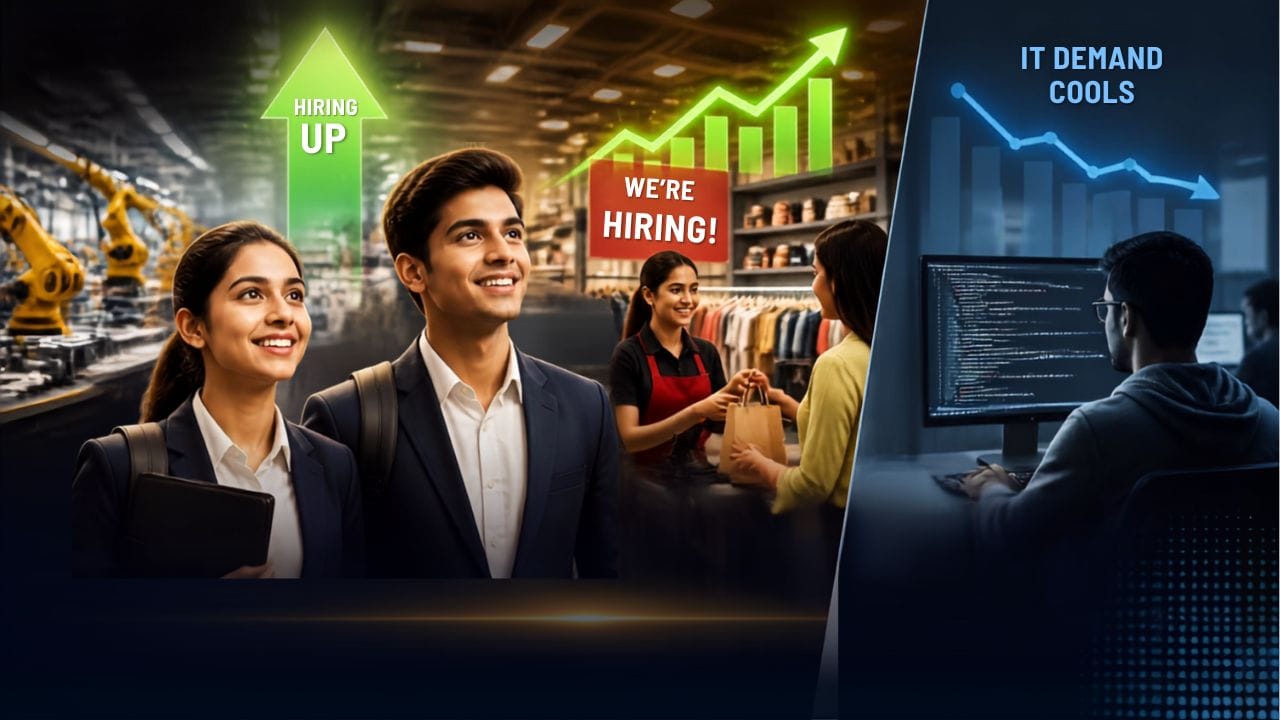
India’s fresher hiring outlook has strengthened for the second half of 2026, although the growth is becoming increasingly uneven across sectors.
Seventy-five per cent of the 1,097 employers surveyed by TeamLease EdTech intend to hire freshers between July and December 2026, up from 73% in the first half of the year. The increase is being led by retail, e-commerce and technology start-ups, manufacturing and other consumer-facing sectors.
The findings indicate that entry-level opportunities are broadening beyond India’s traditional technology hiring engine. At the same time, employers are becoming more selective about candidates’ readiness to contribute from the outset.
Retail and manufacturing lead fresher demand
E-commerce and technology start-ups and retail recorded the highest fresher hiring intent at 93% each. Manufacturing followed at 89%, rising from 86% in the first half of 2026.
Hiring sentiment also improved across FMCG, from 80% to 86%; travel and hospitality, from 77% to 81%; engineering and infrastructure, from 61% to 66%; and logistics, from 48% to 53%.
In contrast, IT sector hiring intent declined from 81% to 76%. Consulting, telecommunications, marketing and advertising, media and entertainment, and educational services also scaled back their fresher recruitment plans.
The overall rise therefore masks a more significant realignment in India’s entry-level labour market, with industrial growth, consumption and digital commerce creating opportunities even as parts of the services economy adopt a more cautious approach.
The skills bar is moving higher
Shantanu Rooj, Founder and CEO of TeamLease EdTech, described the shift as “less about how many freshers get hired, and more about which freshers get hired”.
Employers, particularly in IT and consulting, increasingly expect candidates to demonstrate AI fluency, applied problem-solving and hands-on project experience before entering the workplace. Internships, portfolios, assessments and real-world projects are consequently gaining importance alongside academic qualifications.
The report also identified limited practical exposure, rapidly changing skill requirements and employers’ growing selectivity around training investments as significant challenges for early-career talent.
This creates a difficult transition for graduates who expect their first job to provide practical experience, while employers increasingly favour candidates capable of contributing with shorter learning curves.
Technology skills spread beyond IT
Despite the moderation in IT hiring, demand for technology-enabled roles remains strong across industries. AI Application Developer, Junior Semiconductor Design Engineer, Data Centre Operations Associate, Programmatic Advertising Associate and Inventory and Dispatch Executive are among the most sought-after entry-level roles.
Certifications in VLSI chip design, AI engineering, cloud security, digital marketing analytics and good manufacturing practices are also attracting employer interest, signalling demand for specialised skills linked to India’s industrial and digital expansion.
Geographically, Bengaluru leads with 89% fresher hiring intent, followed by Mumbai at 75% and Chennai at 71%. Hyderabad stands at 60%, Delhi at 49% and Pune at 41%.
The findings point to a fresher employment market that remains positive but increasingly capability-led. For employers and educational institutions, the central challenge is to embed practical experience and emerging skills into learning pathways before graduates begin looking for their first job.