







AI & Emerging Tech
AI is changing careers faster than jobs: Infosys CHRO Shaji Mathew






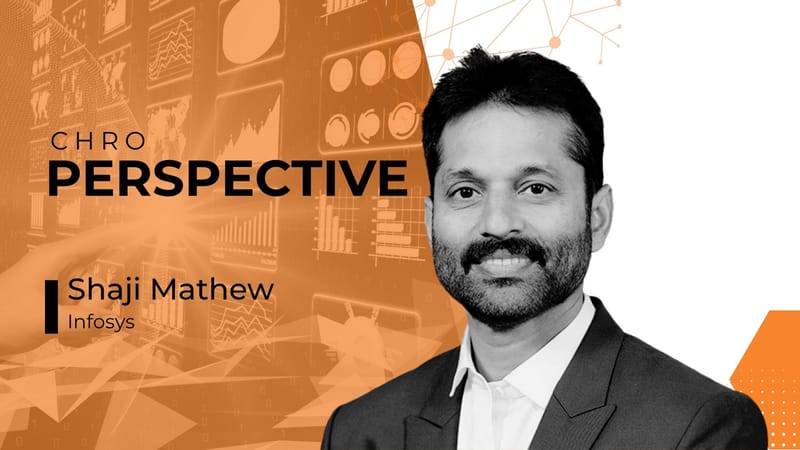
As AI reshapes enterprise work, Infosys CHRO Shaji Mathew explains why organisations must rethink careers, talent models and leadership, not just technology.
Artificial intelligence is changing the way work gets done, but for many organisations, the bigger challenge lies elsewhere. As new technologies become embedded into everyday operations, traditional job structures are being tested by rapidly evolving skill requirements, emerging capability needs and new expectations of leadership.
For Infosys, the response has gone beyond learning programmes and digital upskilling. The company is rethinking how talent is organised, how careers progress and how capabilities are developed in an environment where AI is accelerating change across business functions.
In this edition of People Matters CHRO Perspective, Shaji Mathew, Chief Human Resources Officer, Infosys, shares why AI is changing careers faster than jobs, how new capability pathways are emerging, and why organisations need to view AI transformation as a people and business agenda rather than a technology initiative.
Edited excerpts:
Why talent transformation has become a business priority

As AI becomes embedded across enterprise functions, how is Infosys redesigning its workforce strategy beyond learning and skilling?
At Infosys, we view AI transformation more than a technology shift. It is reshaping how organisations are designed, how careers evolve and how value is created.
While learning and skilling remain foundational, our focus has expanded to reimagining three interconnected areas: our talent operating model, talent career model, and talent development model.
The biggest shift is from talent development as a support process to talent transformation as a business strategy.
From an operating perspective, we are building an ambidextrous organisation that combines broad AI adoption with deeper engineering and domain expertise.
This includes strengthening external hiring for specialist programmers, full-stack engineers, and professionals with deep domain expertise, while accelerating internal capability building through bridge programmes, capability assessments, and business incubator initiatives.
We are also redesigning career architecture to create future-ready pathways that recognise expertise alongside traditional roles.
Finally, our development model is centered on building AI capabilities across the workforce, from enabling employees to use AI effectively to developing AI builders, AI masters and leaders who can drive enterprise-wide transformation.
The rise of capability portfolios

Which roles or capabilities are evolving the fastest within Infosys because of AI?
AI is accelerating demand for deeper engineering expertise, domain knowledge, and the ability to build and deploy AI solutions at scale.
AI is also accelerating the move away from narrowly defined jobs toward broader capability portfolios.
Alongside traditional engineering roles, we are seeing growing emphasis on capabilities such as AI builders, AI masters and forward-deployed engineers who work closely with clients to integrate AI into business environments.
AI builders focus on developing contextual AI platforms, tools, and interfaces, while AI masters help drive AI adoption by shaping vision, governance, and culture across the enterprise.
Forward-deployed engineers work closely with clients to integrate, deploy, and scale AI solutions within real-world business environments.
We believe future careers will be increasingly defined by skills and expertise rather than conventional job titles.
At the same time, our career architecture is evolving to support greater specialization alongside leadership pathways, enabling employees to deepen expertise in technology and domain areas while continuing to create value for clients.
Building a skills-first organisation

Has AI changed the way Infosys approaches workforce planning, hiring and internal talent mobility?
AI has reinforced the importance of building a skills-first organisation.
Our hiring approach continues to focus on strengthening engineering excellence, domain expertise, and specialist capabilities.
For example, we have sharpened our focus on hiring specialist programmers, full-stack engineers, and professionals with deep domain expertise, while internally expanding structured pathways that enable employees to transition into new AI-enabled roles.
At the same time, AI is making internal mobility more important because capability requirements evolve faster than traditional role structures.
There is limited high-quality AI talent pool available in the market as the technology is evolving so rapidly.
We have invested in bridge programmes, capability assessments through our Capability Quotient (CQ) framework and targeted learning interventions to help employees build future-ready skills and move into emerging opportunities.
Business incubator initiatives further enable employees to develop and apply new capabilities in evolving business contexts.
Measuring learning through business outcomes
With more than 300,000 employees trained in AI and digital skills, Infosys measures progress through capability development and business impact rather than course completion alone.
Key indicators include:
- More than 84% of the workforce is AI-enabled
- Employees moving into new AI-led roles
- Application of AI in day-to-day work
- Contributions to client engagements
- Internal mobility and capability growth
- AI adoption across the enterprise
The real measure is whether learning translates into stronger capabilities and meaningful business outcomes.
We look at how employees apply AI in their day-to-day work, move into new AI-led roles, contribute to client engagements, and help accelerate AI adoption at scale.
What AI means for performance and leadership

As AI takes over more routine work, how are performance expectations changing?
As AI becomes more deeply embedded into the way we work, the focus is shifting from routine task execution to building deeper engineering, domain, and functional expertise.
AI can improve productivity and support better decision-making, but employees will increasingly be expected to combine AI fluency with business context, engineering depth, and sound judgment to solve complex business problems.
We therefore see performance increasingly being measured by how employees apply these capabilities to create value for clients and the business.
Leadership expectations are also evolving.
Managers are expected to help teams embrace new ways of working, build AI capabilities, and create an environment where people and AI complement each other.
At Infosys, our approach is centered on Human + AI.
The misconception organisations often make

Looking back over the past two years, what has surprised you most about workforce adaptation to AI?
One important learning has been that AI adoption cannot be viewed as a standalone technology initiative.
To create lasting impact, organisations need to align learning, career development, talent models, and leadership with the way work itself is evolving.
The biggest misconception was that technology would be the primary challenge. In reality, trust, confidence, and change management proved equally important, if not more.
At Infosys, our focus has been on building an AI-first workforce by enabling employees to continuously build new capabilities and apply them in client engagements and business scenarios.
Our Human + AI approach recognises that while AI can improve productivity and decision-making, long-term value is created by combining technology with human judgement, expertise, and responsible leadership.
Why AI strategy and people strategy are the same conversation

What advice would you give business leaders redesigning their organisations for long-term competitiveness?
My learning is to view AI as an organisational transformation rather than a technology programme.
Investing in AI tools is important, but sustainable advantage comes from redesigning how work is organised, how careers evolve and how capabilities are developed.
I would make a strong case for not separating AI strategy from people strategy. They are the same conversation.
Organisations that integrate AI into their operating model, career architecture and talent development strategy will be better positioned to unlock long-term value.
Equally important is ensuring that AI adoption is accompanied by responsible governance, continuous learning, and a strong focus on people.
The organisations that succeed in the AI era will not necessarily be those with the most advanced AI. They will be those that combine technology, talent, and trust most effectively.
As AI continues to reshape enterprise work, Mathew's perspective highlights a shift that extends beyond automation. For organisations preparing for the next phase of transformation, the challenge is increasingly about helping people evolve their capabilities as quickly as technology evolves around them.
This story is part of CHRO Perspective, a People Matters series featuring bold ideas and real-world insights from India’s top CHROs. Stay with us for more perspectives that power the future of work.
Author
Loading...