







Leadership
Reclaiming the Human Advantage: Lessons from People Matters LLC’25 Conference





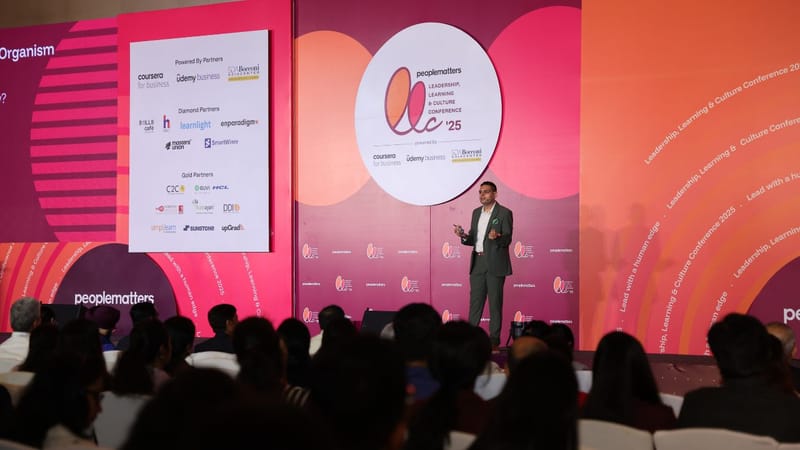
As AI rewrites the rules of work, leaders gathered at the People Matters LLC’25 to explore what remains uniquely human, and why empathy, adaptability, and ethical leadership are the true differentiators in an algorithmic age.
When the human library of progress begins to overflow, algorithms arrive to catalogue our collective knowledge. They organise, predict, and optimise, but they cannot feel. Amid this surge of digital intelligence, one question took centre stage at the People Matters Leadership, Learning & Culture Conference 2025 (LLC’25) in Mumbai: If machines can think, what must humans learn next?
Under the theme “Lead With A Human Edge: Architecting Growth Through Collective Potential,” LLC’25 brought together leaders, thinkers, and practitioners from across industries to unpack the tension and opportunity at the intersection of technology and humanity.
Over two days, one truth became undeniable: as AI accelerates, our advantage will not come from what we know, but from how deeply we connect.
The future isn’t artificial, it’s deeply human: Pushkar Bidwai
Opening the conference, Pushkar Bidwai, CEO of People Matters, challenged leaders to stop asking what technology can do and start asking what humans must become. “Empathy, creativity, and connection are our greatest differentiators,” he said, urging leaders to move from control to culture, from efficiency to awareness.
Referencing Microsoft’s reinvention under Satya Nadella and Haier’s Rendanheyi model, he illustrated how organisations that treat culture as a strategic asset, not a soft one, emerge more agile and innovative. “True leadership,” Pushkar reflected, “is about nurturing ownership, not enforcing hierarchy. The future isn’t artificial, it’s deeply human, and it begins when we lead with heart.”
Andrew Bryant on AI and the art of self-leadership
Global leadership expert Andrew Bryant took the conversation a step further, urging leaders to stop seeing AI as a threat and start seeing it as a partner in potential. “What does it mean to be human in the age of machines?” he asked. “It means integrating technology to amplify our humanity, not diminish it.”
Bryant emphasised self-leadership as the defining skill of the AI era, the ability to influence one’s own thinking, feeling, and actions before leading others. “Be the driver, not the passenger,” he said. “Leadership begins with awareness and accountability and it thrives on authenticity.”
Coaching at Scale: Beyond Quick Fixes
In the session “Coaching at Scale: Strengthening Succession Beyond the C-Suite,” leaders confronted the uncomfortable truth that coaching is often misunderstood. Too many organisations, they argued, assign coaches hoping for a quick fix, without diagnosing the real developmental gap. “We must stop treating coaching’s impact as anecdotal pseudoscience,” the panel asserted.
The discussion underscored that coaching is not an event but a cultural process, one that demands reflection, patience, and vulnerability. “Leaders are conditioned to seek answers,” one speaker noted. “But real coaching helps them find their own, and that’s where transformation begins.”
Always-On Learning: From Intervention to Habit
In a compelling fireside chat, Hemalakshmi Raju (Reliance Industries) and Aditya Sareen (Tata Power), moderated by Arushee Aggarwal (Coursera for Business, India), explored how learning must evolve from one-off initiatives to a daily practice. “Microlearning, even after a decade, remains underutilised,” said Raju.
“Ten minutes of learning every day can transform capability without cognitive overload.” Sareen added that the real shift begins when leaders model curiosity: “Leaders must embrace vulnerability to say, ‘I don’t have the answer. Let’s learn together.’” The discussion reframed learning not as a corporate function, but as a shared, living culture.
Ajay Gupta: The Science of Learning and the ROI Dilemma
Ajay Gupta, Co-Founder of Skills Café, took aim at one of L&D’s biggest blind spots: how success is measured. “A workshop is not evidence of learning, it's only a stimulus,” he said. Ajay also urged HR leaders to move beyond satisfaction scores and completion rates, toward programs grounded in cognitive science and learning readiness. True ROI, he argued, lies not in attendance, but in application. “To drive meaningful outcomes, we must design for how the brain learns and how behaviour changes,” he concluded.
Harish Iyer: Inclusion as a Daily Habit
Few sessions resonated as personally as Harish Iyer’s keynote on “Unlearning Biases & Making Inclusion a Habit.” The Axis Bank DE&I head dismantled the notion that inclusion is policy-driven; instead, he called it a behavioural discipline. “Culture isn’t static,” Harish said. “Inclusion begins with accepting people for who they are. Don’t define people by the bodies they have, but by the body of work they bring.” He reminded leaders that the responsibility for inclusion lies not with the excluded, but with those already inside the circle. “Inclusion,” he said, “is always intentional.”
The Chanakya Code: Dharma, Artha & Shakti
Bridging timeless wisdom with modern leadership, Dr. Radhakrishnan Pillai, Director of Chanakya Aanvikshiki, presented The Chanakya Code, a triad of Dharma (principles), Artha (prosperity), and Shakti (power). “In today’s knowledge economy,” he explained, “Dharma means intellectual rigour. Artha connects purpose to precision. Together, they give rise to Shakti — the strength to turn ideas into sustainable impact.” The takeaway was both philosophical and pragmatic: ethical leadership is still the most scalable form of influence.
Utsav Patodia: Bridging the Talent Supply Gap
In his keynote, Utsav Patodia from Masters’ Union turned the spotlight on talent readiness in an AI-driven economy. “Next time you’re developing smart talent,” he challenged, “don’t focus on GPAs, focus on projects. Don’t test with exams, test with outcomes.” By shifting from credentials to capability, Patodia argued, organisations can close the talent gap and build a workforce defined by real-world performance, not paper qualifications.
The Learning-Obsessed Generation
A vibrant panel featuring Binoj Vasu (Yes Bank), Manavi Pathak (Samsung R&D Institute India), Swati Agarwal (DBS Bank), and Alessandro Giuliani (SDA Bocconi Asia Centre) tackled how Gen Z is rewriting the social contract of work. “Meaningful learning is the new loyalty,” said Binoj. “The new generation measures an organisation by its learning velocity, not tenure.” Manavi emphasised that purpose drives engagement, while Swati warned against turning learning into vanity metrics: “The real challenge,” she said, “is ensuring application matters as much as access.” Their conclusion was unanimous: organisations must evolve into learning ecosystems, not just learning institutions.
Architecting Growth in the Age of AI
The Final Chapter: Leading with a human edge, beyond algorithms
The People Matters Leadership, Learning & Culture Conference 2025 wasn’t a debate about whether AI will change work it already has. It was a reflection on what humans must change within themselves to stay relevant, resilient, and real. In the grand library of progress, algorithms may expand the shelves but it is up to us to decide which volumes endure.
As the conference drew to a close, one insight lingered: the future of work is not artificial; it is deeply, deliberately human. To lead with a human edge is to use technology not as a replacement for thought, but as an amplifier of empathy. It means designing cultures where curiosity is rewarded, ownership is nurtured, and inclusion is instinctive.
In Pushkar Bidwai’s words: “Data drives decisions, but empathy drives destiny. The future isn’t about knowing more, it's about feeling deeper, listening harder, and leading together.”
Topics
Author
Loading...