







Strategic HR
The four things missing from every HR conference this year



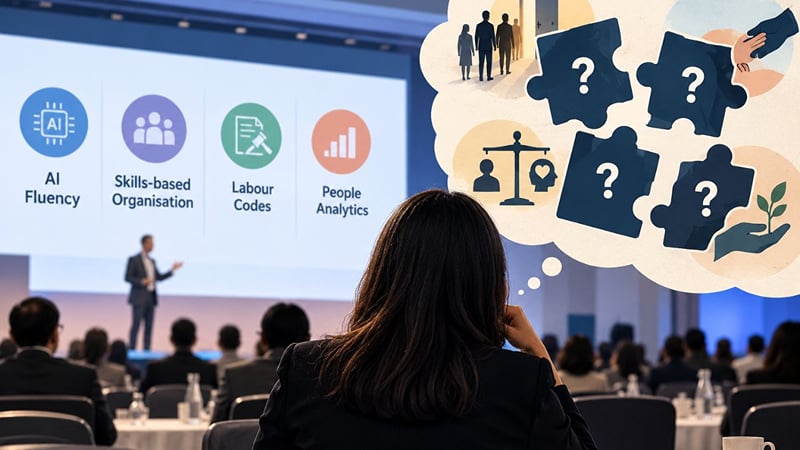
Anand brings attention to four critical skills missing from HR conversations, from managing professional transitions to rethinking employee development.
Walk into any HR conference in India this year and you can predict the slides before the lights dim. AI fluency. Skills-based organisations. Labour Codes. People analytics. Four ideas, endlessly repackaged, each with a consultancy framework and a maturity model attached.
None of them is wrong. That is precisely the problem.
When every vendor, every report and every keynote agrees on what HR needs to learn, those skills are no longer a source of advantage. They are the entry ticket. The CHRO who masters all four by 2028 will not stand out. She will simply still be in the room.
This piece makes two arguments. First, the four skills everyone is talking about are real, urgent and — for most Indian HR functions — still under-built. Second, they are not enough. The skills that will separate the HR leaders of 2029 from the rest are the ones nobody is selling a certificate for yet. They are uncomfortable, slightly unfashionable, and in at least one case unmistakably Indian.
Let us take the familiar four first, quickly and honestly. Then the four nobody is talking about.
Part one: The four everyone is talking about
1. Redesigning work for humans and AI together
The job is no longer the unit of design. The task is. HR must be able to take a role apart, decide which tasks go to people, which to machines, and how the two hand work to each other.
The pace in India’s technology sector is already striking. In a Nasscom-Indeed poll published in January 2026, around 97% of tech-sector HR leaders said that by 2027, work would be done by humans working alongside AI rather than dipping into it occasionally. The same poll put the AI-driven share of work in tech firms at 20–40% already, and found that 83% of HR leaders had redesigned work by adding AI-specific roles.
A caveat worth stating: that poll covered just over 120 HR leaders, all in technology. A steel plant in Jamshedpur or a hospital chain in Kochi is not there yet. But the direction is not in dispute.
2. Skills intelligence and internal mobility
If the task is the unit of work, the skill is the unit of talent. HR needs to know what skills it has, where they sit, what they are worth, and how to move them before buying new ones.
The same Nasscom–Indeed poll found 85% of managers now prioritise skills over credentials, and 79% named internal reskilling as their main strategy for AI adoption. Buying talent is getting harder anyway: 74% of Indian recruiters told LinkedIn they struggle to find qualified people.
3. Workforce and regulatory architecture
This is the most Indian of the four. The four Labour Codes came into effect on 21 November 2025, and the Centre notified the final Central Rules on 8 May 2026, with State Rules still awaited at that point. For HR, this is not a compliance update. It is a redesign of the workforce model itself — the mix of permanent staff, contract labour, fixed-term hires and gig workers, and the wage structures that sit underneath.
One practical shift matters more than most realise. Outsourcing no longer outsources the risk; vendor governance becomes a core HR and legal responsibility. The HR leader who still treats the contractor workforce as procurement’s problem is carrying exposure she cannot see.
4. Data fluency with judgement
AI is moving into people decisions — screening CVs, predicting attrition, flagging performance. HR has to be able to read the data, interrogate the model, and say no when the model is confidently wrong.
LinkedIn’s 2026 data shows data storytelling and data-driven decision-making rising across functions, HR included. The judgement half is harder to survey but more important. An algorithm that quietly screens out women returning from a career break is not a data problem. It is an HR failure with a dashboard attached.
The uncomfortable turn
Here is the irony nobody puts on a slide. Three of those four skills are exactly the kind of work AI is getting good at. Mapping tasks, inferring skills from work histories, tracking compliance across 28 states, building attrition models — a capable AI agent will do much of this within the 36-month horizon we are discussing.
HR will still need to direct and check that work. But the skills that make you valuable cannot be the same skills the machine is learning fastest.
So ask a different question. Not “what does AI change?” but “what does AI make scarcer?” When machines absorb the routine, what becomes rarer, harder and more human?
My answer is four skills that rarely appear in competency frameworks. None of them is about technology. All of them are caused by it.
Part Two: The four nobody is talking about
5. The craft of endings
HR has spent thirty years perfecting beginnings. Onboarding journeys, buddy programmes, welcome kits, the first-90-days plan. We have almost no craft for endings — not exits, which we process, but the ending of a role, a status, a professional identity.
AI will create more endings than any technology before it, and most of them will not be layoffs. They will be quieter. The analyst whose analysis is now generated. The team lead whose team is now three people and an agent. The senior manager whose expertise was the institutional memory — until the memory became searchable. They keep their jobs and lose their sense of who they are at work.
In India, that loss cuts deeper than many global playbooks assume. A job title here is not only a personal label. It is family standing, marriage-market currency, the answer to the neighbour’s question. A Christ University teaching case on displaced IT workers makes the point plainly: in India, a job is bound up with identity, self-esteem and social respect.
The evidence of what happens when this goes unmanaged is starting to appear. A qualitative study of Indian IT professionals facing AI-related job loss or reassignment found layered losses — identity, control, employability and social belonging. After Oracle’s most recent round of layoffs, which reportedly included around 12,000 roles in India, counselling platform YourDOST reported a 150–200% rise in job-loss conversations. Those laid off described a loss of identity. Those who stayed described survivor’s guilt and the anxiety of being next.
That second group is the one HR forgets. Every ending ripples.
What does the skill look like? It is the ability to help someone let go of a version of themselves without humiliating them. To name a loss before it festers into cynicism. To design rituals for role transitions the way we design them for promotions. It borrows from grief counselling, from narrative therapy, from the way good families handle a parent’s retirement. It is not a wellness programme. It is a leadership competence that HR must first master and then teach.
In practice, it starts small. A conversation, held before the reorganisation is announced rather than after, that names what the person is losing as well as what they are gaining. A farewell for a retiring role — the old process, the legacy system, the team being folded in — so that the people who built it are honoured rather than quietly erased. A manager trained to say, “This change costs you something, and I see it.”
The HR leader who can only celebrate arrivals will be badly outnumbered by departures.
6. Engineering apprenticeship back in
Every senior professional reading this learnt their craft the same way: by doing the boring work badly, then less badly, under someone who noticed. The first draft of the board note. The reconciliation nobody else wanted. The bug that took three nights. Judgement is grown on that grunt work, and AI is now eating the grunt work.
The Indian data is unambiguous about where the cut is falling. An ICRIET surey of 651 IT firms across ten cities, conducted between November 2025 and January 2026, found that 65% reported a hiring decline after adopting AI tools. Entry level took the hit: 55% of firms reported junior employment falling. Mid-level demand rose; senior roles barely moved. EY estimated that Indian IT services firms had already cut entry-level roles by 20–25% through automation and AI.
Read those numbers as a pipeline problem, not a hiring problem. If firms stop hiring juniors and machines do the junior work, where do the mid-level professionals of 2032 come from? Today’s strong mid-level demand is being met by people who were juniors in 2019. Nobody is growing their replacements.
The instinct in most organisations is to remove friction everywhere. The skill HR will need is the opposite: designing productive friction back in. That means deliberately reserving certain work for humans to learn on, even when the machine is faster. It means structured apprenticeship — the guild model, the articled clerk, the house surgeon’s rotation — rebuilt for knowledge work. It means measuring managers on the judgement they grow in others, not just the output they deliver.
What would this look like on a Monday morning? A junior analyst drafts the first version of the credit memo before the model does, and a senior compares the two with her. A new engineer handles one production incident a month without AI assistance, with a reviewer alongside. A graduate trainee’s first ninety days are judged not on output but on the questions they learnt to ask. None of this is expensive. All of it requires someone to decide that learning is part of the work, not a cost against it.
This will feel inefficient. It is. Apprenticeship always was. The question is whether HR can make the case to a CFO that a little deliberate inefficiency today is cheaper than a hollow middle tomorrow.
India has an advantage here, if it chooses to use it. The guru–shishya idea of learning — slow, relational, earned — is part of our cultural inheritance. We abandoned it for the bench model of mass hiring. AI may be handing it back.
7. Treating the household as a stakeholder
Nearly every HR framework we use was built in the West, and almost all of them share a silent assumption: the employee is an individual who makes decisions alone. Career conversations, relocation offers, flexibility policies, return-to-work programmes — all designed for one person sitting across the table.
In India, that person is rarely alone. Behind a relocation decision is a spouse’s career, a child’s board exams and an ageing parent in Coimbatore. Behind a woman’s decision not to apply for a promotion is often a household negotiation HR never sees.
The numbers make the invisible visible. In an Indeed survey of 1,141 women across major Indian cities in May 2026, more than eight in ten said they had chosen not to apply for a role because it seemed hard to manage alongside caregiving. India’s Time Use Survey data, as reported, shows women spending about 363 minutes a day on unpaid domestic and care work, against 123 minutes for men. And the support system is itself a family one: one study, of management-institute alumni found grandparents stepping in as primary caregivers in 65% of families.
Think about what that means for an HR policy. Your childcare benefit may matter less than whether the employee’s parents can move in. Your relocation package may fail not because the money is wrong but because the mother-in-law was never part of the conversation.
The skill here is not intrusion. Nobody wants HR at the dining table. It is household literacy — the ability to design careers, policies and conversations that acknowledge the employee is a node in a family system, not a free-floating individual. It might mean eldercare support that counts as seriously as parental leave. It might mean career conversations that explicitly ask, “Who else is this decision for?” It might mean return-to-work programmes designed around the family calendar rather than the fiscal one.
This is where Indian HR can lead rather than follow. Global frameworks will not supply this skill, because the cultures that wrote them do not need it as badly. We do. An Indian CHRO who builds household-aware HR is not localising a global practice. She is inventing one.
8. The discipline of subtraction
In 1865, the economist William Stanley Jevons noticed something counter-intuitive about coal. As steam engines became more efficient, Britain did not use less coal. It used far more. Make something cheaper to use, and people find many more ways to use it.
Apply Jevons to HR. Until recently, a new policy took weeks to draft. A pulse survey needed a vendor. A learning module took a quarter to build. Those costs were a natural brake. AI removes the brake. Policies, surveys, nudges, newsletters, micro-learning paths and personalised “journeys” are now almost free to produce.
So they will multiply. Every HR team that adopts AI without a counterweight will produce more — more programmes, more communications, more listening exercises — and employees will drown politely. The survey-fatigue industry already knows the symptom: people stop responding when they cannot see what is done with their answers. AI will turn that symptom into the default condition.
I have no Indian survey to prove this yet. I have something more persuasive: your own inbox from last week. Count the HR communications. Then count the ones you acted on.
The scarce skill will be editorial. The ability to kill a programme that still has a sponsor. To retire a policy instead of amending it. To say, “We will run one listening exercise this year, and we will act on all of it.” To measure HR not by what it launched but by what it removed — the friction, the noise, the forms nobody reads.
Practically, this could be as simple as a rule: for every new HR programme launched, one existing programme is retired. Or a quarterly stop list that the CHRO publishes alongside the usual launch calendar.
Or an attention budget — a cap on the hours of employee time HR may claim each quarter through surveys, mandatory learning and town halls, treated as seriously as a financial one.
Subtraction is unglamorous. Nobody wins an award for the initiative they did not launch. But in a world where producing more becomes effortless, restraint becomes the rare and valuable act. The best HR functions of 2029 may be recognisable by how little they ask of people.
What the two lists have in common
Put the eight skills side by side and a pattern appears. The first four are about building — new work designs, new skill systems, new structures, new models. The second four are about something harder: letting go, slowing down, widening the frame, and stopping.
That is not an accident. Every technology wave rewards the builders first. The function that endures is the one that also knows what to protect, what to grieve and what to leave undone. AI will make HR faster. It will not, on its own, make HR wiser.
Most Indian HR functions will spend the next three years catching up on the first list. That is necessary work, and it will be done. The real question is whether anyone in the function is quietly building the second.
So before your next capability review, try a small exercise. Write down the four skills your HR team is investing in for 2027. Then hold that list up to the four above.
How much of your list could a machine eventually do — and how much of the second list is anyone in your team even practising?
About the author: Anand Shankar is Chief Transformation Officer at Deloitte South Asia. He has spent over two decades in commercial, CEO, and functional leadership roles across Asia Pacific. The views expressed in this article are the author’s own and do not represent the views of Deloitte, any of its associated firms, or its clients. Anand regularly contributes to People Matters, with his articles published in the last week of each month.
Explore Anand’s columns:
The manager who stopped smiling: Why this is now the CFO's problem, not just the CHRO's
Topics
Author
Loading...