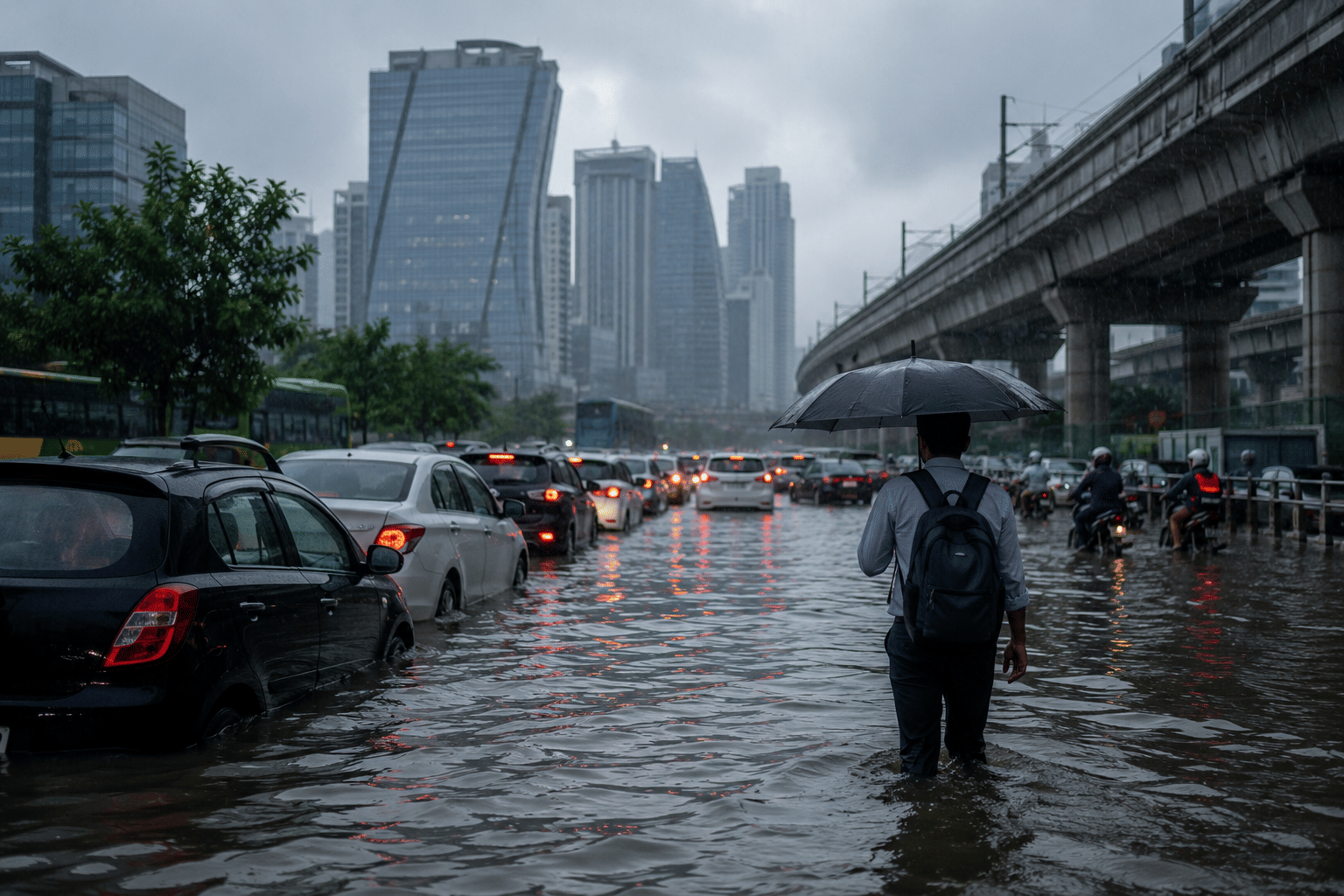
Gurugram's district administration has advised offices to allow employees to work from home and directed schools to conduct classes online after heavy rainfall disrupted normal life across the city on Monday.
According to reports by NDTV, the downpour lasted for around an hour but was enough to overwhelm civic infrastructure, trigger widespread waterlogging and bring traffic movement to a near standstill across several parts of the Millennium City.
The move comes as authorities attempt to reduce commuter movement and ease pressure on roads affected by flooding and severe congestion.
Rainfall disrupts key business and residential corridors
The district administration said Gurugram received 70 mm of rainfall by 1.30 pm, leading to flooding in multiple locations.
Among the worst-affected areas were:
- Rajiv Chowk
- IFFCO Chowk
- Railway Road
- Sector 5
- Old Delhi Road
- Mehrauli Road
- Basai Road
Visuals circulating on social media showed stranded vehicles, submerged roads and motorists abandoning their cars after getting stuck in floodwaters.
Students were also seen navigating flooded streets while returning home from school. According to NDTV's reporting, some moved towards elevated areas, including bus stops, to avoid waterlogged stretches and open manholes concealed beneath muddy water.
Traffic paralysis hits major commute routes
The disruption extended to some of Gurugram's busiest transport corridors.
Traffic slowed significantly on the Delhi-Jaipur Expressway, affecting thousands of commuters and creating long queues despite the highway's multiple lanes.
Commuters told NDTV that the stretch between Signature Tower and Hero Honda Chowk, which typically takes around 15 minutes to traverse, took nearly 50 minutes during the disruption.
A large section of the expressway near Cyber Hub, opposite Gateway Tower Metro Station, remained submerged, further affecting vehicle movement through one of the city's most important commercial zones.
Sheetla Mata Road, which has repeatedly experienced flooding during this monsoon season, was also among the most severely impacted locations.
Remote work returns as a contingency measure
The administration's advisory reflects the growing use of flexible work arrangements during weather-related disruptions.
By encouraging organisations to adopt temporary work-from-home arrangements, authorities aim to reduce traffic volumes and minimise the risks associated with commuting through flooded roads.
Schools were similarly instructed to move classes online to ensure student safety while waterlogging persisted across multiple neighbourhoods.
The decision affected a city that houses a large concentration of corporate offices, multinational companies, technology centres and business parks.
Questions resurface over urban infrastructure resilience
The latest disruption has once again drawn attention to recurring concerns around Gurugram's drainage and civic infrastructure.
Residents told NDTV that severe waterlogging continues to occur after relatively short periods of rainfall despite repeated efforts to improve urban infrastructure.
The city has faced similar disruptions during previous monsoon spells, with flooding affecting roads, traffic movement and daily operations across residential and commercial districts.
As rainfall activity continues during the monsoon season, authorities are likely to remain focused on traffic management, drainage operations and public safety measures to prevent further disruption to work, education and commuting across the National Capital Region.