







Leadership
Day 1 at TechHR India 2026 challenged almost everything we thought we knew about work
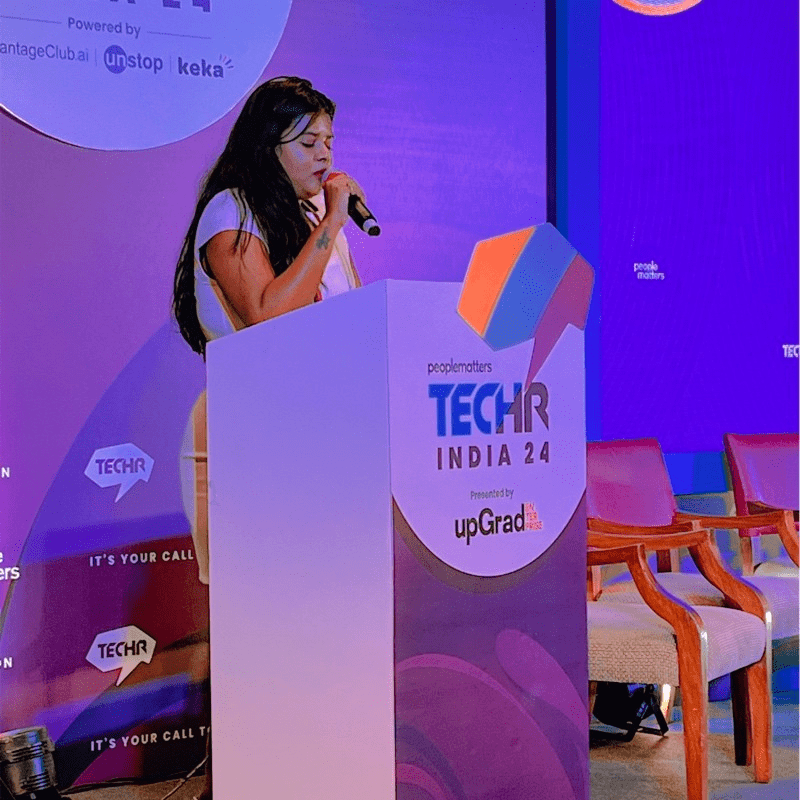





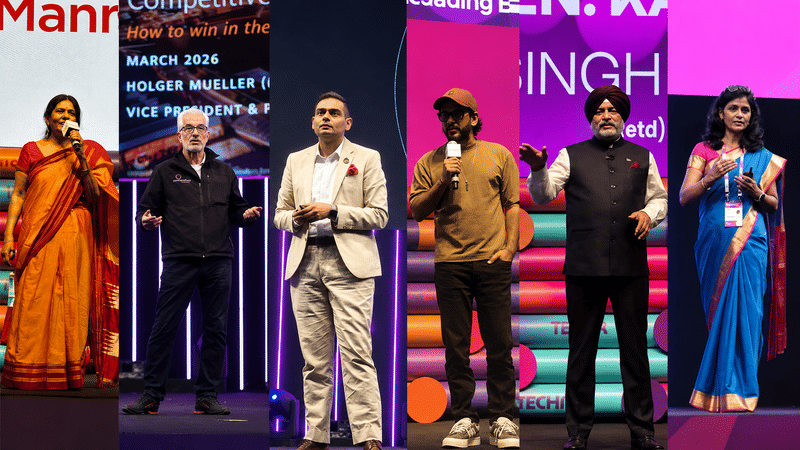
From redesigning work instead of jobs to celebrating failure, rethinking leadership and putting human judgement at the centre of AI, the opening day of TechHR India 2026 offered a fresh playbook for the future of work.
If there was one message that echoed across the halls of People Matters TechHR India 2026 on Day 1, it was this: the future of work will not be defined by AI alone. It will be defined by how organisations rethink work, leadership and human potential in an AI-powered world.
The conversations went well beyond technology adoption. Speakers challenged long-held assumptions around hiring, leadership, workforce planning, skills, employee wellbeing and organisational growth. Together, they painted a picture of a workplace where human judgement, adaptability and creativity become even more valuable as AI becomes more capable.
With more than 5,000 HR and business leaders gathering for two days of discussions, the conference opened with a clear objective: helping organisations harness technology without losing the human edge that drives meaningful growth.
The conversation began with work, not AI
The opening keynote by Pushkaraj Bidwai, CEO of People Matters, set the tone for the day with a simple but provocative question:
"We must stop asking where people fit into AI, and start asking where AI fits into work."
Rather than positioning AI as the centre of transformation, Bidwai called on organisations to reconstruct work itself.
His message challenged leaders to rethink how work is designed before deciding how technology should be deployed. The keynote also introduced personalised Work Intelligence Reports for every delegate, helping participants better understand their strengths, work style and readiness for an AI-enabled future.
AI became a business conversation, not a technology conversation
If one theme cut across multiple sessions, it was the shift in how organisations are approaching AI.
Holger Mueller, VP and Principal Analyst at Constellation Research, encouraged organisations to move beyond pilots and proofs of concept towards enterprise-wide adoption, making AI part of everyday business operations rather than treating it as a standalone initiative.
The conversation continued through Chaitanya Peddi, Co-Founder of Darwinbox, who explored how AI-native HR requires organisations to move beyond rigid workflows towards systems capable of making faster, more contextual decisions. His keynote suggested HR's next evolution lies in building better responses rather than simply better processes.
Throughout the day, discussions consistently returned to one conclusion: AI should strengthen human decision-making rather than replace it.
Leadership took on a new meaning
Leadership emerged as another defining thread.
For Aditya Raj Kaul, Senior Executive Editor at NDTV, leadership is increasingly shaped by uncertainty. Drawing on his experience covering geopolitics and national security, he described resilience as the ability to make clear decisions, earn trust and adapt under pressure rather than simply withstand disruption.
Later in the day, Lieutenant General Kanwal Jeet Singh Dhillon (Tiny Dhillon) reinforced a similar idea through the lens of military leadership.
His observation that "Robots will replace managers. Robots will never replace leaders." resonated strongly with delegates, shifting the discussion from authority to trust, courage and the responsibility to prepare others to lead.
Another leadership conversation featuring Rohit Thakur of Mahindra Group and Mahalakshmi R of Apollo Tyres suggested leaders are increasingly expected to ask better questions, create clarity and guide teams through ambiguity rather than possess every answer themselves.
Old hiring rules came under scrutiny
Perhaps the day's most unconventional conversation came during a fireside chat with entrepreneur Aman Gupta.
Sharing the philosophy behind his new venture OFF/BEAT, Gupta explained why he is intentionally building teams with failed founders and Gen Z professionals. Rather than viewing entrepreneurial failure as a weakness, he described it as evidence of resilience, customer understanding and the ability to navigate uncertainty.
His remarks reflected a broader sentiment visible across several sessions: traditional hiring signals are becoming less reliable indicators of future success than adaptability, curiosity and continuous learning.
The CHRO's role continues to expand
Across multiple discussions, the role of HR leaders extended well beyond talent management.
A panel featuring leaders from Marriott International, CKA Birla Group and Sudarshan Chemical Industries, moderated by Mukul Jain, explored how CHROs are increasingly expected to influence organisational design, workforce strategy and business transformation while balancing technology with human judgement.
A separate discussion on mid-management development reinforced another challenge for organisations: leadership pipelines cannot wait until succession becomes urgent. Developing future leaders earlier is becoming essential as organisations adapt to changing workforce expectations and AI-enabled work.
Meanwhile, conversations around skills highlighted how capability building is evolving into a business priority, with organisations using skills intelligence to inform workforce planning and long-term competitiveness.
Growth was discussed beyond business metrics
Several sessions broadened the conversation around organisational growth.
An exclusive discussion featuring leaders from L&T and Hindustan Power examined how India's people-first talent practices are increasingly influencing organisations beyond its borders.
Another session featuring Dr Ashok Kumar Tyagi of Haldiram Snacks Food Pvt. Ltd. explored how heritage businesses can modernise while preserving the values and trust that define their identity.
Kavitha Rajan of ADP India shifted the focus to global expansion, highlighting the growing importance of integrating HR, payroll and workforce management as organisations scale internationally.
Employee wellbeing also featured prominently, with Shikhar Malhotra, CEO of HCL Healthcare, emphasising that workforce health becomes part of organisational culture when leadership actively participates rather than delegates responsibility.
The conversations extended beyond the stage
Not every defining moment happened inside keynote halls.
The Unconference Track encouraged participants to debate AI, hiring and candidate experience in an open format driven by audience participation.
The Humans@Work Lounge offered delegates creative experiences, from pottery to clay art, reminding attendees that innovation is often sparked away from screens and structured agendas.
Across exhibition spaces, including the Darwinbox booth and the ADP Experience Zone, conversations continued around HR technology, workforce transformation and the future of work, turning networking into an extension of the conference programme.
A day that asked better questions
Day 1 of TechHR India 2026 did not attempt to provide definitive answers about AI or the future of work. Instead, it encouraged leaders to challenge assumptions that have shaped organisations for decades.
Whether the discussion focused on reconstructing work instead of redesigning jobs, building leadership pipelines earlier, hiring beyond conventional credentials or placing human judgement alongside AI, the recurring message remained consistent.
The future of work will belong to organisations willing to question established playbooks as much as adopt new technologies.
As the conference moves into its second day, the conversation is expected to shift from questioning long-held assumptions to exploring how organisations can translate these ideas into action.
Author

Loading...