







Organisational Culture
Rightsizing - a necessary business pain





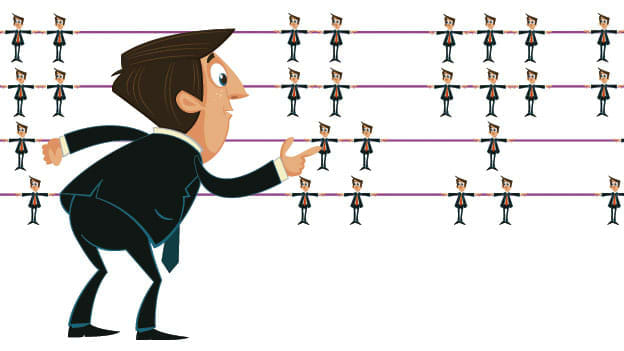
Lay-offs can affect the working culture of a company. It is time to make it an integral part of a business strategy
In March 2008, Praveen (name changed) made his way to Mumbai, the City of Dreams, after he had been recruited by financial services firm Lehman Brothers to work as a senior developer and analyst. Everything was hunky dory until September 15, 2008, when the company filed for Chapter 11 bankruptcy protection, the largest bankruptcy filing in the US history with Lehman holding over $600 billion in assets. News trickled down slowly to the Indian office. Soon, it was confirmed that there would be lay-offs. He was allowed to stay until April 2009. Initially depressed, he was confused about what to do. As no job opportunities came his way, he resolved to make good use of his time. He cleared GMAT and enrolled for an MBA at Purdue University in Germany. Today, he is a senior analyst at Amazon.com.
Circa 2013: Ricky (name changed) had been working with CNN-IBN, a news broadcasting company, for three years. Independence Day had just passed and he came in to work as usual on August 16. As he walked in, he saw many grim faces. There were a bunch of people in the conference room who were stamping what seemed like stacks of envelopes. Curiosity slowly turned to disbelief when employees were called and handed over the letters one by one. They were given 10 minutes to collect their belongings and leave.
It has been over five years since the financial meltdown triggered by the collapse of Lehman Brothers, but the situation does not seem to have improved. One would have assumed that companies would have become more prudent and employees more practical after the last economic slowdown. But have we really learnt any lessons at all?
Despite experiencing slowdown, many companies went back to pre-recession era practices like hiring in large numbers, making up bench strength without taking into account the changing economic realities – the depreciating rupee, rising inflation, low industrial output, weak consumer demand and a slowing economy. To this potpourri, add the new Companies Law and the Land Acquisition Bill, which is touted to protect farmers, Indian corporates seem to have reached their zenith.
When the going was good, most companies made expansion and growth plans, but the same organisations do not prepare equally well prepare for a downturn. Rightsizing is the need of the hour for most companies across spectrum. They need to be prepared with a blueprint as evolving business strategies change the very DNA of people skills leading to rising headcount and salary costs, which in turn eat into the bottom lines. With multiple recessions doing the rounds, enterprises are faced with dealing redundancies on a regular basis.
Economists argue that while complete recovery will be slow, it will be more sustainable and more solidly founded on the principles of classical economics. In a rightsizing, resources are matched with business demand and efficiency is the key. Therefore, progressive thinkers look at rightsizing as a business driver rather than a functional or an HR effort. The purpose of this story is to find out how rightsizing will affect companies, their work cultures and ultimately impact the future success of the organisations.
Lay-offs aplenty - Rightsizing across sectors
Rightsizing is a global reality with reports of lay-offs coming in from laptop makers to auto majors. We are in the midst of the second recession this decade. If in the last slowdown, it was mostly techies and investment bankers who were facing the boot, this time the net has been cast wider and has snared media professionals, auto workers, contract labourers and telecom officials. Job cuts are a necessary pain that the companies must carry the burden of. A smart and adaptive talent management strategy views it as an opportunity to increase the organisation’s human capital effort. But, before we get into the right and wrong parts of it, here is a sector-wise picture on how things stand today.
Media: For once, the TV18 Group was hogging the headlines all by itself. About 300-400 employees of one of the country’s leading broadcaster, which has a bouquet of channels like CNN-IBN, IBN7, CNBC-TV18 and IBN Lokmat, were asked to leave. The redundancies were caused as part of the company’s effort to restructure and synergise TV and web operations, leading to an “integrated newsroom”. These have been the largest retrenchments in the media industry. Earlier, NDTV scaled down its Mumbai office operations and a spokeswoman said less than 50 jobs were lost. It is not only Indian companies that are scaling down. Newsweek set the tone when it announced late last year that the print publication would be shelved and it would go digital from January this year. TIME Inc moved to lay-off about 6 per cent of its workforce (500 jobs), while Microsoft is laying off at least 100 contract and freelance writers from its MSN news and entertainment portal. The New York Times, The Guardian, Disney/ABC Television Group… the list is never ending.
Telecom: On September 19, the Wall Street Journal reported that Blackberry plans to slash thousands of jobs by the year end. The mobile device maker is reportedly gearing up to slash as much as 40 per cent of its 12,700-strong workforce. Closer home, telecom sector was one of the sunshine sectors in terms of employment. But, after the 2G scam broke out, the Supreme Court cancelled 122 licences and ordered a fresh auction. Employees of new telecom players like Uninor, Etisalat DB and Loop Telecom were majorly hit. In Etisalat’s case, nearly 2,000 employees were laid-off as the Abu Dhabi-based company decided to shut operations in India. STel handed out pink slips to more than 400 employees, while Loop Telecom shut offices in all of its 21 circles except Mumbai. In 2011, Airtel underwent a major restructuring exercise and 2,000 jobs were lost in the process. Anil Ambani-controlled Reliance Communications merged its three business divisions, rendering almost 700 jobs redundant. Tata Teleservices has merged its CDMA and GSM divisions and rationalised over 700 positions.
Auto: The auto industry has been reeling under slowing demand for vehicles. According to the latest figures available from Society of Indian Automobile Manufacturers (SIAM), though the industry registered a growth of 8.18 per cent in August, (1,691,553 vehicles as against 1,563,646 in August 2012), the production of vehicles had been on a downward spiral for the past eight months.
FICCI painted a grim picture. “In the auto sector, which has been operating at low capacity due to low demand and sluggish sale and weak demand, some lay off of temporary staff has happened running in 1000s. However, fresh hiring is on a complete freeze in the auto sector,” said FICCI.
Rising fuel costs and interest rates are dampening consumer sentiment. With demand declining and inventory piling up, auto majors have started rationalising production and laying off contract workers. On July 9, Maruti send 200 contractual workers at the Gurgaon plant on indefinite leave, and sent close to 450 workers on leave without pay. Mahindra & Mahindra sacked 500 temporary workers at its Chakan plant, according to a July 15 announcement. Toyota Kirloskar Motor is not renewing the contracts of the temporary employees. Tata Motors rationalised the workforce at the Pantnagar plant by 21 per cent in the first quarter of 2013-14.
Low business confidence
According to the FICCI Business Confidence Survey (September 2013), the Overall Business Confidence Index declined to 49.0, the lowest in about 17 quarters and is somewhat reminiscent of the situation in 2008-09.The corresponding figure in last survey was 57.4 and 51.8 a year back. Exports and employment outlook are muted, weak demand and availability of credit are an issue and most companies don’t expect the overall economic situation to change in the next six months.
CII Business Confidence Index (CII-BCI) remained almost unchanged at 51.2 for April-June 2013 quarter as compared to the previous one. “This ‘status-quo’ in the index value mirrors the air of uncertainty that is still lingering among industry regarding the present business prospects and also throws into question the hopes of an early turnaround,” said Chandrajit Banerjee, Director General, Confederation of Indian Industry.
So how does that impact the talent management strategy of companies? Here are a few pointers:
The industry bodies paint a picture of uncertainty and also dash any hope of a quick turnaround. Companies are restructuring their businesses and workforce in order to cope up with increasing costs of credit. With banks under tremendous pressure to keep their NPAs low and a depreciating rupee making foreign credit out of reach, companies seem strapped for cash.
Are companies doing it the right way?
Most downsizing/rightsizing efforts are directed at cutting costs, often with unintended effects such as lower employee morale, diminished productivity and commitment, lower risk-taking abilities and increasing absenteeism. Downsizing happens in three phases: Planning, Implementation and Aftermath. Companies usually work only on the second aspect. By the time downsizing has occurred there are often strong pressures to get back to business as usual leaving little time to give attention to managing its aftermath. The net result, too frequently, is a whip-lashed and depressed workforce.
An inside source from CNN-IBN, who requested anonymity, said that employees who were fired from the company were given 10 minutes to take their letters and leave. This left a lot of employees in shock and even the ones who survived what he called a “bloodbath” are now jittery about remaining there. The reputation of CNN-IBN might have taken a severe beating because of how this restructuring exercise was conducted.
“Organizations need to realize that they need the trust of the employees for the long term and if they are not authentic in the way they deal with such issues, they can lose the trust of their teams, which nobody can afford,” Ganesh Natarajan, Vice Chairman and CEO of Zensar Technologies, said.
Downsizing: How should companies go about it?
While the jury is out on whether companies treat rightsizing as a short-term or long-term remedy for controlling costs, experts that People Matters spoke to were unanimous on some points.
What should you do if you are laid off?
The No. 1 short-term effect of downsizing is employee engagement. When the communication is not handled well, it leads to a lot of commotion, confusion and a lack of trust. “If the employees are not made to understand the rationale behind the decision, it will have a serious impact on how people are looking at things. The trust level goes down and if you haven’t communicated well, then you end up losing the talent you don’t really want to lose,” said Chaitali Mukherjee, Country Manager – India, Right Management.
Insecurity among your High Potentials and other employees is also prevalent. If this is not addressed, then they will start looking out. A lot of organisations keep their downsizing plans hush-hush as they are afraid that it will erode their employer branding.
Shalini Verma, executive coach and the founder of The Sky Scrapers Academy, said, “Companies should be ready to deal with the reactions of not only employees who are leaving but also the survivors. This area is usually neglected. There should be equal focus on this area if not more because they are the ones who will take you forward. If you are not able to handle them and their psychology and work on the fears they might be holding, then they might not stay.”
In a downsizing, it’s not just employees who face the axe who are affected. The company, its reputation, its creditors and the entire community at large is affected. Verma points out that the employees left behind suffer from “The Survival Syndrome” – they carry some amount of moral guilt, morale and loyalty to the company goes for a toss, trust in the management is lost and the fear of uncertainty hangs in the air that they could be next.
Pointing out that beating around the bush was an Indian issue, Natarajan said, “As a culture, we tend to be very defensive about such issues. But, people in India are more patient. They are not trigger happy in downsizing. Most often, there is a genuine reason why companies had to lay-off people.” Downsizing works if it is done properly. The company should be able to weigh off the short-term effects on the bottom line versus the long-term effects on employee morale.
The spotlight is back on the industrial relations space, especially in the automobile and manufacturing industries. “IR practices that were successful in the 80s and 90s will not be so successful now. It is a different generation of workforce even for blue collars. The economic conditions too have changed and the dependence and the expectations from the workforce are very different. Managing the union relationship has become the most important aspect of a business today,” Mukherjee said.
What should the HR managers do?
One of the biggest casualties of rightsizing is employee morale. But, that can be managed and this is where HR managers can wield their maximum influence and play the role of employee advocacy.
The HR’s role is to lead the way in maximising profitability of the organization (as in many cases the employee costs are a big part of the profitability equation), be the conscious keeper of the board and take a long-term view of the organisation and the brand.
But are HR managers equipped to deal with the evolving IR issues? P. Dwarakanath, Director – Group, Human Capital of Max India, said, “Most of the HR managers are not equipped to handle dynamic and critical IR issues. They do not have the frame of mind, have not been trained and do not have the experience to deal with such issues. Most of the business schools don’t have adequate syllabi on IR and even the faculty members were not trained in the practical aspects of IR. That is a major gap in the HR skill sets.”
Retrenchment is not only redundancy but the whole restructuring and the impact on employees should become a core issue. HR should be in tune with the times. The demographic shift which India is undergoing was largely unnoticed by HR professionals, said S.Y. Siddiqui, COO, Maruti India. “Start understanding business very closely and then look at forecasting what kind of impact it will have on talent, skilling, retention and engagement and ER perspectives. I think from transactional HR to a more strategic HR approach at some of these perspectives and forecasting of what is going to impact the people & talent, a kind of trend analysis, looking at HR analytics, making the maximum use of technology in HR functions – that will be the shift for the future.”
Countries like the US, Austria, Portugal, France and Germany have laws that leave the employee with unemployment benefits or adequate compensation from the companies when laid off. Is India ready for such a law? The response: Either India in its current economic condition is not ready or there is no need for such a law. In fact, Natarajan called for the need of best practices in downsizing. Mukherjee said it will help if the organisation has a downsizing policy in place, but putting a mandate on the kind of compensation will become extremely challenging for the economy.
Dr Mahesh Deshmukh, Director – Business Development & Strategic Alliances, said, “Many times, downsizing is a knee-jerk reaction. During induction programmes, new joinees are told a lot about company culture. But there is no communication on how the expectations need to translate on the ground.” However, he said that many large organisations are using this opportunity to upgrade their workforce.
Industry bodies are urging the government to take drastic steps to help India Inc get back on its feet. “Lay-offs of contractual staff have already started and this could soon move to permanent employees,” FICCI president Naina Lal Kidwai has said, warning the government of “a grim employment scenario” unless growth is revived urgently.
Losing a job is often considered stigma in this country. A lot of the times, people don’t share the news with their families and are on the desperate lookout for a job. Even after losing a job, employees who go through the emotional trauma of downsizing are shy to take up counseling of any sort as that too is looked down upon. Companies need to make sure that employees who leave don’t have bitter memories and the ones who stay back are not made to feel like the Sword of Damocles is hanging above their heads.
Like Chaitali Mukherjee points out, even when the companies try to help the laid off employees, it is more out of guilt and obligation. So what companies need to do is help the person manage this change. Give a man a fish and you feed him for a day. Teach a man to fish and you feed him for a lifetime.
Author
Loading...
Loading...