







Leadership
I love to hire entrepreneurs: Uday S. Kotak





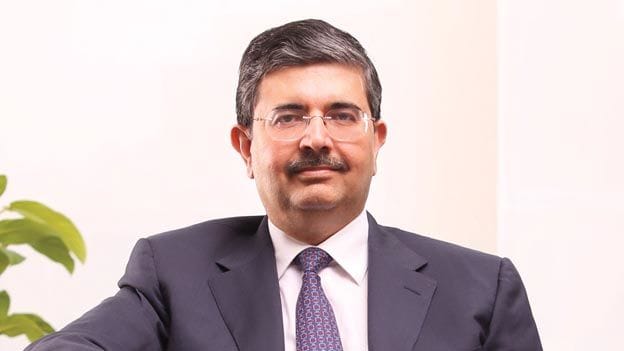
Uday S. Kotak, Exec. Vice Chairman & MD, Kotak Mahindra Bank talks about his entrepreneurial journey
Q. Tell us about your early life. How did it lead you to where you are today?
A. I was born into a traditional Gujarati joint family with 60 members under one roof with a single kitchen in Mumbai. The early mooring of a joint family were deeply ingrained in me. It was capitalism at work and socialism at home but with solid middle class values at heart. All the children in the family went to the same school, while the elders worked together in the family business of trading in agricultural commodities. I went on to do my MBA from Jamnalal Bajaj Institute in Mumbai and like everyone my age, my ambition was to go overseas to study further. I, however, overheard a conversation between my father and grandfather who thought that if I went overseas, I would not come back at all. So I stayed on in India.
Once I completed by graduation, my father offered me 200-300 sq. feet space at the family office at Flora Fountain, Mumbai in case I wanted to start something on my own. I always wanted to get into financial services and was delighted at the prospect. I had read a number of books on Wall Street, takeovers, mergers and even though I did not really know what in financial services I would be doing, I took up the family offer instead of a job offer at Hindustan Lever.
Q. What inspired you to start on this entrepreneurial journey?
A. My entrepreneurial journey started in a very strange manner. A friend of mine joined a Tata company called NELCO in its finance department. He told me that NELCO was always tight on working capital with bank limits in the early eighties. He said that if my family had some surplus money, even if it was as little as Rs 2-3 lakh, we could pay the suppliers now and at the end of 90 days, NELCO would pay back with an interest of 17 per cent. At that time, state-owned banks were lending at 17 per cent and getting deposits at 6 per cent; a nice little spread of 11 per cent in the middle. This sounded like a good business opportunity and so I offered my investors 12 per cent interest and said that the risk was on a Tata company. They all agreed that this was a good bet as it would double the market returns. With that agreement, I went to my friend at NELCO and told him that I would lend money at 16 per cent but he will have to get me more business. So here I was with my new business, getting money at 12 per cent and lending at 16 per cent.
Q. What was the next big turning point in the business?
A. After the Tatas, my next target was the Mahindras. Harish Chandra was the Chairman of Mahindra Ugine Steel Company at that time. When I approached the company, I was told that a new dynamic manager had joined their ranks and was open to new ideas. That manager turned out to be Anand Mahindra who had just returned from Harvard and was General Manager Commercial. Soon, we started the business with Mahindra and a number of other companies as well.
By now, we had made some money and decided that it was time to set up a separate business. The new company was set up in 1985, the same year I got married as well. I invited Anand Mahindra to be a shareholder in the company. All family members in their personal capacity could invest money in the company; I myself borrowed money to buy shares as well. I also invited some of my college friends to become shareholders. By April 1986, we got a capital of Rs 30 lakh. Financial services is a business of reputation and trust, and even though my family was known in the commodities circle, the broader reputation that I wanted the business to achieve was missing. I requested Anand and his father if the name Mahindra could be part of the company’s name, and it was then that the company became Kotak Mahindra Financial.
My next big break in business came in 1989. During those times, there was no concept of financing a car. Citibank entered India at this point and started offering car finance at 13 per cent flat, which came to an IRR of almost 30 percent. This seemed like a great idea, and in 1989 we became the second company to finance car buying in India with a steadily rising business.
Q. You have a long standing team at Kotak. Going back a few years, what were you looking for and how did you build your team?
A. My approach to getting good people was simple. When I dealt with customers, if I found a really good person on the other side, I was tempted to hire them. One of the first employees I hired in that manner was Shivaji Dam from NELCO, who has been with us all along and is still heading the educational initiative for our foundation. Many of our people were hired from our known personal networks. It was about making the dream happen and setting up a financial institution like JP Morgan or Goldman Sachs, in India. After liberalisation of the market in 1991, we revised our focus to the capital market and went into a joint venture with Goldman Sachs in investment banking and securities in 1995. Indian companies at that time were like frogs in a well. Getting into a global partnership was a tremendous learning experience. In the same year, we also went into another venture with Ford Credit. From 1995 to 2005, our professional team learned a lot about how business was done around the world.
Q. What are the value systems which guide the business?
A. Using a metaphor, I prefer marathons to sprints. The core at making the right decisions is taking a long term approach to business. Getting the marathon right is the way I look at making decisions. I agree that opportunities are transient and one has to move quickly, but even in reaching out for those opportunities, one needs to align them to long term goals.
Second is the sense of continuum. If what you create as an individual does not out last you, then you have failed. Individuals create institutions, but ultimately the institutions are far more important. Even when we look at giving back to the society, there is so much to do. We can choose if we want to make a small difference to a large number of people or make a big difference to a small number of people. We choose the do the latter and have chosen education for the underprivileged as the way to go forward. One can make money and give back at the same time. I cannot think of a better place on earth to make a difference. Even in banking, only 400 million people have bank accounts in a country of 1.2 billion. The level of penetration of financial services is very low and there is immense opportunity. The challenge is in the execution.
Q. What is the employee culture that the company follows?
A. It is about middle class values and keeping to human principles of prudence, simplicity and humility. Prudence with no excessive leverage; simplicity by not creating exotic, creative and disruptive products which both the bank and the customer will find hard to understand; and humility as we are in the business of service and hence humility should be at the core of everything we do.
Talking about employee culture, we try to get people for long-term behavior and our focus has always been on ‘customer over product’. A big challenge in financial services is the incentive system. It has been the single biggest agonizing project for me over the years. How to create a culture that is fair for the customer and the employee both? How to retain and incentivise the best team and ensure that the product is right for the customer and not just the employee’s incentive?
Q. As an entrepreneur yourself, what is your advice to entrepreneurs starting out across India?
A. I think this is a great time to be an entrepreneur in India. The transition from an entrepreneur to making a model work is very difficult and the success ratio is less than one percent. We all talk about the successes, but the 99 per cent who found it a challenge are the question and moving from that 99 per cent to one percent takes a lot of courage. I genuinely believe that an entrepreneur who has tried and found it challenging will find it very easy to come back to the mainstream. Having said that, I love to hire people who have had a tough time as entrepreneurs to come and work for me. It is the experience of trying which is priceless. If the younger generation is instinctively passionate about something, now is the right time to give it a try. One of the challenges of the Indian system is the lack of seed capital. India has not developed that industry and at the policy level we really need to find a solution to fund entrepreneurs.
Topics
Author
Loading...