







Leadership
The soccer spectacle fifa - 2014





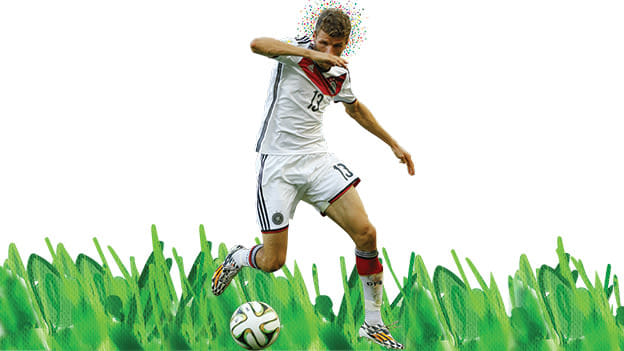
The biggest sporting event of 2014 brought the concepts of leadership and performance to the fore
The FIFA World Cup is unarguably the biggest global sporting event. The 2014 edition in Brazil was watched by more than 26 billion people across the world and economists peg its contribution to the Brazilian economy at $3.03 billion. Further, if we consider the indirect and induced financial transactions, the total contribution would hover around a whooping $11 billion! EY estimates job creation in Brazil from FIFA 2014 to approximately 3.6 million new jobs contributing to approximately 4 per cent a year to the country’s economic growth.
As an economy, the wave of new jobs that the country produced as a result of the mega event and its long-term contribution to the nation’s economy is hard to ignore. After Beijing Olympics 2008, it altered the world’s view about the nation and the economy. From the erstwhile perceptions of an impervious culture, China suddenly became part of the global tourist and business map. It is fascinating to observe the socio-cultural and economic transformations these mega events bring to a nation and Brazil will continue to enjoy the benefits of the nation-branding from FIFA World Cup 2014 in the years and decades to come. In addition, several events in the World Cup threw forth some deep insights about teams, leadership, and human behaviour.
Controversies galore
The World Cup 2014 was marred with several controversies, which erupted right at the onset of the tournament. Brazil’s star player Neymar got away with only a booking in the hosts’ opening match against Croatia for a foul worthy of a red card. In another first round match involving Mexico and Cameroon, two of the South American team’s goals were disallowed. While conspiracy theorists were quick to connect these events with a deep-rooted collusion between the host nation and FIFA, the less cynical also admit that the outcome of the tournament could well have been different if some of these controversial incidents had panned out differently. For neutral sports enthusiasts from across the globe, these events were not taken lightly and there was widespread social-media fire over them. FIFA, in the past, had faced ‘consumer ire’ over allegations of imperialistic practices, but never was it so pronounced. It brought to light a glaring reality of the information era–social media is ‘socialist’ by nature and corporations are better off trying to catch up than fight it.
There is a central talent leadership question that the controversies of the World Cup brought to the fore. Just because participation of star teams was central to the popularity of the championship, was it OK to be unfair to the rest? Very often, an organization shows blatant leniency towards a star performer or a HiPo. While it may mean that the organization achieves immediate objectives, what long-term impressions do such incidents leave in the talent market?
Corruption row and sponsorship threats
Amidst all the fanfare of World Cup 2014, a scandal threatened the very future of the World Cup. FIFA faced acquisitions of corruption in the allegedly dubious selection process of its next two World Cup host nations—Russia (2018) and Qatar (2022). Sony, one of its main sponsors withdrew its sponsorship from FIFA and there were serious doubts about another couple of its long-term sponsors, Visa and McDonald’s pulling out too. One of its oldest sponsors, Coca Cola, which was associated with the brand for over 40 years also reconsidered its association with the event. The names of the implicated FIFA officials were cleared after a year-long investigation accompanied by many controversies of its own but not before the FIFA World Cup brand name suffered a serious damage.
Four Ivey Business School scholars observed that companies track three elements while hiring a leader—competencies, commitment and character. Of the three, their research boldly indicates that character is the most difficult to assess and the least understood. How many organizations actually choose character over competencies while selecting leaders? In the race for achieving business outcomes, choosing a leader with a “proven track record” appears like the easy choice.
Too hot for the stars
World Cup history is proof that many star players crumble at the big stage. When the prolific Diego Maradona failed to make any impact at the 1990 World Cup, the press felt that the team was lugging him along as dead weight because “Brand Maradona” was bigger than the team. While many stars shine brighter than ever at this stage, it is also true that many find the World Cup heat too difficult to handle. Argentina’s star player Lionel Messi won the Golden Ball in 2014, amidst acquisitions that his performance was only a shadow of his potential. The stars who scripted Spain’s dream story in 2010, Fernando Torres and Iniesta, also failed to fire in Brazil 2014. Stars shine the brightest before they ebb, and managing a dying star is an ethereal problem for any organization.
Making the hard decision of ‘benching’ a prolific star is never easy. Jack Welch writes that the only person contended with accommodating an individual in a project team who does not belong there is the star herself. “Before you know,” Welch adds, “other stars will feel insulted and even some midrange performers will feel resentful.” That’s a heavy price to pay just for having star presence in the team.
Brazil’s humiliating defeat
Brazil’s defeat in the semi-finals was perhaps the most humiliating in the nation’s history of participation. While the championship saw a flurry of goals, the 7-0 margin of defeat revealed some genuine cracks in the team’s strategy. Despite the presence of star players such as David Luiz and Hulk, and the prolific striker Neymar, the score line at the end of game, was shocking to state the least. Once again, the match result firmly reiterates that team factors such as coordination, trust, and collaboration in today’s VUCA world far outrun individual brilliance.
Where angels dare to tread
The Dutch team, historically known for its 4-3-3 formation successfully experimented with a new formation, 5-3-2. Behind the team’s unconventional tactics was the coach Louis van Gaal’s bold decisions that were put under the scanner as much as they were decorated. Van Gaal made no attempt at hiding his intent to “go for the kill” during the 96th minute at the semi-finals when he traded his last substitution card for the striker Klaas –Jan Huntelaar contrary to all expectations. He could have easily played safe in the dying minutes and used the opportunity to bring in the prolific goalie, Tim Krul. Krul was instrumental in the team’s quarter-final win in the penalty shootout against Costa Rica, where he came in, incidentally, as a substitute. The team lost the match, ironically in a penalty shootout, but went on to win the third spot in the championship. One may continue to debate whether van Gaal made the right choices, but the fact remains that he displayed a rare quality in leadership—to trust his instinct and experience and take decisions even if they may not be popular. USA’s coach, the ex-German star, Juergen Klinsmann set examples of brave gameplay and shone like a beacon, steering the underdog team toward a truly inspiring performance. While the team did not progress beyond the round of 16, two of its team members, Clint Dempsey and Tim Howard, attained star status in the country. There were several other examples in the tournament where coaches exemplified courageous leadership though bold substitutions, formation changes, and strategy.
Topics
Author
Loading...